
solo per uso di ricerca
Aprepitant Neurokinin Receptor Antagonista
N. Cat.: S1189
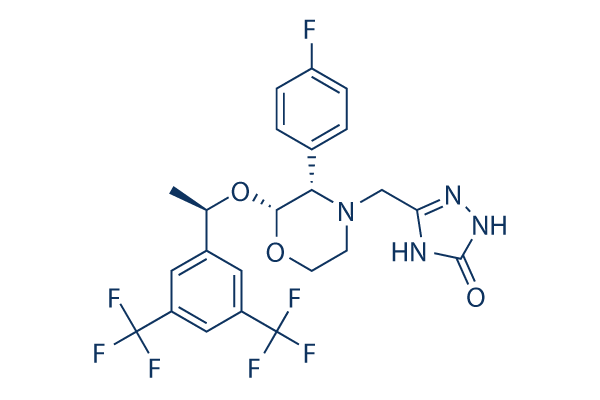
Struttura chimica
Peso molecolare: 534.43
Controllo Qualità (Quality Control)
| Target correlati | Adrenergic Receptor AChR 5-HT Receptor COX Calcium Channel Histamine Receptor Dopamine Receptor GABA Receptor TRP Channel Cholinesterase (ChE) |
|---|---|
| Altro Neurokinin Receptor Inibitori | L-732138 Fezolinetant Maropitant citrate Asparagus Extract Tradipitant Substance P Elinzanetant |
Coltura cellulare, trattamento e concentrazione di lavoro
(Cell Culture, Treatment & Working Concentration)
| Linee cellulari | Tipo di saggio | Concentrazione | Tempo di incubazione | Formulazione | Descrizione dell'attività | PMID |
|---|---|---|---|---|---|---|
| CHO cells | Function assay | Displacement of [125I]SP from human NK1 receptor expressed in CHO cells, IC50=9e-05 μM | ||||
| HEK293 cell | Function assay | Displacement of [125I]-substance P from gerbil NK1 receptor expressed in HEK293 cell membranes incubated for 30 mins by liquid scintillation counting method, IC50=9e-05 μM | ||||
| HEK293 cell | Function assay | Noncompetitive inhibition of wild type human NK1 receptor expressed in HEK293 cells assessed as decrease in SP1-induced [3H]IP accumulation after 20 mins | ||||
| Clicca per visualizzare più dati sperimentali sulle linee cellulari | ||||||
Informazioni chimiche, conservazione e stabilità (Chemical Information, Storage & Stability)
| Peso molecolare | 534.43 | Formula | C23H21F7N4O3 |
Conservazione (Dalla data di ricezione) | |
|---|---|---|---|---|---|
| N. CAS | 170729-80-3 | Scarica SDF | Conservazione delle soluzioni stock |
|
|
| Sinonimi | MK-0869, L-754030 | Smiles | CC(C1=CC(=CC(=C1)C(F)(F)F)C(F)(F)F)OC2C(N(CCO2)CC3=NNC(=O)N3)C4=CC=C(C=C4)F | ||
Solubilità (Solubility)
|
In vitro |
DMSO
: 107 mg/mL
(200.21 mM)
Ethanol : 15 mg/mL Water : Insoluble |
Calcolatore di Molarità
|
In vivo |
|||||
Calcolatore di formulazione in vivo (Soluzione chiara)
Passo 1: Inserire le informazioni di seguito (Consigliato: Un animale aggiuntivo per tenere conto della perdita durante l'esperimento)
Passo 2: Inserire la formulazione in vivo (Questo è solo il calcolatore, non la formulazione. Contattateci prima se non c'è una formulazione in vivo nella sezione Solubilità.)
Risultati del calcolo:
Concentrazione di lavoro: mg/ml;
Metodo per preparare il liquido master di DMSO: mg farmaco predissolto in μL DMSO ( Concentrazione del liquido master mg/mL, Vi preghiamo di contattarci prima se la concentrazione supera la solubilità del DMSO del lotto del farmaco. )
Metodo per preparare la formulazione in vivo: Prendere μL DMSO liquido master, quindi aggiungereμL PEG300, mescolare e chiarire, quindi aggiungereμL Tween 80, mescolare e chiarire, quindi aggiungere μL ddH2O, mescolare e chiarire.
Metodo per preparare la formulazione in vivo: Prendere μL DMSO liquido master, quindi aggiungere μL Olio di mais, mescolare e chiarire.
Nota: 1. Si prega di assicurarsi che il liquido sia limpido prima di aggiungere il solvente successivo.
2. Assicurarsi di aggiungere il/i solvente/i in ordine. È necessario assicurarsi che la soluzione ottenuta, nell'aggiunta precedente, sia una soluzione limpida prima di procedere all'aggiunta del solvente successivo. Metodi fisici come il vortex, gli ultrasuoni o il bagno d'acqua calda possono essere utilizzati per facilitare la dissoluzione.
Meccanismo d'azione (Mechanism of Action)
| Targets/IC50/Ki |
G-CSF
IL-6
IL-8
TNFα
Neurokinin-1 receptor
(Cell-free assay) 0.1 nM
|
|---|---|
| In vitro |
Aprepitant antagonizes the effects of substance P by binding to NK-1 receptors primarily in the CNS, but also in the periphery. This compound, at concentrations of 0.1 nM displaces 50% of substance P from hNK1 receptors transfected in CHO or COS cells. In radioligand binding assays, it is 3000-fold selective for the human cloned NK1 receptor versus the human cloned NK3 receptor and >50,000-fold selective over the human cloned NK2 receptor. In a range of assays at other human cloned G–protein coupled receptors, this chemical retains >50,000-fold selectivity for the human cloned NK1 receptor. It is inactive in human monoamine oxidase A and B assays and at human serotonin 5–HT1A, 5–HT2A, 5–HT2c, 5–HT3, 5–HT5, 5–HT6, and 5–HT7 receptors (IC50>3 μM). In the PANLABS panel of radioligand binding screens using native animal tissues, this compound inhibits [3H]substance P binding to native NK1 receptors in rat submaxillary gland; there are no significant interactions of it with any other native animal G–protein coupled receptors or ion channels examined in the PANLABS screen. It is inactive in monoamine uptake site (NE, 5–HT, DA) counterscreens using human and animal tissues (IC50> 3 μM) |
| In vivo |
Aprepitant crosses the blood–brain barrier and occupied NK-1 receptors in the brain. This compound has been shown to inhibit both acute and delayed emesis induced by cytotoxic chemotherapeutic such as cisplatin by blocking substance P. It (3 mg/kg i.v. or p.o.) inhibits the emetic response to cisplatin (10 mg/kg i.v.). The anti-emetic protection afforded by this chemical (0.1 mg/kg i.v.) is enhanced by combined treatment with either dexamethasone (20 mg/kg i.v.) or the 5–HT3 receptor antagonist ondansetron (0.1 mg/kg i.v.). In a model of acute and delayed emesis, ferrets are dosed with cisplatin (5 mg/kg i.p.) and the retching and vomiting response recorded for 72 h. Pretreatment with it (4–16 mg/kg p.o.) dose-dependently inhibits the emetic response to cisplatin. Once daily treatment with this compound (2 and 4 mg/kg p.o.) completely prevents retching and vomiting in all ferrets tested. Further when daily dosing began at 24 h after cisplatin injection, when the acute phase of emesis had already become established, it (4 mg/kg p.o. at 24 and 48 h after cisplatin) prevents retching and vomiting in three out of four ferrets. This chemical also plays a key part in transmission of pain impulses from the peripheral receptors to the CNS and is involved in various behavioural, neurochemical and cardiovascular responses to stress. |
Riferimenti |
|
Informazioni sullo studio clinico (Clinical Trial Information)
(dati da https://clinicaltrials.gov, aggiornato il 2023-05-03)
| Numero NCT | Reclutamento | Condizioni | Sponsor/Collaboratori | Data di inizio | Fasi |
|---|---|---|---|---|---|
| NCT05841849 | NOT_YET_RECRUITING | Breast Cancer; Chemotherapy-induced Nausea and Vomiting |
Second Affiliated Hospital, Zhejiang University, School of Medicine |
2023-07 | PHASE4 |
| NCT06740812 | NOT_YET_RECRUITING | Nausea and Vomiting; Nausea; Vomiting |
Montefiore Medical Center |
2026-12 | PHASE4 |
| NCT07662200 | NOT_YET_RECRUITING | Germ Cell Cancer |
Ottawa Hospital Research Institute |
2026-08 | EARLY_PHASE1 |
| NCT07639723 | NOT_YET_RECRUITING | PONV |
Endeavor Health |
2026-07 | PHASE4 |
| NCT06462287 | RECRUITING | Apnea, Obstructive |
University Hospital, Rouen |
2024-03-05 | PHASE2 |
| NCT07371728 | NOT_YET_RECRUITING | Otologic Disease |
Sir Mortimer B. Davis - Jewish General Hospital |
2026-06-01 | PHASE4 |

I prodotti sono solo per uso di ricerca. Non per uso umano. Non vendiamo a pazienti.
©Copyright 2013 Selleck Chemicals. Tutti i diritti riservati.