
solo per uso di ricerca
Heparin Sodium Anticoagulante
N. Cat.S1346
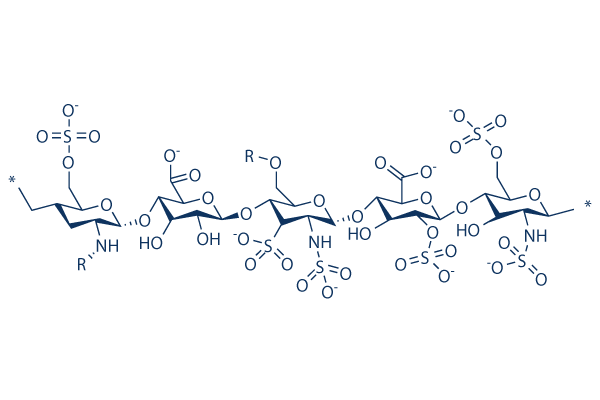
Struttura chimica
Peso molecolare:
Controllo Qualità
Informazioni chimiche, conservazione e stabilità
| Peso molecolare | Formula | (C12H16NS2Na3)20 |
Conservazione (Dalla data di ricezione) | ||
|---|---|---|---|---|---|
| N. CAS | 9041-08-1 | -- | Conservazione delle soluzioni stock |
|
|
| Sinonimi | N/A | Smiles | CCC1CC(N[R])C(OC1CO[S]([O-])(=O)=O)OC2C(O)C(O)C(OC3C(CO[R])OC(OC4C(O)C(O[S]([O-])(=O)=O)C(OC5C(O)C(N[S]([O-])(=O)=O)C(C)OC5CO[S]([O-])(=O)=O)OC4C([O-])=O)C(N[S]([O-])(=O)=O)C3[S]([O-])(=O)=O)OC2C([O-] | ||
Solubilità
|
In vitro |
Water : 162 mg/mL
DMSO
: Insoluble
Ethanol : Insoluble |
Calcolatore di Molarità
|
In vivo |
|||||
Calcolatore di formulazione in vivo (Soluzione chiara)
Passo 1: Inserire le informazioni di seguito (Consigliato: Un animale aggiuntivo per tenere conto della perdita durante lesperimento)
Passo 2: Inserire la formulazione in vivo (Questo è solo il calcolatore, non la formulazione. Contattateci prima se non cè una formulazione in vivo nella sezione Solubilità.)
Risultati del calcolo:
Concentrazione di lavoro: mg/ml;
Metodo per preparare il liquido master di DMSO: mg farmaco predissolto in μL DMSO ( Concentrazione del liquido master mg/mL, Vi preghiamo di contattarci prima se la concentrazione supera la solubilità del DMSO del lotto del farmaco. )
Metodo per preparare la formulazione in vivo: Prendere μL DMSO liquido master, quindi aggiungereμL PEG300, mescolare e chiarire, quindi aggiungereμL Tween 80, mescolare e chiarire, quindi aggiungere μL ddH2O, mescolare e chiarire.
Metodo per preparare la formulazione in vivo: Prendere μL DMSO liquido master, quindi aggiungere μL Olio di mais, mescolare e chiarire.
Nota: 1. Si prega di assicurarsi che il liquido sia limpido prima di aggiungere il solvente successivo.
2. Assicurarsi di aggiungere il/i solvente/i in ordine. È necessario assicurarsi che la soluzione ottenuta, nellaggiunta precedente, sia una soluzione limpida prima di procedere allaggiunta del solvente successivo. Metodi fisici come il vortex, gli ultrasuoni o il bagno dacqua calda possono essere utilizzati per facilitare la dissoluzione.
Meccanismo dazione
| Targets/IC50/Ki |
Antithrombin III
|
|---|---|
| In vitro |
L'eparina è ampiamente utilizzata come farmaco anticoagulante grazie alla sua capacità di accelerare la velocità con cui l'antitrombina inibisce le proteases della serina nella cascata di coagulazione del sangue. L'eparina e il solfato di eparano strutturalmente correlato sono polimeri lineari complessi costituiti da una miscela di catene di diversa lunghezza, aventi sequenze variabili. L'eparina interagisce più strettamente con i peptidi contenenti un sito di legame complementare ad alta densità di carica positiva. L'eparina e il solfato di eparano mostrano prevalentemente strutture secondarie elicoidali lineari con gruppi solfo e carbossilici disposti a intervalli definiti e in orientazioni definite lungo lo scheletro polisaccaridico. L'eparina assomiglia al DNA in quanto entrambi sono polimeri lineari altamente carichi che si comportano come polielettroliti. Si ritiene che l'eparina funzioni come anticoagulante principalmente attraverso la sua interazione con l'AT III migliorando l'inibizione mediata dall'AT-III dei fattori di coagulazione del sangue, inclusi la thrombin e il Factor Xa. L'eparina si lega all'AT III e alla trombina in un complesso ternario, aumentando la costante di velocità bimolecolare per l'inibizione della trombina di un fattore 2000. L'eparina è principalmente localizzata nei granuli dei mastociti tissutali che sono strettamente associati alla risposta immunitaria. L'eparina stabilisce numerosi contatti sia con FGF-2 che con FGFR-1 stabilizzando il legame FGF–FGFR. L'eparina stabilisce anche contatti con il FGFR-1 del complesso FGF–FGFR adiacente, sembrando così promuovere la dimerizzazione del FGFR. |
Riferimenti |
|
Supporto tecnico
Istruzioni per la manipolazione
Tel: +1-832-582-8158 Ext:3
Per qualsiasi altra domanda, si prega di lasciare un messaggio.

I prodotti sono solo per uso di ricerca. Non per uso umano. Non vendiamo a pazienti.
©Copyright 2013 Selleck Chemicals. Tutti i diritti riservati.