
solo per uso di ricerca
LKB1 Antibody [M21A16]
N. Cat.: F4179
Applicazione:
Reattività:
-
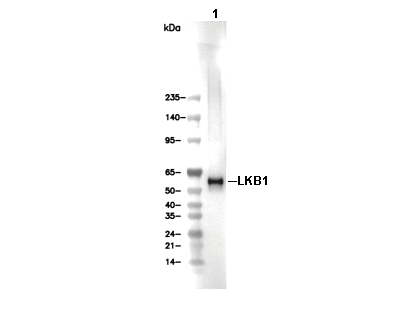 Lane 1: COS7
Elementi essenziali dellesperimento
WB
Exposure time of at least 60s is recommended.
Exposure time of at least 60s is recommended.
Informazioni sullutilizzo
| Diluizione |
|---|
|
| Applicazione |
|---|
| WB, IP |
| Reattività |
|---|
| Human, Monkey |
| Fonte |
|---|
| Rabbit Monoclonal Antibody |
| Tampone di conservazione |
|---|
| PBS, pH 7.2+50% Glycerol+0.05% BSA+0.01% NaN3 |
| Conservazione (dalla data di ricezione) |
|---|
| -20°C (avoid freeze-thaw cycles), 2 years |
| PM previsto |
|---|
| 54 kDa |
| Controllo positivo | Caki-1 cell; COS cell; 293T cell |
|---|---|
| Controllo negativo |
Metodi sperimentali
| WB |
|---|
Experimental Protocol:
Sample preparation
1. Tissue: Lyse the tissue sample by adding an appropriate volume of ice-cold RIPA/NP-40 Lysis Buffer (containing Protease Inhibitor Cocktail),and homogenize the tissue at a low temperature. 2. Adherent cell: Aspirate the culture medium and wash the cells with ice-cold PBS twice. Lyse the cells by adding an appropriate volume of RIPA/NP-40 Lysis Buffer (containing Protease Inhibitor Cocktail) and put the sample on ice for 5 min. 3. Suspension cell: Transfer the culture medium to a pre-cooled centrifuge tube. Centrifuge and aspirate the supernatant. Wash the cells with ice-cold PBS twice. Lyse the cells by adding an appropriate volume of RIPA/NP-40 Lysis Buffer (containing Protease Inhibitor Cocktail) and put the sample on ice for 5 min. 4. Place the lysate into a pre-cooled microcentrifuge tube. Centrifuge at 4°C for 15 min. Collect the supernatant;
5. Remove a small volume of lysate to determine the protein concentration;
6. Combine the lysate with protein loading buffer. Boil 20 µL sample under 95-100°C for 5 min. Centrifuge for 5 min after cool down on ice.
Electrophoretic separation
1. According to the concentration of extracted protein, load appropriate amount of protein sample and marker onto SDS-PAGE gels for electrophoresis. Recommended separating gel (lower gel) concentration: 10%. Reference Table for Selecting SDS-PAGE Separation Gel Concentrations 2. Power up 80V for 30 minutes. Then the power supply is adjusted (110 V~150 V), the Marker is observed, and the electrophoresis can be stopped when the indicator band of the predyed protein Marker where the protein is located is properly separated. (Note that the current should not be too large when electrophoresis, too large current (more than 150 mA) will cause the temperature to rise, affecting the result of running glue. If high currents cannot be avoided, an ice bath can be used to cool the bath.)
Transfer membrane
1. Take out the converter, soak the clip and consumables in the pre-cooled converter;
2. Activate PVDF membrane with methanol for 1 min and rinse with transfer buffer;
3. Install it in the order of "black edge of clip - sponge - filter paper - filter paper - glue -PVDF membrane - filter paper - filter paper - sponge - white edge of clip"; 4. The protein was electrotransferred to PVDF membrane. ( 0.45 µm PVDF membrane is recommended ) Reference Table for Selecting PVDF Membrane Pore Size Specifications Recommended conditions for wet transfer: 200 mA, 120 min. ( Note that the transfer conditions can be adjusted according to the protein size. For high-molecular-weight proteins, a higher current and longer transfer time are recommended. However, ensure that the transfer tank remains at a low temperature to prevent gel melting.)
Block
1. After electrotransfer, wash the film with TBST at room temperature for 5 minutes;
2. Incubate the film in the blocking solution for 1 hour at room temperature;
3. Wash the film with TBST for 3 times, 5 minutes each time.
Antibody incubation
1. Use 5% skim milk powder to prepare the primary antibody working liquid (recommended dilution ratio for primary antibody 1:1000), gently shake and incubate with the film at 4°C overnight; 2. Wash the film with TBST 3 times, 5 minutes each time;
3. Add the secondary antibody to the blocking solution and incubate with the film gently at room temperature for 1 hour;
4. After incubation, wash the film with TBST 3 times for 5 minutes each time.
Antibody staining
1. Add the prepared ECL luminescent substrate (or select other color developing substrate according to the second antibody) and mix evenly;
2. Incubate with the film for 1 minute, remove excess substrate (keep the film moist), wrap with plastic film, and expose in the imaging system. (Exposure time of at least 60s is recommended) |
Descrizione biologica
| Specificità |
|---|
| LKB1 antibody [M21A16] detects endogenous levels of LKB1 protein. |
| Localizzazione subcellulare |
|---|
| Cytoplasm, Membrane, Mitochondrion, Nucleus |
| Uniprot ID |
|---|
| Q15831 |
| Clone |
|---|
| M21A16 |
| Sinonimo |
|---|
| Serine/threonine-protein kinase STK11; Liver kinase B1 (LKB1; hLKB1); Renal carcinoma antigen NY-REN-19; STK11; LKB1; PJS |
| Background |
|---|
| LKB1, also known as STK11, is a serine/threonine kinase that functions as a tumor suppressor by regulating cell polarity, apoptosis, and energy metabolism through its control of various downstream kinases. It directly activates AMP-activated protein kinase (AMPK) as well as multiple AMPK-related kinases. Among human cancers, LKB1 is one of the most frequently altered genes, particularly in different subtypes of non-small cell lung carcinoma (NSCLC). Both LKB1 and AMPK operate as heterotrimeric protein complexes. Germline loss-of-function mutations in LKB1 are responsible for the hereditary cancer disorder Peutz-Jeghers Syndrome. Most mutations compromise the kinase domain, highlighting that its tumor-suppressive role depends on catalytic activity. LKB1 is phosphorylated at several residues within cells, including Ser31, Ser325, Ser428, Thr189, Thr336, and Thr363 in human LKB1. Beyond inherited mutations, a range of somatic LKB1 alterations has also been linked to the development of sporadic tumors across multiple tissue types. |
| Riferimenti |
|---|
|
Supporto tecnico
Istruzioni per la manipolazione
Tel: +1-832-582-8158 Ext:3
Per qualsiasi altra domanda, si prega di lasciare un messaggio.

I prodotti sono solo per uso di ricerca. Non per uso umano. Non vendiamo a pazienti.
©Copyright 2013 Selleck Chemicals. Tutti i diritti riservati.