
uitsluitend voor onderzoeksdoeleinden
Verteporfin YAP-remmer
Cat.Nr.S1786
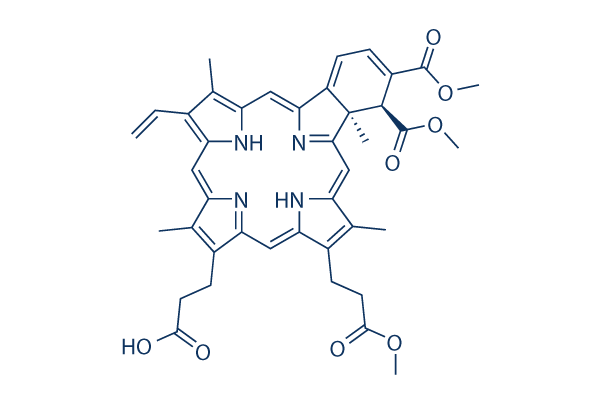
Chemische structuur
Moleculair gewicht: 718.79
Kwaliteitscontrole
Celkweek, behandeling & werkconcentratie
| Cellijnen | Assaytype | Concentratie | Incubatietijd | Formulering | Activiteitsbeschrijving | PMID |
|---|---|---|---|---|---|---|
| HL-60 | Function assay | ~100 ng/mL | DMSO | increases DNA fragmentation levels | 10607710 | |
| HL-60 | cytotoxicity assay | ~100 ng/mL | DMSO | inhibits cell viability | 10607710 | |
| Jurkat | Apoptosis assay | ~280 nM | DMSO | induces a Bcl-2-dependent apoptosis | 11245415 | |
| RIF-1 | Function assay | 1 μg/ml | DMSO | decreases oxygen consumption | 12615718 | |
| RIF-1 | cytotoxicity assay | 1 μg/ml | DMSO | decrease to 20 ± 5% cell survival | 12615718 | |
| SVEC4-10 | Function assay | 200 ng/ml | DMSO | induces microtubule depolymerization | 16467106 | |
| SVEC4-10 | Function assay | 200 ng/ml | DMSO | induces stress actin fiber formation | 16467106 | |
| ARPE-19 | cytotoxicity assay | ~0.1 μg/ml | DMSO | shows a dose-dependent toxicity | 16987905 | |
| ARPE-19 | Function assay | 0.01 μg/ml | DMSO | increases VEGF and reduces PEDF expression | 16987905 | |
| Y-79 | Growth inhibitory assay | ~1 μg/ml | DMSO | decreases retinoblastoma cell proliferation | 18579764 | |
| WERI-Rb1 | Growth inhibitory assay | ~1 μg/ml | DMSO | decreases retinoblastoma cell proliferation | 18579764 | |
| RB247C3 | Growth inhibitory assay | ~1 μg/ml | DMSO | decreases retinoblastoma cell proliferation | 18579764 | |
| RB355 | Growth inhibitory assay | ~1 μg/ml | DMSO | decreases retinoblastoma cell proliferation | 18579764 | |
| RB383 | Growth inhibitory assay | ~1 μg/ml | DMSO | decreases retinoblastoma cell proliferation | 18579764 | |
| hFibro | cytotoxicity assay | 0.5 µg/ml | DMSO | decreases viability by 86,5% | 23441114 | |
| pTMC | cytotoxicity assay | 0.5 µg/ml | DMSO | decreases viability by 92.9% | 23441114 | |
| hTMC | cytotoxicity assay | 0.5 µg/ml | DMSO | decreases viability by 88.9% | 23441114 | |
| ARPE-19 | cytotoxicity assay | 0.5 µg/ml | DMSO | decreases viability by 55.5% | 23441114 | |
| Panc-1 | Growth inhibitory assay | 10 μM | DMSO | inhibits cell proliferation | 24069069 | |
| MIA PaCa-2 | Growth inhibitory assay | 10 μM | DMSO | inhibits cell proliferation | 24069069 | |
| BxPC-3 | Growth inhibitory assay | 10 μM | DMSO | inhibits cell proliferation completely | 24069069 | |
| SU86.86 | Growth inhibitory assay | 10 μM | DMSO | inhibits cell proliferation completely | 24069069 | |
| MCF-7 | Autophagy assay | 10 μM | DMSO | inhibits gemcitabine-induced autophagy | 24069069 | |
| WERI | Growth inhibitory assay | ~10 μg/ml | DMSO | inhibits growth of retinoblastoma cells | 24837142 | |
| WERI | Function assay | ~10 μg/ml | DMSO | blocks cell cycle progression | 24837142 | |
| Y-79 | Function assay | ~10 μg/ml | DMSO | blocks cell cycle progression | 24837142 | |
| Y-79 | Function assay | ~10 μg/ml | DMSO | affects YAP-TEAD proto-oncogene pathway | 24837142 | |
| Y-79 | Function assay | ~10 μg/ml | DMSO | down-regulates pluripotency marker OCT-4 | 24837142 | |
| Phototoxicity assay | B16F10 | 24 hrs | IC50 = 1.07 μM | 27136389 | ||
| Phototoxicity assay | B16F10 | 24 hrs | IC50 = 1.2 μM | 27136389 | ||
| Phototoxicity assay | A375 | 24 hrs | IC50 = 2.06 μM | 27136389 | ||
| Dark toxicity assay | B16F10 | 48 hrs | IC50 = 24.92 μM | 27136389 | ||
| Dark toxicity assay | B16F10 | 48 hrs | IC50 = 25.03 μM | 27136389 | ||
| Dark toxicity assay | A375 | 48 hrs | IC50 = 36.33 μM | 27136389 | ||
| qHTS assay | TC32 | qHTS of pediatric cancer cell lines to identify multiple opportunities for drug repurposing: Primary screen for TC32 cells | 29435139 | |||
| qHTS assay | U-2 OS | qHTS of pediatric cancer cell lines to identify multiple opportunities for drug repurposing: Primary screen for U-2 OS cells | 29435139 | |||
| qHTS assay | A673 | qHTS of pediatric cancer cell lines to identify multiple opportunities for drug repurposing: Primary screen for A673 cells | 29435139 | |||
| qHTS assay | DAOY | qHTS of pediatric cancer cell lines to identify multiple opportunities for drug repurposing: Primary screen for DAOY cells | 29435139 | |||
| qHTS assay | Saos-2 | qHTS of pediatric cancer cell lines to identify multiple opportunities for drug repurposing: Primary screen for Saos-2 cells | 29435139 | |||
| qHTS assay | BT-37 | qHTS of pediatric cancer cell lines to identify multiple opportunities for drug repurposing: Primary screen for BT-37 cells | 29435139 | |||
| qHTS assay | RD | qHTS of pediatric cancer cell lines to identify multiple opportunities for drug repurposing: Primary screen for RD cells | 29435139 | |||
| qHTS assay | SK-N-SH | qHTS of pediatric cancer cell lines to identify multiple opportunities for drug repurposing: Primary screen for SK-N-SH cells | 29435139 | |||
| qHTS assay | BT-12 | qHTS of pediatric cancer cell lines to identify multiple opportunities for drug repurposing: Primary screen for BT-12 cells | 29435139 | |||
| qHTS assay | MG 63 (6-TG R) | qHTS of pediatric cancer cell lines to identify multiple opportunities for drug repurposing: Primary screen for MG 63 (6-TG R) cells | 29435139 | |||
| qHTS assay | OHS-50 | qHTS of pediatric cancer cell lines to identify multiple opportunities for drug repurposing: Primary screen for OHS-50 cells | 29435139 | |||
| qHTS assay | Rh41 | qHTS of pediatric cancer cell lines to identify multiple opportunities for drug repurposing: Primary screen for Rh41 cells | 29435139 | |||
| qHTS assay | SJ-GBM2 | qHTS of pediatric cancer cell lines to identify multiple opportunities for drug repurposing: Primary screen for SJ-GBM2 cells | 29435139 | |||
| qHTS assay | SK-N-MC | qHTS of pediatric cancer cell lines to identify multiple opportunities for drug repurposing: Primary screen for SK-N-MC cells | 29435139 | |||
| qHTS assay | LAN-5 | qHTS of pediatric cancer cell lines to identify multiple opportunities for drug repurposing: Primary screen for LAN-5 cells | 29435139 | |||
| Antitumor assay | B16F10 | 2 mg/kg | 2 hrs | Antitumor activity against B16F10 cells implanted in C57BL/6 mouse assessed as tumor growth inhibition at 2 mg/kg, iv administered for 2 hrs followed by irradiation with laser at 150 J/cm'2 for 10 mins | 27136389 | |
| Klik om meer experimentele gegevens over de cellijn te bekijken | ||||||
Chemische informatie, Opslag en Stabiliteit
| Moleculair gewicht | 718.79 | Formule | C41H42N4O8 |
Opslag (Vanaf de ontvangstdatum) | 3 years-20°C (in the dark)powder |
|---|---|---|---|---|---|
| CAS-nr. | 129497-78-5 | SDF downloaden | Opslag van stamoplossingen |
|
|
| Synoniemen | CL 318952 | Smiles | COC(=O)CCC1=C(C)C2=CC3=NC(=CC4=C(C)C(=C([NH]4)C=C5N=C(C=C1[NH]2)C(=C5C)CCC(O)=O)C=C)C6=CC=C(C(C(=O)OC)C36C)C(=O)OC | ||
Oplosbaarheid
|
In vitro |
DMSO
: 100 mg/mL
(139.12 mM)
Water : Insoluble Ethanol : Insoluble |
Molariteitscalculator
|
In vivo |
|||||
In vivo Formuleringscalculator (Heldere oplossing)
Stap 1: Voer de onderstaande informatie in (Aanbevolen: Een extra dier voor het geval van verlies tijdens het experiment)
Stap 2: Voer de in vivo formulering in (Dit is alleen de calculator, geen formulering. Neem eerst contact met ons op als er geen in vivo formulering is in het gedeelte Oplosbaarheid.)
Berekeningsresultaten:
Werkconcentratie: mg/ml;
Methode voor het bereiden van DMSO-mastervloeistof: mg geneesmiddel vooraf opgelost in μL DMSO ( Concentratie mastervloeistof mg/mL, Neem eerst contact met ons op als de concentratie de DMSO-oplosbaarheid van de partij geneesmiddel overschrijdt. )
Methode voor het bereiden van in vivo formulering: Neem μL DMSO mastervloeistof, voeg vervolgens toeμL PEG300, mengen en helder maken, voeg vervolgens toeμL Tween 80, mengen en helder maken, voeg vervolgens toe μL ddH2O, mengen en helder maken.
Methode voor het bereiden van in vivo formulering: Neem μL DMSO mastervloeistof, voeg vervolgens toe μL Maïsolie, mengen en helder maken.
Opmerking: 1. Zorg ervoor dat de vloeistof helder is voordat u het volgende oplosmiddel toevoegt.
2. Zorg ervoor dat u het/de oplosmiddel(en) in de juiste volgorde toevoegt. U moet ervoor zorgen dat de verkregen oplossing, bij de vorige toevoeging, een heldere oplossing is voordat u verdergaat met het toevoegen van het volgende oplosmiddel. Fysische methoden zoals vortexen, echografie of een warmwaterbad kunnen worden gebruikt om het oplossen te bevorderen.
Werkingsmechanisme
| Targets/IC50/Ki |
VDA
(Endothelial cells) YAP/TEAD interaction
|
|---|---|
| In vitro |
Verteporfin is ongeveer vier keer efficiënter in het absorberen van licht bij golflengten die weefsels het best doordringen (d.w.z. rond 700 nm) en zorgt daardoor voor een veel hoger cytotoxisch effect dan hematoporfyrine (10 keer meer in humane adherente cellijnen). Deze verbinding is lipofiel en wordt gemakkelijker opgenomen door maligne of geactiveerde cellen, vergeleken met normale of rustende cellen. Het bindt met LDL om een complex te vormen, dat vervolgens wordt opgenomen in prolifererende cellen (bijv. neovasculaire endotheelcellen), waarschijnlijk via LDL-receptoren en endocytose. Deze therapie bereikt een volledige angiografische occlusie van het neovasculaire compartiment door trombose van vasculaire kanalen, na selectieve endotheelschade. Het induceert selectief reproduceerbare en geïsoleerde choriocapillaire occlusie zonder wijziging van de bovenliggende fotoreceptoren of ganglioncellen, zoals aangetoond door licht- en elektronenmicroscopie. Deze chemische stof vertoont in combinatie met licht snel Apoptosis related veranderingen, wat wordt weerspiegeld door caspase-3- en caspase-9-activatie en PARP-splitsing in HL-60-cellen, veranderingen die worden geblokkeerd door de algemene caspase-remmer ZVAD.fmk. |
| In vivo |
Verteporfin kan worden gebruikt voor angiografische visualisatie van choroïdale vaten en CNV, wat aantoont dat de photosensitizer zich snel ophoopt in experimentele CNV bij apen. Deze verbinding hoopt zich snel op in de gevestigde vaten van het choroïd, RPE en fotoreceptoren van konijnenogen. Het bereikt maximale weefselniveaus binnen 3 uur na intraveneuze injectie, gevolgd door een snelle daling binnen 24 uur bij muizen. Deze chemische stof wordt in vivo gemetaboliseerd tot een minder actieve vorm en wordt zeer snel geklaard, voornamelijk in de ontlasting en een zeer klein deel wordt uitgescheiden in de urine. De therapie voorkomt effectief en selectief fluoresceïnelekkage van experimenteel geïnduceerde CNV bij apen. |
Referenties |
|
Toepassingen
| Methoden | Biomarkers | Afbeeldingen | PMID |
|---|---|---|---|
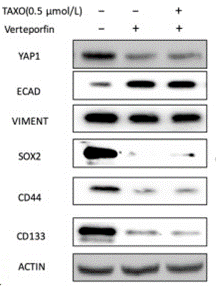
| Western blot | ECAD / Vimentin / Sox2 / CD44 / CD133 c-Myc / Bcl-2 p-S6(S240/244) / p-4EBP1(S65) beta-catenin |
|
30467925 |
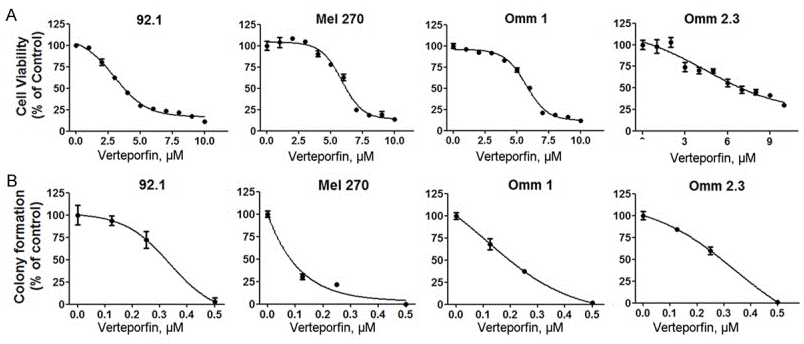
| Growth inhibition assay | Cell viability |
|
28042502 |
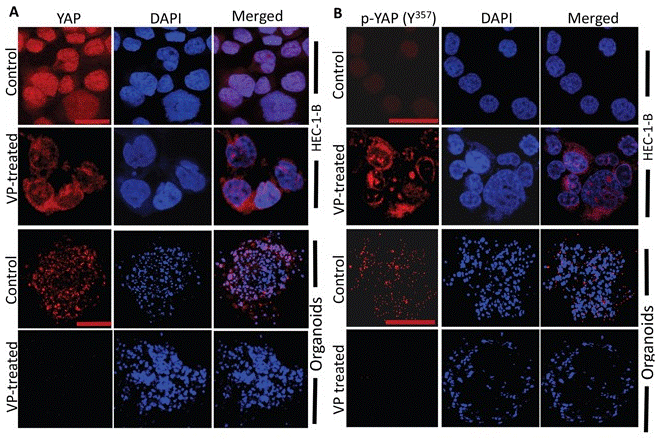
| Immunofluorescence | p-YAP(Y357) Calreticulin YAP1 |
|
28404908 |
Informatie klinische proef
(gegevens van https://clinicaltrials.gov, bijgewerkt op 2024-05-22)
| NCT-nummer | Rekrutering | Aandoeningen | Sponsor/Medewerkers | Startdatum | Fasen |
|---|---|---|---|---|---|
| NCT04590664 | Recruiting | Glioblastoma|Recurrent Glioblastoma |
Emory University|National Cancer Institute (NCI) |
January 15 2021 | Phase 1|Phase 2 |
| NCT03797547 | Unknown status | Myopic Choroidal Neovascularisation |
Poitiers University Hospital |
June 22 2018 | -- |
| NCT01846273 | Completed | Age-related Macular Degeneration|Polypoidal Choroidal Vasculopathy |
Novartis Pharmaceuticals|Novartis |
August 7 2013 | Phase 4 |
| NCT00423189 | Terminated | Age-Related Macular Degeneration |
David M. Brown M.D.|Novartis Pharmaceuticals|Greater Houston Retina Research |
January 2007 | Phase 4 |
| NCT00403442 | Terminated | Macular Degeneration |
Vitreous -Retina- Macula Consultants of New York|QLT Inc. |
September 2006 | Phase 1 |
Technische ondersteuning
Tel: +1-832-582-8158 Ext:3
Als u nog andere vragen heeft, kunt u een bericht achterlaten.

Producten zijn uitsluitend voor onderzoeksdoeleinden. Niet voor menselijk gebruik. Wij verkopen niet aan patiënten.
©Copyright 2013 Selleck Chemicals. Alle rechten voorbehouden.