
uitsluitend voor onderzoeksdoeleinden
Ipatasertib (GDC-0068) Akt remmer
Cat.Nr.S2808
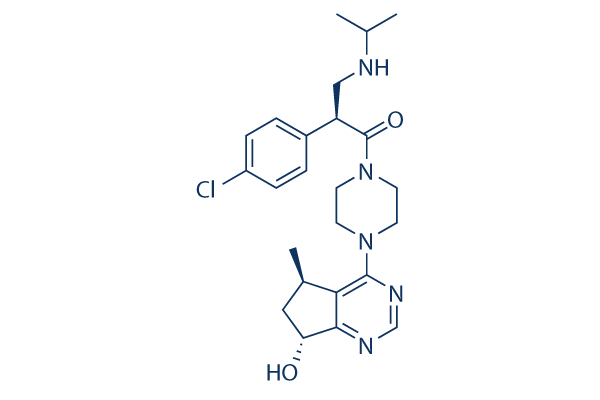
Chemische structuur
Moleculair gewicht: 458
Kwaliteitscontrole
| Gerelateerde doelwitten | PI3K mTOR GSK-3 ATM/ATR DNA-PK AMPK PDPK1 PTEN PP2A PDK |
|---|---|
| Overige Akt Inhibitoren | SC79 AZD5363 (Capivasertib) MK-2206 Dihydrochloride Perifosine GSK690693 Triciribine (API-2) Afuresertib (GSK2110183) CCT128930 A-674563 HCl Akti-1/2 |
Celkweek, behandeling & werkconcentratie
| Cellijnen | Assaytype | Concentratie | Incubatietijd | Formulering | Activiteitsbeschrijving | PMID |
|---|---|---|---|---|---|---|
| HCC70 | Function Assay | 1 μM | 24 h | increases the abundance of HER3 and induces the phosphorylation (activation) of both EGFR and HER3 | 24667376 | |
| MDA-MB-468 | Function Assay | 1 μM | 24 h | increases the abundance of HER3 | 24667376 | |
| HCC70 | Growth Inhibition Assay | 1 μM | 5 d | enhances the antiproliferative response | 24667376 | |
| MDA-MB-468 | Growth Inhibition Assay | 1 μM | 5 d | enhances the antiproliferative response | 24667376 | |
| PC-3 | Function Assay | 0.0038-2.5 μM | 1 h | DMSO | induces a dose-dependent increase in Akt phosphorylation at both Thr308 (T308) and Ser473 | 23287563 |
| BT474M1 | Function Assay | 0.0038-2.5 μM | 1 h | DMSO | induces a dose-dependent increase in Akt phosphorylation at both Thr308 (T308) and Ser473 | 23287563 |
| IGROV-1 | Function Assay | 0.0038-2.5 μM | 1 h | DMSO | induces a dose-dependent increase in Akt phosphorylation at both Thr308 (T308) and Ser473 | 23287563 |
| PC-3 | Growth Inhibition Assay | 1/5/10 μM | 24/48/72 h | DMSO | dose-dependently increases the G0–G1 phase population | 23287563 |
| MCF7-neo/HER2 | Growth Inhibition Assay | 1/5/10 μM | 24/48/72 h | DMSO | dose-dependently increases the G0–G1 phase population | 23287563 |
| BT474M1 | Growth Inhibition Assay | 1/5/10 μM | 24/48/72 h | DMSO | dose-dependently increases the G0–G1 phase population | 23287563 |
| PC-3 | Apoptosis Assay | 1/5/10 μM | 15/48/72 h | DMSO | causes a dose- and time-dependent increase in apoptotic and necrotic populations | 23287563 |
| MCF7-neo/HER2 | Apoptosis Assay | 1/5/10 μM | 15/48/72 h | DMSO | causes a dose- and time-dependent increase in apoptotic and necrotic populations | 23287563 |
| BT474M1 | Apoptosis Assay | 1/5/10 μM | 15/48/72 h | DMSO | causes a dose- and time-dependent increase in apoptotic and necrotic populations | 23287563 |
| LNCAP | Cytotoxicity assay | 72 hrs | Cytotoxicity against human LNCAP cells assessed as reduction of resazurin to resorufin after 72 hrs, IC50 = 0.095 μM. | 22934575 | ||
| LNCAP | Function assay | 1.5 hrs | Inhibition of Akt1 in human LNCAP cells assessed as phosphorylation of PRAS40 at Thr246 after 1.5 hrs, IC50 = 0.157 μM. | 22934575 | ||
| PC3 | Function assay | 50 mg/kg | 9 hrs | Plasma concentration in nu/nu mouse xenografted with human PC3 cells at 50 mg/kg, po at 9 hrs by LC/MS/MS analysis, Cp = 0.5 μM. | 22934575 | |
| BT474M1 | Cytotoxicity assay | 96 hrs | Cytotoxicity against human BT474M1 cells assessed as decrease in cell viability after 96 hrs by CellTitre-Glo assay, IC50 = 1 μM. | 22934575 | ||
| PC3 | Cytotoxicity assay | 96 hrs | Cytotoxicity against human PC3 cells assessed as decrease in cell viability after 96 hrs by CellTitre-Glo assay, IC50 = 1 μM. | 22934575 | ||
| MCF7 | Cytotoxicity assay | 96 hrs | Cytotoxicity against human MCF7 cells overexpressing Her2 assessed as decrease in cell viability after 96 hrs by CellTitre-Glo assay, IC50 = 1 μM. | 22934575 | ||
| PC3 | Function assay | 50 mg/kg | 1 hr | Plasma concentration in nu/nu mouse xenografted with human PC3 cells at 50 mg/kg, po at 1 hr by LC/MS/MS analysis, Cp = 7.4 μM. | 22934575 | |
| PC3 | Function assay | 100 mg/kg | 8 hrs | Inhibition of Akt in nu/nu mouse xenografted with human PC3 cells assessed as decrease in tumor p-S6RP level at 100 mg/kg, po at 8 hrs by ELISA relative to total S6RP | 22934575 | |
| MCF7 | Function assay | Inhibition of Akt1-mediated PRAS40 phosphorylation in human MCF7 cells overexpressing Her2 | 22934575 | |||
| BT474M1 | Function assay | Inhibition of Akt1-mediated PRAS40 phosphorylation in human BT474M1 cells | 22934575 | |||
| PC3 | Function assay | Inhibition of Akt1-mediated PRAS40 phosphorylation in human PC3 cells | 22934575 | |||
| LNCAP | Function assay | Inhibition of Akt1-mediated PRAS40 phosphorylation in human LNCAP cells | 22934575 | |||
| A673 | qHTS assay | qHTS of pediatric cancer cell lines to identify multiple opportunities for drug repurposing: Primary screen for A673 cells | 29435139 | |||
| DAOY | qHTS assay | qHTS of pediatric cancer cell lines to identify multiple opportunities for drug repurposing: Primary screen for DAOY cells | 29435139 | |||
| Saos-2 | qHTS assay | qHTS of pediatric cancer cell lines to identify multiple opportunities for drug repurposing: Primary screen for Saos-2 cells | 29435139 | |||
| BT-37 | qHTS assay | qHTS of pediatric cancer cell lines to identify multiple opportunities for drug repurposing: Primary screen for BT-37 cells | 29435139 | |||
| RD | qHTS assay | qHTS of pediatric cancer cell lines to identify multiple opportunities for drug repurposing: Primary screen for RD cells | 29435139 | |||
| SK-N-SH | qHTS assay | qHTS of pediatric cancer cell lines to identify multiple opportunities for drug repurposing: Primary screen for SK-N-SH cells | 29435139 | |||
| BT-12 | qHTS assay | qHTS of pediatric cancer cell lines to identify multiple opportunities for drug repurposing: Primary screen for BT-12 cells | 29435139 | |||
| MG 63 (6-TG R) | qHTS assay | qHTS of pediatric cancer cell lines to identify multiple opportunities for drug repurposing: Primary screen for MG 63 (6-TG R) cells | 29435139 | |||
| NB1643 | qHTS assay | qHTS of pediatric cancer cell lines to identify multiple opportunities for drug repurposing: Primary screen for NB1643 cells | 29435139 | |||
| OHS-50 | qHTS assay | qHTS of pediatric cancer cell lines to identify multiple opportunities for drug repurposing: Primary screen for OHS-50 cells | 29435139 | |||
| LAN-5 | qHTS assay | qHTS of pediatric cancer cell lines to identify multiple opportunities for drug repurposing: Confirmatory screen for LAN-5 cells | 29435139 | |||
| SK-N-SH | qHTS assay | qHTS of pediatric cancer cell lines to identify multiple opportunities for drug repurposing: Confirmatory screen for SK-N-SH cells | 29435139 | |||
| Rh41 | qHTS assay | qHTS of pediatric cancer cell lines to identify multiple opportunities for drug repurposing: Primary screen for Rh41 cells | 29435139 | |||
| MG 63 (6-TG R) | qHTS assay | qHTS of pediatric cancer cell lines to identify multiple opportunities for drug repurposing: Confirmatory screen for MG 63 (6-TG R) cells | 29435139 | |||
| Rh30 | qHTS assay | qHTS of pediatric cancer cell lines to identify multiple opportunities for drug repurposing: Confirmatory screen for Rh30 cells | 29435139 | |||
| Rh41 | qHTS assay | qHTS of pediatric cancer cell lines to identify multiple opportunities for drug repurposing: Confirmatory screen for Rh41 cells | 29435139 | |||
| SJ-GBM2 | qHTS assay | qHTS of pediatric cancer cell lines to identify multiple opportunities for drug repurposing: Primary screen for SJ-GBM2 cells | 29435139 | |||
| SK-N-MC | qHTS assay | qHTS of pediatric cancer cell lines to identify multiple opportunities for drug repurposing: Primary screen for SK-N-MC cells | 29435139 | |||
| NB-EBc1 | qHTS assay | qHTS of pediatric cancer cell lines to identify multiple opportunities for drug repurposing: Primary screen for NB-EBc1 cells | 29435139 | |||
| LAN-5 | qHTS assay | qHTS of pediatric cancer cell lines to identify multiple opportunities for drug repurposing: Primary screen for LAN-5 cells | 29435139 | |||
| Rh18 | qHTS assay | qHTS of pediatric cancer cell lines to identify multiple opportunities for drug repurposing: Primary screen for Rh18 cells | 29435139 | |||
| SK-N-MC | qHTS assay | qHTS of pediatric cancer cell lines to identify multiple opportunities for drug repurposing: Confirmatory screen for SK-N-MC cells | 29435139 | |||
| TC32 | qHTS assay | qHTS of pediatric cancer cell lines to identify multiple opportunities for drug repurposing: Confirmatory screen for TC32 cells | 29435139 | |||
| Saos-2 | qHTS assay | qHTS of pediatric cancer cell lines to identify multiple opportunities for drug repurposing: Confirmatory screen for Saos-2 cells | 29435139 | |||
| Klik om meer experimentele gegevens over de cellijn te bekijken | ||||||
Chemische informatie, Opslag en Stabiliteit
| Moleculair gewicht | 458 | Formule | C24H32ClN5O2 |
Opslag (Vanaf de ontvangstdatum) | |
|---|---|---|---|---|---|
| CAS-nr. | 1001264-89-6 | SDF downloaden | Opslag van stamoplossingen |
|
|
| Synoniemen | RG7440 | Smiles | CC1CC(C2=C1C(=NC=N2)N3CCN(CC3)C(=O)C(CNC(C)C)C4=CC=C(C=C4)Cl)O | ||
Oplosbaarheid
|
In vitro |
DMSO
: 91 mg/mL
(198.68 mM)
Ethanol : 91 mg/mL Water : Insoluble |
Molariteitscalculator
|
In vivo |
|||||
In vivo Formuleringscalculator (Heldere oplossing)
Stap 1: Voer de onderstaande informatie in (Aanbevolen: Een extra dier voor het geval van verlies tijdens het experiment)
Stap 2: Voer de in vivo formulering in (Dit is alleen de calculator, geen formulering. Neem eerst contact met ons op als er geen in vivo formulering is in het gedeelte Oplosbaarheid.)
Berekeningsresultaten:
Werkconcentratie: mg/ml;
Methode voor het bereiden van DMSO-mastervloeistof: mg geneesmiddel vooraf opgelost in μL DMSO ( Concentratie mastervloeistof mg/mL, Neem eerst contact met ons op als de concentratie de DMSO-oplosbaarheid van de partij geneesmiddel overschrijdt. )
Methode voor het bereiden van in vivo formulering: Neem μL DMSO mastervloeistof, voeg vervolgens toeμL PEG300, mengen en helder maken, voeg vervolgens toeμL Tween 80, mengen en helder maken, voeg vervolgens toe μL ddH2O, mengen en helder maken.
Methode voor het bereiden van in vivo formulering: Neem μL DMSO mastervloeistof, voeg vervolgens toe μL Maïsolie, mengen en helder maken.
Opmerking: 1. Zorg ervoor dat de vloeistof helder is voordat u het volgende oplosmiddel toevoegt.
2. Zorg ervoor dat u het/de oplosmiddel(en) in de juiste volgorde toevoegt. U moet ervoor zorgen dat de verkregen oplossing, bij de vorige toevoeging, een heldere oplossing is voordat u verdergaat met het toevoegen van het volgende oplosmiddel. Fysische methoden zoals vortexen, echografie of een warmwaterbad kunnen worden gebruikt om het oplossen te bevorderen.
Werkingsmechanisme
| Targets/IC50/Ki |
Akt1
(Cell-free assay) 5 nM
Akt3
(Cell-free assay) 8 nM
Akt2
(Cell-free assay) 18 nM
|
|---|---|
| In vitro |
Ipatasertib (GDC-0068) werd getest tegen een breed panel van 230 kinasen, en het remt slechts 3 kinasen met >70% bij een concentratie van 1 μM (PRKG1α, PRKG1β en p70S6K, met IC50 van respectievelijk 98 nM, 69 nM en 860 nM). Deze verbinding vertoont >100-voudige selectiviteit voor Akt boven PKA met IC50 van 3,1 μM. In LNCaP-, PC3- en BT474M1-cellen remt het de fosforylering van het Akt-substraat, PRAS40 met IC50 van respectievelijk 157 nM, 197 nM en 208 nM. Bovendien remt het selectief de celcyclusprogressie en de levensvatbaarheid van kankercellijnen die worden aangedreven door Akt-signalering, inclusief die met defecten in de tumorsuppressor PTEN, oncogene mutaties in PIK3CA en amplificatie van HER2, met de sterkste effecten in HER2+ en Luminale subtypes. |
| In vivo |
Orale toediening van Ipatasertib (GDC-0068) in PC3-prostaattumorxenograftmodellen induceert de downregulatie van p-PRAS40. In BT474-Tr-xenografts vermindert deze verbinding de pS6- en peIF4G-niveaus, herlocaliseert FOXO3a naar de celkern en induceert feedback-opregulatie van HER3 en pERK. Het vertoont een potente antitumorale werkzaamheid in meerdere xenograft-tumormodellen, waaronder de PTEN-deficiënte prostaatkankermodellen LNCaP en PC3, het PIK3CA H1047R-mutante borstkankermodel KPL-4 en het MCF7-neo/HER2-tumormodel. |
Referenties |
|
Toepassingen
| Methoden | Biomarkers | Afbeeldingen | PMID |
|---|---|---|---|
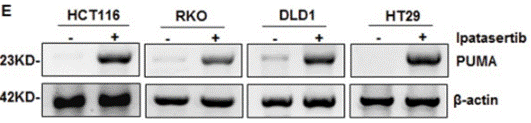
| Western blot | PUMA p-AKT / AKT / p-FoxO3a / FoxO3a / p-p65 / p65 Noxa / Bid / Bad / Bim / Bcl-2 / Bcl-xl / Mcl-1 cleaved-caspase3 p-PRAS40(T246) / PRAS40 / p-ERK / ERK / pFOXO1 / pFOXO3a / pGSK3b(S9) / pAS160(S318) / pBAD(S136) / pS6 / p4E-BP1 |
|
30185800 |
Informatie klinische proef
(gegevens van https://clinicaltrials.gov, bijgewerkt op 2024-05-22)
| NCT-nummer | Rekrutering | Aandoeningen | Sponsor/Medewerkers | Startdatum | Fasen |
|---|---|---|---|---|---|
| NCT01090960 | Completed | Solid Cancers |
Genentech Inc. |
March 2010 | Phase 1 |
Technische ondersteuning
Tel: +1-832-582-8158 Ext:3
Als u nog andere vragen heeft, kunt u een bericht achterlaten.

Producten zijn uitsluitend voor onderzoeksdoeleinden. Niet voor menselijk gebruik. Wij verkopen niet aan patiënten.
©Copyright 2013 Selleck Chemicals. Alle rechten voorbehouden.