
réservé à la recherche
Niraparib (MK-4827) PARP inhibiteur
N° Cat.S2741
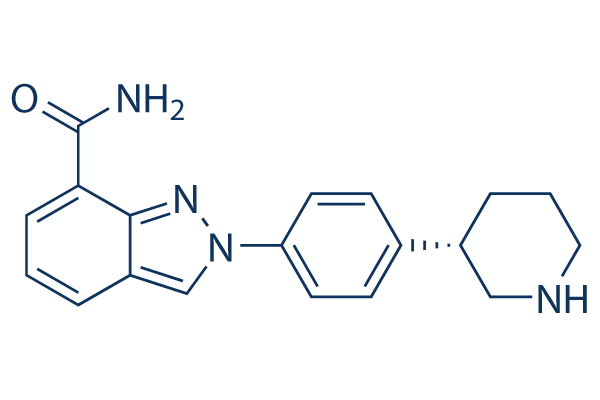
Structure chimique
Poids moléculaire: 320.39
Contrôle qualité
| Cibles apparentées | HDAC ATM/ATR DNA-PK WRN DNA/RNA Synthesis Topoisomerase PPAR Sirtuin Casein Kinase eIF |
|---|---|
| Autre PARP Inhibiteurs | XAV-939 AZD5305 (Saruparib) Veliparib (ABT-888) PJ34 HCl AG-14361 Iniparib (BSI-201) G007-LK Pamiparib UPF 1069 A-966492 |
Culture cellulaire, traitement et concentration de travail
| Lignées cellulaires | Type dessai | Concentration | Temps dincubation | Formulation | Description de lactivité | PMID |
|---|---|---|---|---|---|---|
| HeLa cells | Function assay | Inhibition of PARP in hydrogen peroxide-induced human HeLa cells assessed as inhibition DNA-damage-induced PARylation, EC50=0.004 μM | 19873981 | |||
| A549 cells | Cytotoxicity assay | 5-7 days | Cytotoxicity against human A549 cells transfected with BRCA2 shRNA assessed as inhibition of cell proliferation after 5 to 7 days by CellTiter-Blue assay, CC50=0.011 μM | 25761096 | ||
| MDA-MB-436 cells | Proliferation assay | 6 days | Antiproliferative activity against human MDA-MB-436 cells expressing BRCA1 5396 + 1G>A mutant after 6 days by cell titer-blue assay, CC50=18 nM | 19873981 | ||
| SUM1315MO2 cells | Cytotoxicity assay | 12 days | Cytotoxicity against human SUM1315MO2 cells carrying BRCA1 mutant assessed as inhibition of cell proliferation after 12 days by CellTiter-Blue assay, CC50=0.02 μM | 25761096 | ||
| DoTc2-4510 cells | Cytotoxicity assay | 5-7 days | Cytotoxicity against human DoTc2-4510 cells carrying BRCA2 mutant assessed as inhibition of cell proliferation after 5 to 7 days by CellTiter-Blue assay, CC50=0.023 μM | 25761096 | ||
| SUM149PT cells | Cytotoxicity assay | 5-7 days | Cytotoxicity against human SUM149PT cells carrying BRCA1 mutant assessed as inhibition of cell proliferation after 5 to 7 days by CellTiter-Blue assay, CC50=0.024 μM | 25761096 | ||
| UWB1.289 cells | Cytotoxicity assay | 5-7 days | Cytotoxicity against human UWB1.289 cells carrying BRCA1 mutant assessed as inhibition of cell proliferation after 5 to 7 days by CellTiter-Blue assay, CC50=0.056 μM | 25761096 | ||
| Capan1 cells | Cytotoxicity assay | Cytotoxicity against BRCA2-deficient human Capan1 cells, CC50=0.09 μM | 25761096 | |||
| Jurkat cells | Function assay | Inhibition of PARP1 in human Jurkat cells assessed as reduction of cell viability after 96 hrs by MTS assay in presence of 100 uM of temozolomide, EC50=0.2 μM | 23850199 | |||
| BT20 cells | Cytotoxicity assay | 5-7 days | Cytotoxicity against human BT20 cells assessed as inhibition of cell proliferation after 5 to 7 days by CellTiter-Blue assay, CC50=2.2 μM | 25761096 | ||
| Antiproliferative assay | HeLa | 7 days | Antiproliferative activity against BRCA1 deficient human HeLa cells after 7 days by cell titer-blue assay, CC50 = 0.033 μM. | 19873981 | ||
| Function assay | HeLa | Inhibition of PARP in hydrogen peroxide-induced human HeLa cells assessed as inhibition DNA-damage-induced PARylation, EC90 = 0.045 μM. | 19873981 | |||
| Antiproliferative assay | Capan1 | 13 days | Antiproliferative activity against human Capan1 cells expressing BRCA2 6174delT mutation and loss of wild-type allele after 13 days by cell titer-blue assay, CC50 = 0.09 μM. | 19873981 | ||
| Antiproliferative assay | HeLa | 7 days | Antiproliferative activity against human HeLa cells expressing wild type BRCA1 after 7 days by cell titer-blue assay, CC50 = 0.86 μM. | 19873981 | ||
| Function assay | Jurkat | 96 hrs | Inhibition of PARP1 in human Jurkat cells assessed as reduction of cell viability after 96 hrs by MTS assay, EC50 = 31 μM. | 23850199 | ||
| Function assay | CAPAN-1 | Inhibition of PARP in BRCA2-deficient human CAPAN-1 cells assessed as inhibition of hydrogen peroxide-induced PARylation by cell-based assay, IC50 = 0.0035 μM. | 25761096 | |||
| Function assay | HeLa | Inhibition of PARP in human HeLa cells assessed as inhibition of hydrogen peroxide-induced PARylation by cell-based assay, EC50 = 0.004 μM. | 25761096 | |||
| Function assay | A2780 | Inhibition of PARP in human A2780 cells assessed as inhibition of hydrogen peroxide-induced PARylation by cell-based assay, IC50 = 0.004 μM. | 25761096 | |||
| Cytotoxicity assay | MDA-MB-436 | Cytotoxicity against human MDA-MB-436 cells carrying BRCA1 mutant assessed as inhibition of cell proliferation, CC50 = 0.018 μM. | 25761096 | |||
| Cytotoxicity assay | HeLa | 5 to 7 days | Cytotoxicity against human HeLa cells transfected with BRCA1 shRNA assessed as reduction of cell viability after 5 to 7 days by CellTiter-Blue assay, CC50 = 0.034 μM. | 25761096 | ||
| Function assay | HeLa | Inhibition of PARP in human HeLa cells assessed as inhibition of hydrogen peroxide-induced PARylation by cell-based assay, IC90 = 0.046 μM. | 25761096 | |||
| Function assay | CAPAN-1 | Inhibition of PARP in BRCA2-deficient human CAPAN-1 cells assessed as inhibition of hydrogen peroxide-induced PARylation by cell-based assay, IC90 = 0.05 μM. | 25761096 | |||
| Function assay | A2780 | Inhibition of PARP in human A2780 cells assessed as inhibition of hydrogen peroxide-induced PARylation by cell-based assay, IC90 = 0.052 μM. | 25761096 | |||
| Cytotoxicity assay | HeLa | 5 to 7 days | Cytotoxicity against wild type human HeLa cells assessed as inhibition of cell proliferation after 5 to 7 days by CellTiter-Blue assay, CC50 = 0.852 μM. | 25761096 | ||
| Cytotoxicity assay | UWB1.289 | 5 to 7 days | Cytotoxicity against human UWB1.289 cells expressing BRCA1 assessed as inhibition of cell proliferation after 5 to 7 days by CellTiter-Blue assay, CC50 = 0.975 μM. | 25761096 | ||
| Cytotoxicity assay | A549 | 5 to 7 days | Cytotoxicity against wild type human A549 cells assessed as inhibition of cell proliferation after 5 to 7 days by CellTiter-Blue assay, CC50 = 1.76 μM. | 25761096 | ||
| Cytotoxicity assay | Capan1 | Cytotoxicity against BRCA2-deficient human Capan1 cells, EC50 = 0.65 μM. | 26652717 | |||
| Antitumor assay | MDA-MB-436 | 50 mg/kg | 33 days | Antitumor activity against human MDA-MB-436 cells expressing BRCA1 5396 + 1G>A mutant xenografted in CD1 mouse assessed as tumor regression at 50 mg/kg, po bid for 33 days | 19873981 | |
| Antitumor assay | MDA-MB-436 | 100 mg/kg | 33 days | Antitumor activity against human MDA-MB-436 cells expressing BRCA1 5396 + 1G>A mutant xenografted in CD1 mouse assessed as tumor regression at 100 mg/kg, po qd for 33 days | 19873981 | |
| Antitumor assay | MDA-MB-436 | 80 mg/kg | 1 to 2 weeks | Antitumor activity against human MDA-MB-436 cells harboring BRCA1 mutant xenografted in immunocompromised mouse assessed as tumor growth inhibition at 80 mg/kg, po qd for 1 to 2 weeks | 25761096 | |
| Antitumor assay | MDA-MB-436 | 80 mg/kg | 4 weeks | Antitumor activity against human MDA-MB-436 cells harboring BRCA1 mutant xenografted in immunocompromised mouse assessed as complete and sustained tumor regression at 80 mg/kg, po qd for 4 weeks | 25761096 | |
| Antitumor assay | MDA-MB-436 | 50 mg/kg | Antitumor activity against human MDA-MB-436 cells harboring BRCA1 mutant xenografted in immunocompromised mouse assessed as tumor growth inhibition at 50 mg/kg, po administered daily | 25761096 | ||
| Antitumor assay | MDA-MB-436 | 80 mg/kg | 3 weeks | Antitumor activity against human MDA-MB-436 cells harboring BRCA1 mutant xenografted in immunocompromised mouse assessed as tumor shrinkage at 80 mg/kg, po qd for 3 weeks | 25761096 | |
| qHTS assay | TC32 | qHTS of pediatric cancer cell lines to identify multiple opportunities for drug repurposing: Primary screen for TC32 cells | 29435139 | |||
| qHTS assay | A673 | qHTS of pediatric cancer cell lines to identify multiple opportunities for drug repurposing: Primary screen for A673 cells | 29435139 | |||
| qHTS assay | NB1643 | qHTS of pediatric cancer cell lines to identify multiple opportunities for drug repurposing: Primary screen for NB1643 cells | 29435139 | |||
| qHTS assay | A673 | qHTS of pediatric cancer cell lines to identify multiple opportunities for drug repurposing: Confirmatory screen for A673 cells) | 29435139 | |||
| qHTS assay | BT-37 | qHTS of pediatric cancer cell lines to identify multiple opportunities for drug repurposing: Confirmatory screen for BT-37 cells | 29435139 | |||
| qHTS assay | SK-N-MC | qHTS of pediatric cancer cell lines to identify multiple opportunities for drug repurposing: Primary screen for SK-N-MC cells | 29435139 | |||
| qHTS assay | NB-EBc1 | qHTS of pediatric cancer cell lines to identify multiple opportunities for drug repurposing: Primary screen for NB-EBc1 cells | 29435139 | |||
| qHTS assay | LAN-5 | qHTS of pediatric cancer cell lines to identify multiple opportunities for drug repurposing: Primary screen for LAN-5 cells | 29435139 | |||
| qHTS assay | SK-N-MC | qHTS of pediatric cancer cell lines to identify multiple opportunities for drug repurposing: Confirmatory screen for SK-N-MC cells | 29435139 | |||
| qHTS assay | TC32 | qHTS of pediatric cancer cell lines to identify multiple opportunities for drug repurposing: Confirmatory screen for TC32 cells | 29435139 | |||
| Cliquez pour voir plus de données expérimentales sur les lignées cellulaires | ||||||
Informations chimiques, stockage et stabilité
| Poids moléculaire | 320.39 | Formule | C19H20N4O |
Stockage (À partir de la date de réception) | |
|---|---|---|---|---|---|
| N° CAS | 1038915-60-4 | Télécharger le SDF | Stockage des solutions mères |
|
|
Solubilité
|
In vitro |
DMSO
: 64 mg/mL
(199.75 mM)
Ethanol : 64 mg/mL Water : Insoluble |
Calculateur de molarité
|
In vivo |
|||||
Calculateur de formulation in vivo (Solution claire)
Étape 1 : Entrez les informations ci-dessous (Recommandé : Un animal supplémentaire pour tenir compte des pertes pendant lexpérience)
Étape 2 : Entrez la formulation in vivo (Ceci nest que le calculateur, pas la formulation. Veuillez nous contacter dabord sil ny a pas de formulation in vivo dans la section Solubilité.)
Résultats du calcul :
Concentration de travail : mg/ml;
Méthode de préparation du liquide maître DMSO : mg médicament prédissous dans μL DMSO ( Concentration du liquide maître mg/mL, Veuillez nous contacter dabord si la concentration dépasse la solubilité du DMSO du lot de médicament. )
Méthode de préparation de la formulation in vivo : Prendre μL DMSO liquide maître, ajouter ensuiteμL PEG300, mélanger et clarifier, ajouter ensuiteμL Tween 80, mélanger et clarifier, ajouter ensuite μL ddH2O, mélanger et clarifier.
Méthode de préparation de la formulation in vivo : Prendre μL DMSO liquide maître, ajouter ensuite μL Huile de maïs, mélanger et clarifier.
Remarque : 1. Assurez-vous que le liquide est clair avant dajouter le solvant suivant.
2. Assurez-vous dajouter le(s) solvant(s) dans lordre. Vous devez vous assurer que la solution obtenue lors de lajout précédent est une solution claire avant de procéder à lajout du solvant suivant. Des méthodes physiques telles que le vortex, les ultrasons ou le bain-marie peuvent être utilisées pour faciliter la dissolution.
Mécanisme daction
| Targets/IC50/Ki |
PARP2
(Cell-free assay) 2.1 nM
PARP1
(Cell-free assay) 3.8 nM
|
|---|---|
| In vitro |
Dans un test sur cellules entières, Niraparib (MK-4827) a inhibé l'activité PARP avec une EC50 = 4 nM et a inhibé la prolifération des cellules cancéreuses avec des mutations BRCA-1 et BRCA-2 avec une CC50 dans la plage de 10-100 nM. Il s'est avéré être un inhibiteur puissant et sélectif de PARP-1 et PARP-2 avec une IC50 respective de 3,8 et 2,1 nM. De plus, ce composé a montré une sélectivité au moins 100 fois supérieure à celle de PARP-3, V-PARP et tankyrase-1, avec des IC50 respectives de 1300, 330 et 570 nM. En plus d'inhiber la croissance des cellules HeLa dépourvues de BRCA-1 en raison d'un silençage par interférence ARN, il est capable d'inhiber la prolifération des lignées cellulaires cancéreuses portant des mutations naturelles BRCA-1 ou BRCA-2. Dans les cellules d'adénocarcinome mammaire humain MDA-MB-436 portant des mutations BRCA-1, il a montré une CC50 = 18 nM, tandis que dans les cellules d'adénocarcinome pancréatique humain CAPAN-1, qui sont mutantes BRCA-2, il a montré une CC50 = 90 nM. En revanche, les cellules épithéliales prostatiques et mammaires humaines normales sont résistantes au MK-4827, montrant des effets antiprolifératifs dans la gamme micromolaire, démontrant ainsi la cytotoxicité sélective très élevée de ces inhibiteurs de PARP dans les cellules cancéreuses mutantes BRCA-1 et -2 par rapport aux tissus environnants.
|
| In vivo |
Niraparib (MK-4827), un nouvel inhibiteur de PARP-1 et PARP-2 biodisponible par voie orale, a fortement amélioré l'effet des radiations sur une variété de xénogreffes de tumeurs humaines, à la fois de type sauvage p53 et de type mutant p53. Il a été bien toléré in vivo et a démontré une efficacité en tant qu'agent unique dans un modèle de xénogreffe de cancer déficient en BRCA-1.
|
Références |
|
Applications
| Méthodes | Biomarqueurs | Images | PMID |
|---|---|---|---|
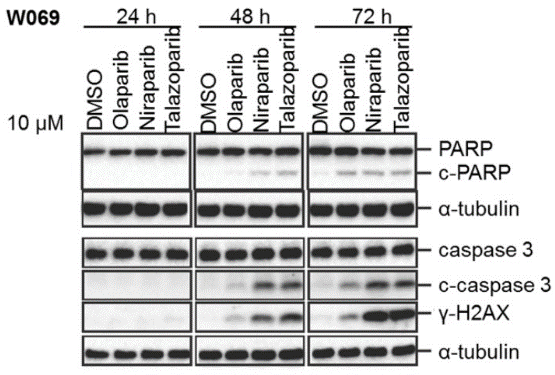
| Western blot | c-PARP /c-caspase 3 / γ-H2AX |
|
29158830 |
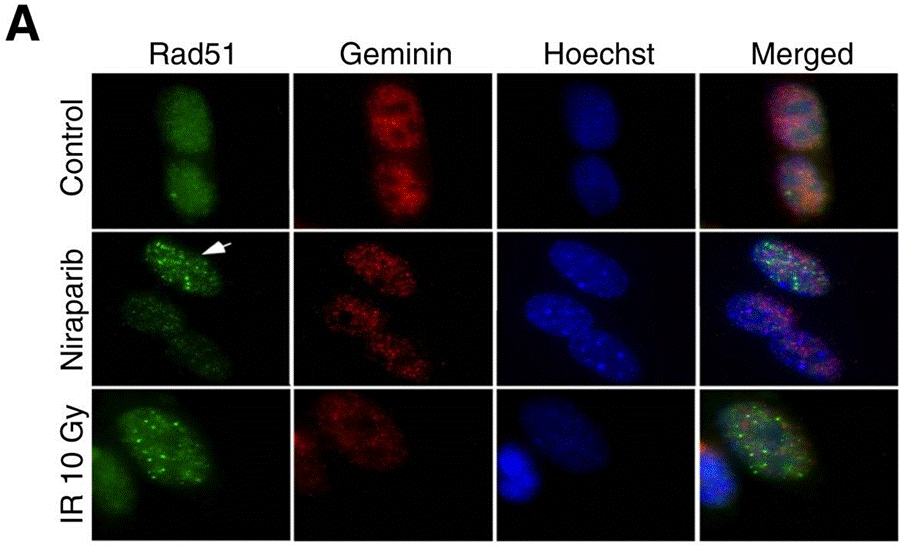
| Immunofluorescence | Rad51 / Geminin |
|
27614696 |
Informations sur lessai clinique
(données de https://clinicaltrials.gov, mis à jour le 2024-05-22)
| Numéro NCT | Recrutement | Conditions | Sponsor/Collaborateurs | Date de début | Phases |
|---|---|---|---|---|---|
| NCT05289648 | Not yet recruiting | Endometrial Cancer|Serous Adenocarcinoma|Uterine Neoplasm |
Sir Mortimer B. Davis - Jewish General Hospital |
May 1 2024 | Early Phase 1 |
| NCT06077877 | Recruiting | Neoplasms |
GlaxoSmithKline |
October 24 2023 | Phase 1|Phase 2 |
| NCT05666349 | Withdrawn | Recurrent Glioblastoma |
University College London|GlaxoSmithKline |
October 13 2023 | Phase 1 |
Support technique
Tel: +1-832-582-8158 Ext:3
Si vous avez dautres questions, veuillez laisser un message.
Questions fréquemment posées
Question 1:
How to reconstitute it for in vivo studies?
Réponse :
It can be orally administered using the formulation 1% CMC-Na (suspension).

Les produits sont destinés à la recherche uniquement. Non destinés à lusage humain. Nous ne vendons pas aux patients.
©Copyright 2013 Selleck Chemicals. Tous droits réservés.