
réservé à la recherche
AZD1480 JAK inhibiteur
N° Cat.S2162
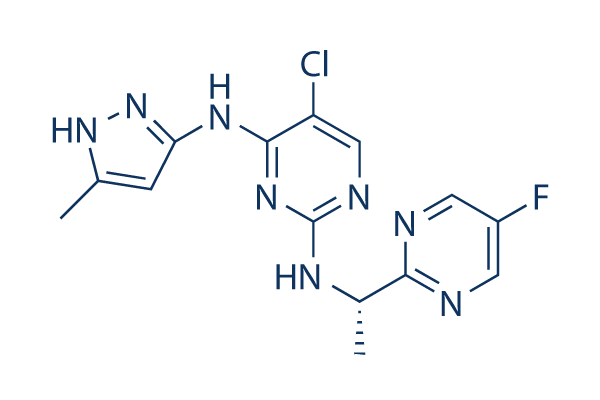
Structure chimique
Poids moléculaire: 348.77
Contrôle qualité
| Cibles apparentées | EGFR STAT Pim |
|---|---|
| Autre JAK Inhibiteurs | BMS-986165 (Deucravacitinib) WP1066 Momelotinib (CYT387) Filgotinib (GLPG0634) AT9283 Gandotinib (LY2784544) Pacritinib TG101209 Cerdulatinib (PRT062070) hydrochloride NVP-BSK805 2HCl |
Culture cellulaire, traitement et concentration de travail
| Lignées cellulaires | Type dessai | Concentration | Temps dincubation | Formulation | Description de lactivité | PMID |
|---|---|---|---|---|---|---|
| SW620 | Function Assay | 5 μM | 48 h | DMSO | blocks JAK2/STAT3 signaling | 25954974 |
| LoVo | Function Assay | 5 μM | 48 h | DMSO | blocks JAK2/STAT3 signaling | 25954974 |
| HN5 | Growth Inhibition Assay | 72 h | EC50=3.81 ± 1.99 μM | 25810010 | ||
| Cal33 | Growth Inhibition Assay | 72 h | EC50=3.37 ± 0.75 μM | 25810010 | ||
| UM-22B | Growth Inhibition Assay | 72 h | EC50=2.66 ± 0.24 μM | 25810010 | ||
| 686LN | Growth Inhibition Assay | 72 h | EC50=2.05 ± 1.33 μM | 25810010 | ||
| UM SCC-1 | Growth Inhibition Assay | 72 h | EC50=1.67 ± 0.42 μM | 25810010 | ||
| UM-22A | Growth Inhibition Assay | 72 h | EC50=1.32 ± 0.39 μM | 25810010 | ||
| OSC19 | Growth Inhibition Assay | 72 h | EC50=1.26 ± 0.20 μM | 25810010 | ||
| PCI-52 | Growth Inhibition Assay | 72 h | EC50=1.00 ± 0.09 μM | 25810010 | ||
| PCI-15B | Growth Inhibition Assay | 72 h | EC50=0.99 ± 1.74 μM | 25810010 | ||
| UMSCC-1 | Function Assay | 0.0005-1.6 μM | 24 h | abrogates IL-6–induced up-regulation of pSTAT3Tyr705 in a dose-dependent manner | 25810010 | |
| Cal33 | Function Assay | 0.0005-3.8 μM | 24 h | abrogates IL-6–induced up-regulation of pSTAT3Tyr705 in a dose-dependent manner | 25810010 | |
| HH5 | Function Assay | 0.0005-3.8 μM | 24 h | abrogates IL-6–induced up-regulation of pSTAT3Tyr705 in a dose-dependent manner | 25810010 | |
| UM-22A | Function Assay | 0.0005-1.6 μM | 24 h | abrogates IL-6–induced up-regulation of pSTAT3Tyr705 in a dose-dependent manner | 25810010 | |
| A1847 | Function Assay | 0.05-10 μM | 24 h | DMSO | reduces phosphorylated STAT3 levels | 25646015 |
| OVCAR-5 | Function Assay | 0.05-10 μM | 24 h | DMSO | reduces phosphorylated STAT3 levels | 25646015 |
| OVCAR-8 | Function Assay | 0.05-10 μM | 24 h | DMSO | reduces phosphorylated STAT3 levels | 25646015 |
| MOVCAR-5447 | Function Assay | 0.05-10 μM | 24 h | DMSO | reduces phosphorylated STAT3 levels | 25646015 |
| MOVCAR-5009 | Function Assay | 0.05-10 μM | 24 h | DMSO | reduces phosphorylated STAT3 levels | 25646015 |
| A1847 | Cell Viability Assay | 0.05-10 μM | 72 h | DMSO | reduces cell viability at the concerntration of 5 μM | 25646015 |
| OVCAR-5 | Cell Viability Assay | 0.05-10 μM | 72 h | DMSO | reduces cell viability at the concerntration of 5 μM | 25646015 |
| OVCAR-8 | Cell Viability Assay | 0.05-10 μM | 72 h | DMSO | reduces cell viability at the concerntration of 5 μM | 25646015 |
| OVCAR-5 | Apoptosis Assay | 0.5/1/5 μM | 48 h | DMSO | induces significant apoptosis at high concerntration | 25646015 |
| OVCAR-8 | Apoptosis Assay | 0.5/1/5 μM | 48 h | DMSO | induces significant apoptosis at high concerntration | 25646015 |
| AKRSL | Cell Viability Assay | 72 h | IC50>10 μM | 25504635 | ||
| PALJDL | Cell Viability Assay | 72 h | IC50=2.4 μM | 25504635 | ||
| MO4 | Function Assay | 0.5/1/5 μM | 6 h | inhibits P-STAT3 expression | 25149535 | |
| DU145 | Function Assay | 0-200 nM | 1 h | suppresses IL-6-activated Stat3 and ERK1/2 signaling | 24577942 | |
| DU145 | Function Assay | 800 nM | 72 h | suppresses IL-6-induced migratory | 24577942 | |
| CWR22Rv1 | Function Assay | 800 nM | 72 h | suppresses IL-6-induced migratory | 24577942 | |
| N592 | Growth Inhibition Assay | IC50=0.84 μM | 24158701 | |||
| H82 | Growth Inhibition Assay | IC50=1.37 μM | 24158701 | |||
| GLC4 | Growth Inhibition Assay | IC50=1.79 μM | 24158701 | |||
| H526 | Growth Inhibition Assay | IC50=3.08 μM | 24158701 | |||
| H1173 | Growth Inhibition Assay | IC50=2.39 μM | 24158701 | |||
| DMS114 | Growth Inhibition Assay | IC50=0.73 μM | 24158701 | |||
| NCI-N592 | Function Assay | 0.3/1/3 μM | 24 h | induces G2/M cell cycle arrest | 24158701 | |
| GLC4 | Function Assay | 0.3/1/3 μM | 24 h | induces G2/M cell cycle arrest | 24158701 | |
| NCI-H82 | Function Assay | 0.3/1/3 μM | 24 h | induces G2/M cell cycle arrest | 24158701 | |
| NCI-N592 | Apoptosis Assay | 0.3/1/3 μM | 48 h | increases the level of cleaved-Caspase 3 | 24158701 | |
| GLC4 | Apoptosis Assay | 0.3/1/3 μM | 48 h | increases the level of cleaved-Caspase 3 | 24158701 | |
| NCI-H82 | Apoptosis Assay | 0.3/1/3 μM | 48 h | increases the level of cleaved-Caspase 3 | 24158701 | |
| CWR22Rv1 | Apoptosis Assay | IC50=0.482 μM | 23942095 | |||
| CWR22Pc | Apoptosis Assay | IC50=0.438 μM | 23942095 | |||
| PC-3 | Apoptosis Assay | IC50=1.755 μM | 23942095 | |||
| DU145 | Apoptosis Assay | IC50=3.517 μM | 23942095 | |||
| RC165N | Apoptosis Assay | IC50=2.083 μM | 23942095 | |||
| ARPE19 | Growth Inhibition Assay | DMSO | IC50=24.38 μM | 23531921 | ||
| HEK293 | Growth Inhibition Assay | DMSO | IC50=8.67 μM | 23531921 | ||
| KCNR | Growth Inhibition Assay | DMSO | IC50=0.46 μM | 23531921 | ||
| SY5Y | Growth Inhibition Assay | DMSO | IC50=0.36 μM | 23531921 | ||
| BE2 | Growth Inhibition Assay | DMSO | IC50=0.71 μM | 23531921 | ||
| AS | Growth Inhibition Assay | DMSO | IC50=1.53 μM | 23531921 | ||
| NGP | Growth Inhibition Assay | DMSO | IC50=0.56 μM | 23531921 | ||
| IMR32 | Growth Inhibition Assay | DMSO | IC50=0.66 μM | 23531921 | ||
| LAN5 | Growth Inhibition Assay | DMSO | IC50=1.04 μM | 23531921 | ||
| RH18 | Growth Inhibition Assay | DMSO | IC50=1.42 μM | 23531921 | ||
| RH30 | Growth Inhibition Assay | DMSO | IC50=1.25 μM | 23531921 | ||
| RH17 | Growth Inhibition Assay | DMSO | IC50=2.51 μM | 23531921 | ||
| RH28 | Growth Inhibition Assay | DMSO | IC50=4.28 μM | 23531921 | ||
| RH36 | Growth Inhibition Assay | DMSO | IC50=5.37 μM | 23531921 | ||
| RH41 | Growth Inhibition Assay | DMSO | IC50=0.48 μM | 23531921 | ||
| RD | Growth Inhibition Assay | DMSO | IC50=4.32 μM | 23531921 | ||
| TC32 | Growth Inhibition Assay | DMSO | IC50=3.85 μM | 23531921 | ||
| TC71 | Growth Inhibition Assay | DMSO | IC50=4.33 μM | 23531921 | ||
| KCNR | Apoptosis Assay | 0.5/1.0/2.5 μM | 24 h | DMSO | induces an increase in caspase 3/7 activity | 23531921 |
| SY5Y | Apoptosis Assay | 0.5/1.0/2.5 μM | 24 h | DMSO | induces an increase in caspase 3/7 activity | 23531921 |
| Rh18 | Apoptosis Assay | 0.5/1.0/2.5 μM | 24 h | DMSO | induces an increase in caspase 3/7 activity | 23531921 |
| TC32 | Apoptosis Assay | 0.5/1.0/2.5 μM | 24 h | DMSO | induces an increase in caspase 3/7 activity | 23531921 |
| KCNR | Function Assay | 0.5/1.0/2.5/5 μM | 24 h | DMSO | inhibits both endogenous constitutive and IL-6-induced STAT3 activation | 23531921 |
| SY5Y | Function Assay | 0.5/1.0/2.5/5 μM | 24 h | DMSO | inhibits both endogenous constitutive and IL-6-induced STAT3 activation | 23531921 |
| Rh18 | Function Assay | 0.5/1.0/2.5/5 μM | 24 h | DMSO | inhibits both endogenous constitutive and IL-6-induced STAT3 activation | 23531921 |
| TC32 | Function Assay | 0.5/1.0/2.5/5 μM | 24 h | DMSO | inhibits both endogenous constitutive and IL-6-induced STAT3 activation | 23531921 |
| TPC-1 | Growth Inhibition Assay | 1 µM | 0-4 d | DMSO | inhibits cell growth after 2 d treatment | 23056499 |
| MZ-CRC1 | Growth Inhibition Assay | 1 µM | 0-5 d | DMSO | inhibits cell growth after 1 d treatment | 23056499 |
| TT | Growth Inhibition Assay | 1 µM | 0-4 d | DMSO | inhibits cell growth after 1 d treatment | 23056499 |
| TPC-1 | Function Assay | 1 µM | 72 h | DMSO | induces G1 blockage | 23056499 |
| MZ-CRC1 | Function Assay | 1 µM | 72 h | DMSO | induces G1 blockage | 23056499 |
| TT | Function Assay | 1 µM | 72 h | DMSO | induces G1 blockage | 23056499 |
| MZ-CRC1 | Apoptosis Assay | 1 µM | 48 h | DMSO | induces apoptosis | 23056499 |
| TT | Apoptosis Assay | 1 µM | 48 h | DMSO | induces apoptosis | 23056499 |
| HD-LM2 | Growth Inhibition Assay | 72 h | DMSO | IC50=7.844 μM | 22829094 | |
| L-428 | Growth Inhibition Assay | 72 h | DMSO | IC50=7.947 μM | 22829094 | |
| KM-H2 | Growth Inhibition Assay | 72 h | DMSO | IC50=1.308 μM | 22829094 | |
| L-540 | Growth Inhibition Assay | 72 h | DMSO | IC50=8.216 μM | 22829094 | |
| HD-LM2 | Function Assay | 0.1/0.5/1/5 μM | 72 h | DMSO | inhibits STAT3, STAT5 and STAT6 phosphorylation | 22829094 |
| L-428 | Function Assay | 0.1/0.5/1/5 μM | 72 h | DMSO | inhibits STAT3, STAT5 and STAT6 phosphorylation | 22829094 |
| KM-H2 | Function Assay | 0.1/0.5/1/5 μM | 72 h | DMSO | inhibits STAT3, STAT5 and STAT6 phosphorylation | 22829094 |
| L-540 | Function Assay | 0.1/0.5/1/5 μM | 72 h | DMSO | inhibits STAT3, STAT5 and STAT6 phosphorylation | 22829094 |
| HD-LM2 | Apoptosis Assay | 1/5 μM | 72 h | DMSO | induces apoptosis | 22829094 |
| L-428 | Apoptosis Assay | 1/5 μM | 72 h | DMSO | induces apoptosis | 22829094 |
| KM-H2 | Apoptosis Assay | 1/5 μM | 72 h | DMSO | induces apoptosis | 22829094 |
| L-540 | Apoptosis Assay | 1/5 μM | 72 h | DMSO | induces apoptosis | 22829094 |
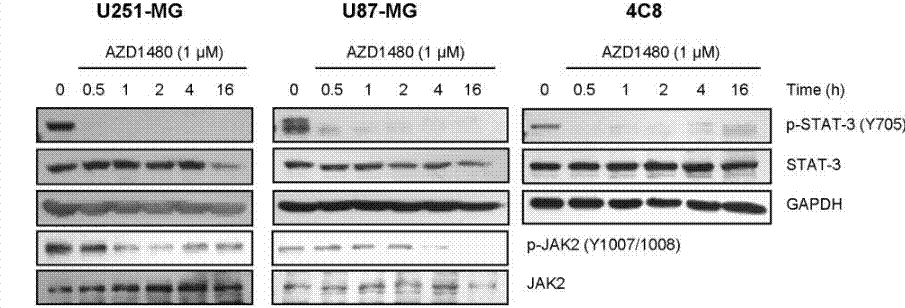
| U251-MG | Function Assay | 1 µM | 0-16 h | inhibits constitutive STAT-3 and JAK2 activation | 22027691 | |
| U87-MG | Function Assay | 1 µM | 0-16 h | inhibits constitutive STAT-3 and JAK2 activation | 22027691 | |
| 4C8 | Function Assay | 1 µM | 0-16 h | inhibits constitutive STAT-3 and JAK2 activation | 22027691 | |
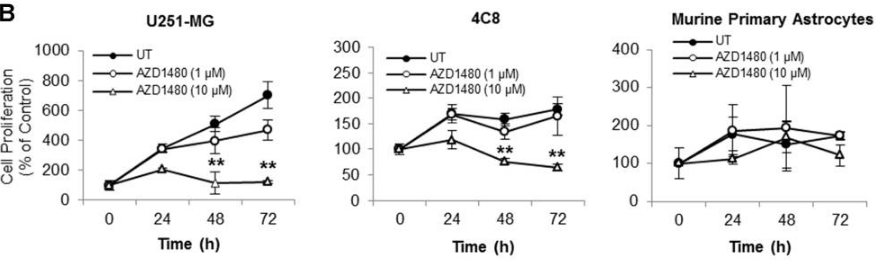
| U251-MG | Growth Inhibition Assay | 1/10 µM | 24/48/72 h | inhibits cell proliferation at a concentration of 10 µM | 22027691 | |
| U87-MG | Growth Inhibition Assay | 1/10 µM | 24/48/72 h | inhibits cell proliferation at a concentration of 10 µM | 22027691 | |
| 4C8 | Growth Inhibition Assay | 1/10 µM | 24/48/72 h | inhibits cell proliferation at a concentration of 10 µM | 22027691 | |
| U266 | Apoptosis Assay | 0.5-2 μM | 48/72 h | induces apoptosis dose dependently | 21164517 | |
| Kms.11 | Apoptosis Assay | 0.5-2 μM | 48/72 h | induces apoptosis dose dependently | 21164517 | |
| 8226 | Apoptosis Assay | 0.5-2 μM | 48/72 h | induces apoptosis dose dependently | 21164517 | |
| SET2 | Growth inhibition assay | 48 hrs | Growth inhibition of human SET2 cells expressing Jak2 V617F mutant after 48 hrs by MTS assay, GI50 = 0.016 μM. | 21138246 | ||
| SET2 | Function assay | 1 hr | Inhibition of Stat3 phosphorylation in human SET2 cells after 1 hr by Western blotting, IC50 = 0.023 μM. | 21138246 | ||
| SET2 | Function assay | 1 hr | Inhibition of Stat5 phosphorylation in human SET2 cells after 1 hr by Western blotting, IC50 = 0.025 μM. | 21138246 | ||
| HEL | Function assay | 1 hr | Inhibition of Stat5 phosphorylation in human HEL cells after 1 hr by Western blotting, IC50 = 0.041 μM. | 21138246 | ||
| Ba/F3 | Function assay | Inhibition of Stat5 phosphorylation in mouse Ba/F3 cells expressing TEL-Jak2, IC50 = 0.046 μM. | 21138246 | |||
| UKE1 | Growth inhibition assay | 48 hrs | Growth inhibition of human UKE1 cells expressing Jak2 V617F mutant after 48 hrs by MTS assay, GI50 = 0.054 μM. | 21138246 | ||
| BA/F3 | Growth inhibition assay | 48 hrs | Growth inhibition of mouse BA/F3 cells expressing Tel-JAK2 kinase after 48 hrs by MTS assay, GI50 = 0.06 μM. | 21138246 | ||
| HEL | Function assay | 1 hr | Inhibition of Stat3 phosphorylation in human HEL cells after 1 hr by Western blotting, IC50 = 0.08 μM. | 21138246 | ||
| HEL | Growth inhibition assay | 48 hrs | Growth inhibition of human HEL cells expressing Jak2 V617F mutant after 48 hrs by MTS assay, GI50 = 0.39 μM. | 21138246 | ||
| BA/F3 | Growth inhibition assay | 48 hrs | Growth inhibition of mouse BA/F3 cells expressing Tel-JAK1 kinase after 48 hrs by MTS assay, GI50 = 0.7 μM. | 21138246 | ||
| BA/F3 | Growth inhibition assay | 48 hrs | Growth inhibition of mouse BA/F3 cells expressing Tel-Tyk2 kinase after 48 hrs by MTS assay, GI50 = 2 μM. | 21138246 | ||
| BA/F3 | Growth inhibition assay | 48 hrs | Growth inhibition of mouse BA/F3 cells expressing Tel-JAK3 kinase after 48 hrs by MTS assay, GI50 = 2.1 μM. | 21138246 | ||
| UKE1 | Function assay | 1 hr | Inhibition of Stat5 phosphorylation in human UKE1 cells after 1 hr by Western blotting | 21138246 | ||
| SW620 | Cell cycle assay | 3.3 uM | 24 hrs | Cell cycle arrest in human SW620 cells assessed as accumulation at G2/M phase at 3.3 uM after 24 hrs by flow cytometry | 21138246 | |
| HEL | Function assay | 0.3 uM | 5 mins | Inhibition of Stat5 phosphorylation in human HEL cells at 0.3 uM after 5 mins by Western blotting | 21138246 | |
| HEL | Function assay | 0.3 uM | 30 to 60 mins | Inhibition of Stat5 phosphorylation in human HEL cells at 0.3 uM after 30 to 60 mins by Western blotting | 21138246 | |
| BA/F3 | Antitumor assay | 30 mg/kg | 12 hrs | Antitumor activity against mouse BA/F3 cells expressing Tel-JAK2 xenografted in NCr mouse assessed as reduction of phosphorylated Stat5 level in spleen at 30 mg/kg, po after 12 hrs by Western blotting | 21138246 | |
| HEL | Function assay | 0.3 uM | 5 mins | Inhibition of Stat3 phosphorylation in human HEL cells at 0.3 uM after 5 mins by Western blotting | 21138246 | |
| HEL | Function assay | 0.3 uM | 30 to 60 mins | Inhibition of Stat3 phosphorylation in human HEL cells at 0.3 uM after 30 to 60 mins by Western blotting | 21138246 | |
| Hs578T | Function assay | 1 uM | 24 hrs | Inhibition of STAT3C-mediated transcription in human Hs578T cells at 1 uM after 24 hrs by luciferase reporter gene assay | 24978112 | |
| NCI-H1975 | Function assay | 0.003 to 3 uM | 2 hrs | Inhibition of JAK1 in human NCI-H1975 cells assessed as reduction in STAT3 phosphorylation at 0.003 to 3 uM after 2 hrs by Western blot analysis | 26614408 | |
| HEL 92.1.7 | Function assay | 2 hrs | Inhibition of JAK2 in human HEL 92.1.7 cells assessed as reduction in STAT5 phosphorylation after 2 hrs by Western blot analysis | 26614408 | ||
| DAOY | qHTS assay | qHTS of pediatric cancer cell lines to identify multiple opportunities for drug repurposing: Primary screen for DAOY cells | 29435139 | |||
| SJ-GBM2 | qHTS assay | qHTS of pediatric cancer cell lines to identify multiple opportunities for drug repurposing: Primary screen for SJ-GBM2 cells | 29435139 | |||
| A673 | qHTS assay | qHTS of pediatric cancer cell lines to identify multiple opportunities for drug repurposing: Primary screen for A673 cells | 29435139 | |||
| SK-N-MC | qHTS assay | qHTS of pediatric cancer cell lines to identify multiple opportunities for drug repurposing: Primary screen for SK-N-MC cells | 29435139 | |||
| BT-37 | qHTS assay | qHTS of pediatric cancer cell lines to identify multiple opportunities for drug repurposing: Primary screen for BT-37 cells | 29435139 | |||
| NB-EBc1 | qHTS assay | qHTS of pediatric cancer cell lines to identify multiple opportunities for drug repurposing: Primary screen for NB-EBc1 cells | 29435139 | |||
| Saos-2 | qHTS assay | qHTS of pediatric cancer cell lines to identify multiple opportunities for drug repurposing: Primary screen for Saos-2 cells | 29435139 | |||
| SK-N-SH | qHTS assay | qHTS of pediatric cancer cell lines to identify multiple opportunities for drug repurposing: Primary screen for SK-N-SH cells | 29435139 | |||
| NB1643 | qHTS assay | qHTS of pediatric cancer cell lines to identify multiple opportunities for drug repurposing: Primary screen for NB1643 cells | 29435139 | |||
| BT-12 | qHTS assay | qHTS of pediatric cancer cell lines to identify multiple opportunities for drug repurposing: Primary screen for BT-12 cells | 29435139 | |||
| OHS-50 | qHTS assay | qHTS of pediatric cancer cell lines to identify multiple opportunities for drug repurposing: Primary screen for OHS-50 cells | 29435139 | |||
| RD | qHTS assay | qHTS of pediatric cancer cell lines to identify multiple opportunities for drug repurposing: Primary screen for RD cells | 29435139 | |||
| MG 63 (6-TG R) | qHTS assay | qHTS of pediatric cancer cell lines to identify multiple opportunities for drug repurposing: Primary screen for MG 63 (6-TG R) cells | 29435139 | |||
| Rh41 | qHTS assay | qHTS of pediatric cancer cell lines to identify multiple opportunities for drug repurposing: Primary screen for Rh41 cells | 29435139 | |||
| Cliquez pour voir plus de données expérimentales sur les lignées cellulaires | ||||||
Informations chimiques, stockage et stabilité
| Poids moléculaire | 348.77 | Formule | C14H14ClFN8 |
Stockage (À partir de la date de réception) | |
|---|---|---|---|---|---|
| N° CAS | 935666-88-9 | Télécharger le SDF | Stockage des solutions mères |
|
|
| Synonymes | N/A | Smiles | CC1=CC(=NN1)NC2=NC(=NC=C2Cl)NC(C)C3=NC=C(C=N3)F | ||
Solubilité
|
In vitro |
DMSO
: 70 mg/mL
(200.7 mM)
Water : Insoluble Ethanol : Insoluble |
Calculateur de molarité
|
In vivo |
|||||
Calculateur de formulation in vivo (Solution claire)
Étape 1 : Entrez les informations ci-dessous (Recommandé : Un animal supplémentaire pour tenir compte des pertes pendant lexpérience)
Étape 2 : Entrez la formulation in vivo (Ceci nest que le calculateur, pas la formulation. Veuillez nous contacter dabord sil ny a pas de formulation in vivo dans la section Solubilité.)
Résultats du calcul :
Concentration de travail : mg/ml;
Méthode de préparation du liquide maître DMSO : mg médicament prédissous dans μL DMSO ( Concentration du liquide maître mg/mL, Veuillez nous contacter dabord si la concentration dépasse la solubilité du DMSO du lot de médicament. )
Méthode de préparation de la formulation in vivo : Prendre μL DMSO liquide maître, ajouter ensuiteμL PEG300, mélanger et clarifier, ajouter ensuiteμL Tween 80, mélanger et clarifier, ajouter ensuite μL ddH2O, mélanger et clarifier.
Méthode de préparation de la formulation in vivo : Prendre μL DMSO liquide maître, ajouter ensuite μL Huile de maïs, mélanger et clarifier.
Remarque : 1. Assurez-vous que le liquide est clair avant dajouter le solvant suivant.
2. Assurez-vous dajouter le(s) solvant(s) dans lordre. Vous devez vous assurer que la solution obtenue lors de lajout précédent est une solution claire avant de procéder à lajout du solvant suivant. Des méthodes physiques telles que le vortex, les ultrasons ou le bain-marie peuvent être utilisées pour faciliter la dissolution.
Mécanisme daction
| Targets/IC50/Ki |
JAK2
(Cell-free assay) 0.26 nM
|
|---|---|
| In vitro |
Le 5μM AZD1480 induit un arrêt G2/M et la mort cellulaire en inhibant les kinases Aurora. Ce composé est un puissant inhibiteur de JAK2 qui peut supprimer la croissance, la survie, ainsi que la signalisation FGFR3 et STAT3 et les cibles en aval, y compris la Cycline D2, dans les cellules de myélome multiple humain. À de faibles concentrations micromolaires, il bloque la prolifération cellulaire et induit l'apoptose des lignées cellulaires de myélome. Ce produit chimique bloque efficacement la phosphorylation constitutive et induite par les stimuli de JAK1, JAK2 et STAT-3 dans les cellules de gliome humaines et murines, et entraîne une diminution de la prolifération cellulaire et l'induction de l'apoptose. C'est un inhibiteur puissant et compétitif à petite molécule de la kinase JAK1/2, et il est capable d'inhiber la phosphorylation de STAT3 et la croissance tumorale d'une manière dépendante de STAT3. Cet inhibiteur inhibe l'angiogenèse tumorale et les métastases en partie en affectant le microenvironnement tumoral.
|
| Kinase Assay |
essais kinase
|
|
Les études d'inhibition d'AZD1480 sont réalisées en utilisant les Jak1, Jak2 ou Jak3 recombinantes dans des conditions de tampon de 50 mM HEPES pH 7.3, 1 mM DTT, 0.01% Tween-20, 50 mM/ml BSA et 10 mM MgCl2. L'enzyme Jak3 est exprimée sous forme de fusion GST N-terminale dans des cellules d'insectes et purifiée par chromatographies d'affinité au glutathion et d'exclusion de taille. Les enzymes sont testées en présence de ce composé (réponse dose-effet à 10 points, en triple, de 8.3 μM à 0.3 nM en étapes de dilution d'un demi-log) en utilisant 1.5 μM de substrat peptidique (Jak1: FITC-C6-KKHTDDGYMPMSPGVA-NH2, Jak2 et Jak3: FAM-SRCtide) et criblées sous leurs Km ATP respectifs (Jak1: 55 μM, Jak2: 15 μM, Jak3: 3 μM) et une concentration physiologique d'ATP approximative de 5 mM. Les peptides phosphorylés et non phosphorylés sont séparés et quantifiés par un système Caliper LC3000 pour le calcul du pourcentage d'inhibition.
|
|
| In vivo |
AZD1480 inhibe la phosphorylation de STAT3 dans un modèle de xénogreffe de tumeurs solides humaines et de myélome multiple. In vivo, ce composé inhibe la croissance des tumeurs sous-cutanées et augmente la survie des souris porteuses de tumeurs glioblastomateuses (GBM) intracrâniennes en inhibant l'activité de STAT-3, indiquant que l'inhibition pharmacologique de la voie JAK/STAT-3 par ce produit chimique devrait être envisagée pour une étude dans le traitement des patients atteints de tumeurs GBM. Il bloque l'infiltration pulmonaire des cellules myéloïdes et la formation de métastases pulmonaires dans les modèles expérimentaux syngéniques de souris et les modèles métastatiques spontanés. De plus, cet agent réduit l'angiogenèse et les métastases dans un modèle de xénogreffe de tumeur humaine. L'inhibiteur de Jak2 supprime la croissance des xénogreffes de tumeurs solides humaines hébergeant une activité Stat3 persistante.
|
Références |
|
Applications
| Méthodes | Biomarqueurs | Images | PMID |
|---|---|---|---|
| Western blot | p-STAT3 / STAT3 / p-JAK2 / JAK2 p-STAT1 / STAT1 / p-STAT5 / STAT5 / p-STAT6 / STAT6 p-ERK / ERK / p-p38 / p38 / SOCS3 / p-SHP2 / SHP2 |
|
22027691 |
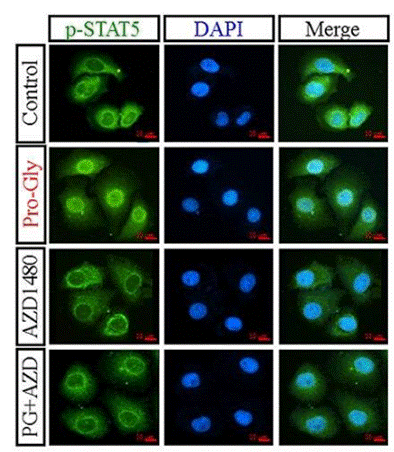
| Immunofluorescence | pSTAT5 |
|
30140255 |
| Growth inhibition assay | Cell proliferation Cell viability |
|
22027691 |
Informations sur lessai clinique
(données de https://clinicaltrials.gov, mis à jour le 2024-05-22)
| Numéro NCT | Recrutement | Conditions | Sponsor/Collaborateurs | Date de début | Phases |
|---|---|---|---|---|---|
| NCT01219543 | Terminated | Solid Tumour|Advanced Solid Malignancies|Child-Pugh A to B7 Advanced Hepatocellular Carcinoma|EGFR and/or ROS Mutant NSCLC|Lung Metastasis Carcinoma|Gastric Cancer |
AstraZeneca |
November 2010 | Phase 1 |
| NCT01112397 | Terminated | Solid Malignancies |
AstraZeneca |
April 2010 | Phase 1 |
Support technique
Tel: +1-832-582-8158 Ext:3
Si vous avez dautres questions, veuillez laisser un message.

Les produits sont destinés à la recherche uniquement. Non destinés à lusage humain. Nous ne vendons pas aux patients.
©Copyright 2013 Selleck Chemicals. Tous droits réservés.