
Dati tecnici
| Formula | C19H14Cl2N2O3S |
||||||||||||||
| Peso molecolare | 421.3 | Numero CAS | 879085-55-9 | ||||||||||||
| Solubilità (25°C)* | In vitro | DMSO | 84 mg/mL (199.38 mM) | ||||||||||||
| Water | Insoluble | ||||||||||||||
| Ethanol | Insoluble | ||||||||||||||
| In vivo (Aggiungere i solventi al prodotto singolarmente e in ordine.) |
|
||||||||||||||
|
* <1 mg/ml significa leggermente solubile o insolubile. * Si prega di notare che Selleck testa la solubilità di tutti i composti internamente e la solubilità effettiva può differire leggermente dai valori pubblicati. Ciò è normale ed è dovuto a leggere variazioni da lotto a lotto. * Spedizione a temperatura ambiente (I test di stabilità mostrano che questo prodotto può essere spedito senza alcuna misura di raffreddamento.) |
|||||||||||||||
Preparazione delle soluzioni stock
Attività biologica
| Descrizione | Vismodegib (GDC-0449) è un potente, nuovo e specifico inibitore di hedgehog con IC50 di 3 nM e inibisce anche la P-gp con IC50 di 3,0 μM in un saggio senza cellule. | ||
|---|---|---|---|
| Target |
|
||
| In vitro | Vismodegib (GDC-0449) ha come bersaglio la via di segnalazione Hedgehog, bloccando le attività dei recettori di superficie cellulare PTCH e/o SMO del ligando Hedgehog e sopprimendo la segnalazione Hedgehog. Questo composto previene numerosi trasportatori ABC (ATP-binding cassette) e blocca anche ABCG2, Pgp e MRP1, importanti trasportatori ABC associati alla MDR. È un potente inibitore dei trasportatori ABC, ABCG2/BCRP e ABCB1/Pgp, ed è un lieve inibitore di ABCC1/MRP1. Nelle cellule HEK293 che sovraesprimono ABCG2, aumenta la ritenzione del substrato fluorescente BODIPY di ABCG2 e resensibilizza queste cellule. Nelle cellule renali canine Madin-Darby II ingegnerizzate per sovraesprimere Pgp o MRP1, aumenta la ritenzione di calceina-AM e le resensibilizza. Resensibilizza anche le cellule di carcinoma polmonare non a piccole cellule umane NCI-H460/par e NCI-H460/MX20, che sovraesprimono ABCG2 in risposta a SN-38. I valori di IC50 per la prevenzione di ABCG2 e Pgp sono rispettivamente di circa 1,4 μM e 3,0 μM. Inoltre, altera l'omeostasi intracellulare del Ca2+ e inibisce la crescita cellulare nelle cellule di cancro al polmone resistenti. |
||
| In vivo | Vismodegib (GDC-0449) è stato utilizzato per trattare il medulloblastoma in modelli animali. Previene la crescita di xenotrapianti pancreatici primari senza inibire in modo non specifico la proliferazione delle cellule pancreatiche. La somministrazione orale di questo composto provoca regressioni tumorali nel modello di allotrapianto di medulloblastoma Ptch(+/-) a dosi ≥25 mg/kg e inibizione della crescita tumorale a dosi fino a 92 mg/kg somministrate due volte al giorno in due modelli di cancro colorettale ligando-dipendenti, D5123 e 1040830. L'analisi dell'attività della via Hh e la modellizzazione PK/PD rivelano che inibisce Gli1 con un IC50 simile sia nei modelli di medulloblastoma che di D5123 (rispettivamente 0,165 μM e 0,267 μM). La modulazione della via è collegata all'efficacia utilizzando un modello PK/PD integrato che rivela una relazione ripida in cui > 50% dell'attività di GDC-0449 è associata a > 80% di repressione della via Hh. |
Protocollo (da riferimento)
| Saggio cellulare: |
|
|---|---|
| Studio sugli animali: |
|
Riferimenti
|
Convalida del prodotto da parte del cliente
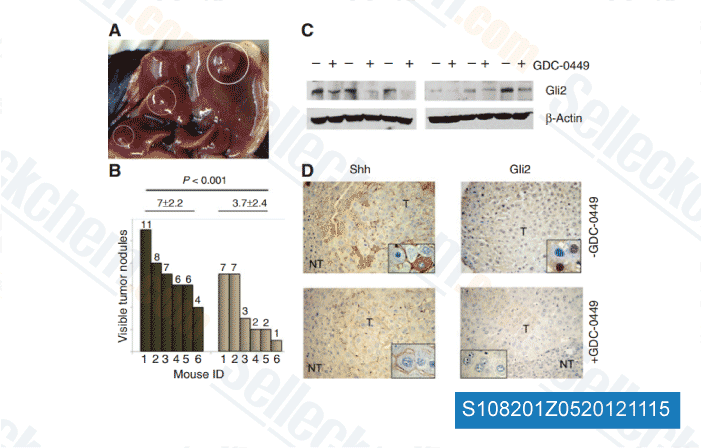
-
Dati da [ Cancer Res , 2014 , 72, 5912-20 ]
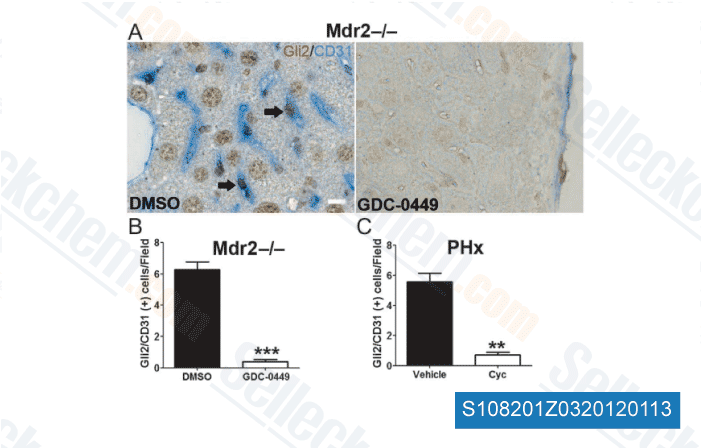
-
Dati da [ Gut , 2013 , 62, 299-309 ]
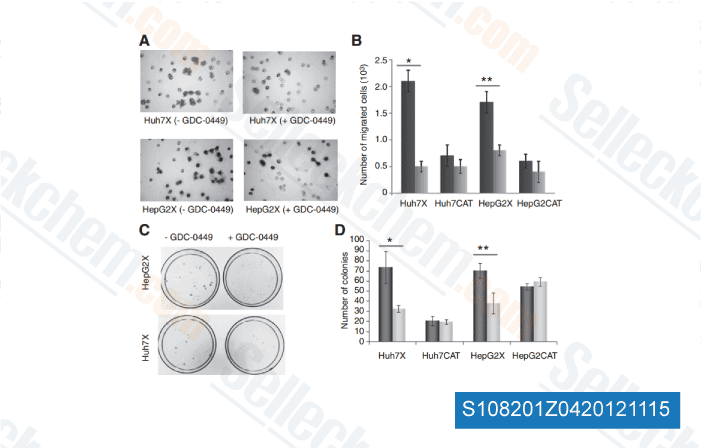
-
Dati da [ Cancer Res , 2013 , 72, 5912-20 ]
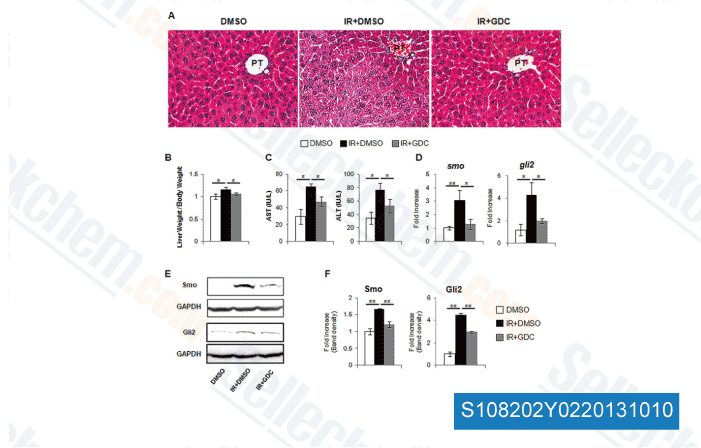
-
Dati da [ PLoS One , 2013 , 8, e74141 ]
Sellecks Vismodegib (GDC-0449) È stato citato da 225 Pubblicazioni
| Sonic hedgehog medulloblastomas are dependent on Netrin-1 for survival [ Nat Commun, 2025, 16(1):5137] | PubMed: 40461501 |
| OLIG2 mediates a rare targetable stem cell fate transition in sonic hedgehog medulloblastoma [ Nat Commun, 2025, 16(1):1092] | PubMed: 39904987 |
| The O-glycosyltransferase C1GALT1 promotes EWSR1::FLI1 expression and is a therapeutic target for Ewing sarcoma [ Nat Commun, 2025, 16(1):1267] | PubMed: 39894896 |
| BBS8-dependent ciliary Hedgehog signaling governs cell fate in the white adipose tissue [ EMBO J, 2025, 10.1038/s44318-025-00524-y] | PubMed: 40836034 |
| GPR137-RAB8A activation promotes ovarian cancer development via the Hedgehog pathway [ J Exp Clin Cancer Res, 2025, 44(1):22] | PubMed: 39856733 |
| BCL2 drives castration resistance in castration-sensitive prostate cancer by orchestrating reciprocal crosstalk between oncogenic pathways [ Cell Rep, 2025, 44(6):115779] | PubMed: 40448998 |
| The acetylation GLI1 affects arsenical-induced renal fibrosis by mediating the Hedgehog signalling pathway [ Ecotoxicol Environ Saf, 2025, 302:118676] | PubMed: 40669272 |
| Cranial base synostosis in mice caused by upregulation of Wnt following partial inhibition of Shh [ BMC Biol, 2025, 23(1):268] | PubMed: 40859304 |
| Spatially organized tumor-stroma boundary determines the efficacy of immunotherapy in colorectal cancer patients [ Nat Commun, 2024, 15(1):10259] | PubMed: 39592630 |
| Basal-to-inflammatory transition and tumor resistance via crosstalk with a pro-inflammatory stromal niche [ Nat Commun, 2024, 15(1):8134] | PubMed: 39289380 |
POLITICA DI RESO
La politica di reso incondizionato di Selleck Chemical garantisce ai nostri clienti unesperienza di acquisto online senza problemi. Se non sei in alcun modo soddisfatto del tuo acquisto, puoi restituire qualsiasi articolo entro 7 giorni dalla ricezione. In caso di problemi di qualità del prodotto, sia relativi al protocollo che al prodotto, puoi restituire qualsiasi articolo entro 365 giorni dalla data di acquisto originale. Si prega di seguire le istruzioni seguenti per la restituzione dei prodotti.
SPEDIZIONE E CONSERVAZIONE
I prodotti Selleck vengono trasportati a temperatura ambiente. Se ricevi il prodotto a temperatura ambiente, ti assicuriamo che il Dipartimento di Ispezione Qualità di Selleck ha condotto esperimenti per verificare che la conservazione a temperatura normale per un mese non influirà sullattività biologica dei prodotti in polvere. Dopo la raccolta, conservare il prodotto secondo le indicazioni descritte nella scheda tecnica. La maggior parte dei prodotti Selleck è stabile nelle condizioni raccomandate.
NON PER USO UMANO, DIAGNOSTICO VETERINARIO O TERAPEUTICO.