
Dati tecnici
| Formula | C23H18ClF2N3O3S |
||||||||||
| Peso molecolare | 489.92 | Numero CAS | 918504-65-1 | ||||||||
| Solubilità (25°C)* | In vitro | DMSO | 98 mg/mL (200.03 mM) | ||||||||
| Water | Insoluble | ||||||||||
| Ethanol | Insoluble | ||||||||||
| In vivo (Aggiungere i solventi al prodotto singolarmente e in ordine.) |
|
||||||||||
|
* <1 mg/ml significa leggermente solubile o insolubile. * Si prega di notare che Selleck testa la solubilità di tutti i composti internamente e la solubilità effettiva può differire leggermente dai valori pubblicati. Ciò è normale ed è dovuto a leggere variazioni da lotto a lotto. * Spedizione a temperatura ambiente (I test di stabilità mostrano che questo prodotto può essere spedito senza alcuna misura di raffreddamento.) |
|||||||||||
Preparazione delle soluzioni stock
Attività biologica
| Descrizione | Vemurafenib (PLX4032, RG7204, RO5185426) è un nuovo e potente inibitore di B-RafV600E con IC50 di 31 nM in saggio senza cellule. Selettivo 10 volte per B-RafV600E rispetto al B-Raf wild-type in saggi enzimatici e la selettività cellulare può superare le 100 volte. Vemurafenib (PLX4032, RG7204) induce l'Autophagy. | |||||||||||
|---|---|---|---|---|---|---|---|---|---|---|---|---|
| Target |
|
|||||||||||
| In vitro | Vemurafenib (PLX4032) inibisce B-RAFV600E, C-RAF, così come B-RAF wildtype, con IC50 di 31 nM, 48 nM e 100 nM, rispettivamente. Questo composto inibisce anche diverse chinasi non-RAF, tra cui ACK1, KHS1 e SRMS, con IC50 da 18 nM a 51 nM. Nelle linee cellulari di melanoma, l'effetto inibitorio dipende dallo stato mutazionale di B-RAF, poiché inibisce potentemente quelle che ospitano mutanti B-RAF V600, inclusi V600E, V600D, V600K e V600R, ma non il tipo wildtype o altri mutanti. I valori di IC50 su queste cellule, inclusi MALME-3M, Colo829, Colo38, A375, SK-MEL28 e A2058, vanno da 20 nM a 1 μM. In queste cellule, Vemurafenib (da 0,1 μM a 30 μM) inibisce anche la fosforilazione sia di MEK1/2 che di ERK1/2. È altamente efficace nel trattamento del melanoma, per la sua capacità di inibire B-RAFV600E. Tuttavia, questo composto mostra un effetto limitato nei pazienti con cancro del colon che portano anche l'oncoproteina B-RAFV600E. La ragione di ciò è che, nelle cellule di cancro del colon, l'inibizione di B-RAFV600E da parte di esso si traduce in una rapida attivazione di feedback dell'EGFR, che compensa la proliferazione cellulare inibita da PLX4032. | |||||||||||
| In vivo | In modelli di xenotrapianto di topi mutanti B-RAFV600E, Vemurafenib (PLX4032) (6 mg/kg–20 mg/kg) inibisce la crescita tumorale. In modelli di xenotrapianto di topi con cellule LOX, Colo829 e A375, questo composto (12,5 mg/kg–100 mg/kg) inibisce la crescita tumorale e prolunga la sopravvivenza dei topi. | |||||||||||
| Caratteristiche | Un nuovo e potente inibitore dell'oncoproteina B-RAFV600E. |
Protocollo (da riferimento)
| Saggio della chinasi: |
|
|---|---|
| Saggio cellulare: |
|
| Studio sugli animali: |
|
Riferimenti
|
Convalida del prodotto da parte del cliente
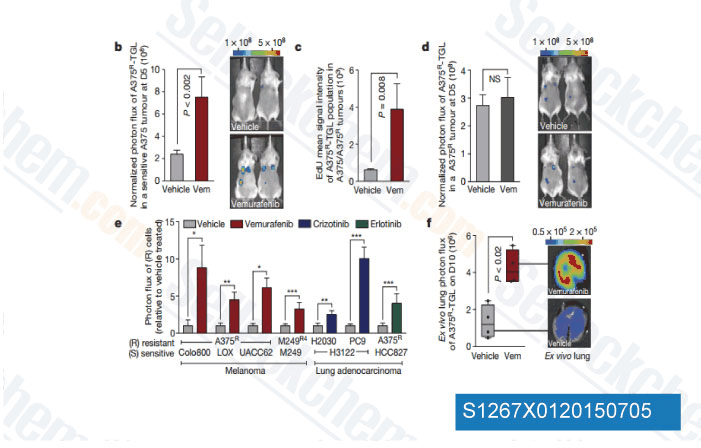
-
Dati da [ Nature , 2015 , 520(7547), 368-72 ]
![FRA1 downregulation during RAFi treatment drives the reactive secretome. c, Relative mRNA levels of FRA1 during vemurafenib exposure [0.1-1 uM]. d, Representative immunofluorescence staining of A375/A375R tumours for GFP (A375R, green) and FRA1 (red) after vehicle or vemurafenib treatment (5 days). DAPI, 49,6-diamidino-2-phenylindole. Scale bars, 50 um.](https://file.selleckchem.com/downloads/review/700px/Vemurafenib-S1267X0220150705.gif)
-
Dati da [ Nature , 2015 , 520(7547), 368-72 ]
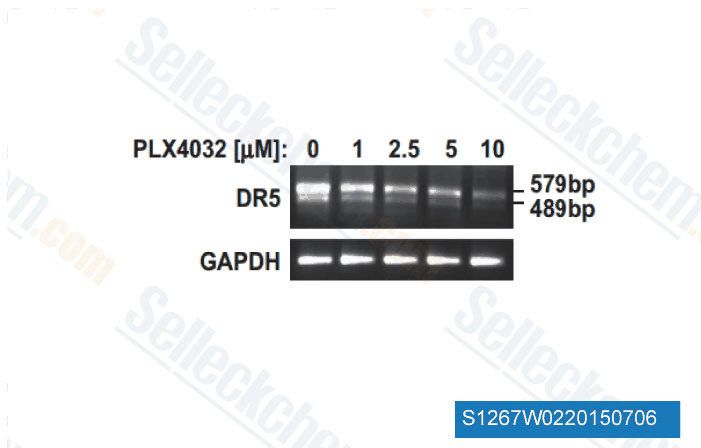
-
Dati da [ Oncogene , 2015 , 10.1038/onc.2015.97 ]
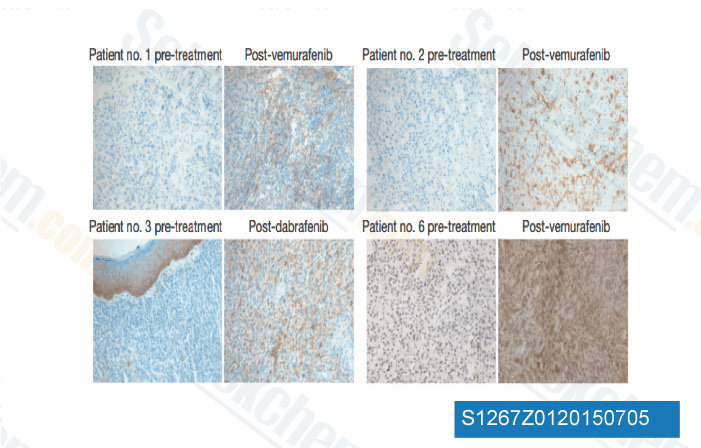
-
Dati da [ Nature , 2014 , 508(7494), 118-22 ]
Sellecks PLX4032 (Vemurafenib) È stato citato da 714 Pubblicazioni
| Pan-inhibition of super-enhancer-driven oncogenic transcription by next-generation synthetic ecteinascidins yields potent anti-cancer activity [ Nat Commun, 2025, 16(1):512] | PubMed: 39779693 |
| Blocking interplay between TERT and c-Myc: a new therapeutic strategy for BRAFV600E/pTERT double mutated tumors [ Int J Biol Sci, 2025, 21(11):4961-4978] | PubMed: 40860184 |
| Downregulated ALDH2 Contributes to Tumor Progression and Targeted Therapy Resistance in Human Metastatic Melanoma Cells [ Cells, 2025, 14(12)913] | PubMed: 40558540 |
| Inter-Relationship Between Melanoma Vemurafenib Tolerance Thresholds and Metabolic Pathway Choice [ Cells, 2025, 14(12)923] | PubMed: 40558548 |
| Exploiting Paradoxical Activation of Oncogenic MAPK Signaling by Targeting Mitochondria to Sensitize NRAS Mutant-Melanoma to Vemurafenib [ Int J Mol Sci, 2025, 26(6)2675] | PubMed: 40141318 |
| Acquired resistance to vemurafenib restrains thyroid cancer stem cell self-renewal by suppressing STAT3 activation [ Cell Signal, 2025, 133:111845] | PubMed: 40345509 |
| Dihydrotanshinone I enhanced BRAF mutant melanoma treatment efficacy by inhibiting the STAT3/SOX2 signaling pathway [ Front Oncol, 2025, 15:1429018] | PubMed: 39944829 |
| Suppression of Sebum Production by Vemurafenib Through Paradoxical ERK Activation Resulted in the Inhibition of the mTOR Pathway in 5α-Dihydrotestosterone-Differentiated Hamster Sebocytes In Vitro [ Exp Dermatol, 2025, 34(8):e70150] | PubMed: 40817681 |
| Selective inhibition of p300 by a novel small molecule EPS496 promotes cell death in vemurafenib-resistant BRAFV600E mutated melanoma cells [ Biochem Biophys Res Commun, 2025, 750:151382] | PubMed: 39884005 |
| Increased Mitochondrial Superoxide Level Is Partially Associated With Vemurafenib-Induced Renal Tubular Toxicity [ Basic Clin Pharmacol Toxicol, 2025, 136(4):e70015] | PubMed: 40018909 |
POLITICA DI RESO
La politica di reso incondizionato di Selleck Chemical garantisce ai nostri clienti unesperienza di acquisto online senza problemi. Se non sei in alcun modo soddisfatto del tuo acquisto, puoi restituire qualsiasi articolo entro 7 giorni dalla ricezione. In caso di problemi di qualità del prodotto, sia relativi al protocollo che al prodotto, puoi restituire qualsiasi articolo entro 365 giorni dalla data di acquisto originale. Si prega di seguire le istruzioni seguenti per la restituzione dei prodotti.
SPEDIZIONE E CONSERVAZIONE
I prodotti Selleck vengono trasportati a temperatura ambiente. Se ricevi il prodotto a temperatura ambiente, ti assicuriamo che il Dipartimento di Ispezione Qualità di Selleck ha condotto esperimenti per verificare che la conservazione a temperatura normale per un mese non influirà sullattività biologica dei prodotti in polvere. Dopo la raccolta, conservare il prodotto secondo le indicazioni descritte nella scheda tecnica. La maggior parte dei prodotti Selleck è stabile nelle condizioni raccomandate.
NON PER USO UMANO, DIAGNOSTICO VETERINARIO O TERAPEUTICO.