
Dati tecnici
| Formula | C21H22Cl2N4O2 |
||||||
| Peso molecolare | 433.33 | Numero CAS | 869886-67-9 | ||||
| Solubilità (25°C)* | In vitro | DMSO | 86 mg/mL (198.46 mM) | ||||
| Ethanol | 43 mg/mL (99.23 mM) | ||||||
| Water | Insoluble | ||||||
| In vivo (Aggiungere i solventi al prodotto singolarmente e in ordine.) |
|
||||||
|
* <1 mg/ml significa leggermente solubile o insolubile. * Si prega di notare che Selleck testa la solubilità di tutti i composti internamente e la solubilità effettiva può differire leggermente dai valori pubblicati. Ciò è normale ed è dovuto a leggere variazioni da lotto a lotto. * Spedizione a temperatura ambiente (I test di stabilità mostrano che questo prodotto può essere spedito senza alcuna misura di raffreddamento.) |
|||||||
Preparazione delle soluzioni stock
Attività biologica
| Descrizione | Ulixertinib (BVD-523, VRT752271) è un potente e reversibile inibitore di ERK1/ERK2 con un'IC50 di <0,3 nM per ERK2. Questo composto è in Fase 1. | ||||
|---|---|---|---|---|---|
| Target |
|
||||
| In vitro | In una linea cellulare di melanoma A375 contenente una mutazione b-RAFV600E, Ulixertinib (BVD-523) riduce i livelli di ERK2 fosforilato (pERK) e della fosforilazione della chinasi a valle RSK (pRSK) con IC50 di 4,1/0,14 μM, rispettivamente. Inibisce anche la proliferazione delle cellule A375 con IC50 di 180 nM. |
Protocollo (da riferimento)
| Saggio della chinasi:[1] |
|
|---|---|
| Saggio cellulare:[1] |
|
Riferimenti
|
Convalida del prodotto da parte del cliente
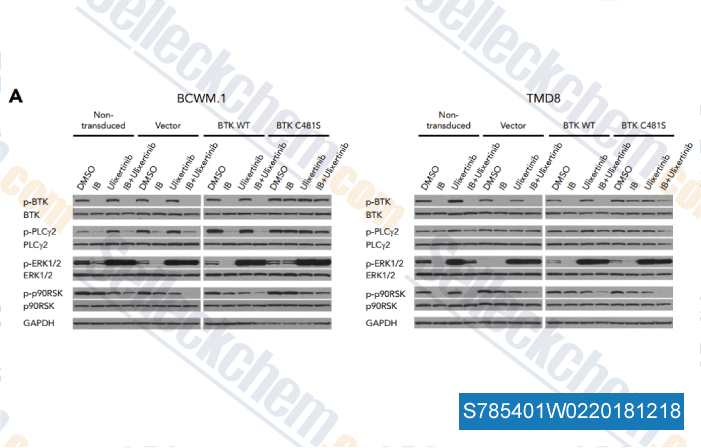
-
Dati da [ , , Blood, 2018, 131(18):2047-2059 ]

-
Dati da [ , , Haematologica, 2018, doi:10.3324/haematol.2018.196931 ]
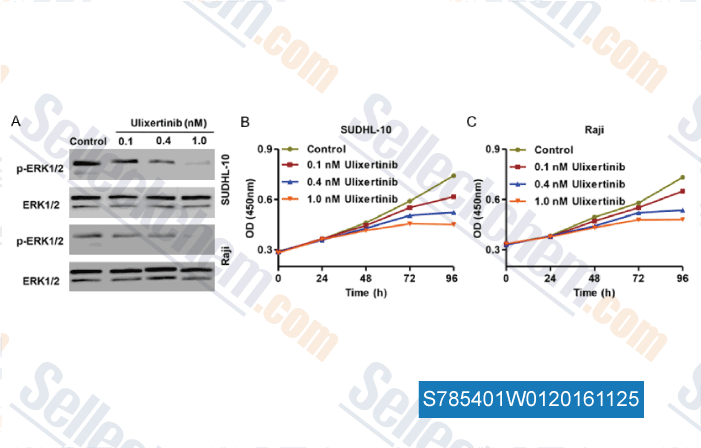
-
Dati da [ , , Int J Clin Exp Med, 2016, 9(6):10955-10962. ]
Sellecks Ulixertinib (BVD-523) È stato citato da 72 Pubblicazioni
| RAF-independent MEK mutations drive refractory histiocytic neoplasms but respond to ERK inhibition [ Cancer Cell, 2025, S1535-6108(25)00406-4] | PubMed: 41135521 |
| DUSP8 as a regulator of glioblastoma stem-like cell contribution to tumor vascularization [ J Exp Clin Cancer Res, 2025, 44(1):269] | PubMed: 41029387 |
| A bedside-to-bench translational analysis of NF1 alterations and CDK4/6 inhibitor resistance in hormone receptor-positive metastatic breast cancer [ EBioMedicine, 2025, 118:105828] | PubMed: 40578027 |
| Genes driving three-dimensional growth of immortalized cells and cancer [ Cell Death Dis, 2025, 16(1):442] | PubMed: 40494869 |
| PRDX1 knockdown promotes erastin-induced ferroptosis and impedes diffuse large B-cell lymphoma development by inhibiting the MAPK/ERK pathway [ BMC Cancer, 2025, 25(1):806] | PubMed: 40307771 |
| Independent and synergistic roles of MEK-ERK1/2 and PKC pathways in regulating functional changes in vascular tissue following flow cessation [ J Mol Cell Cardiol Plus, 2025, 12:100300] | PubMed: 40395439 |
| Multi-selective RAS(ON) Inhibition Targets Oncogenic RAS Mutations and Overcomes RAS/MAPK-Mediated Resistance to FLT3 and BCL2 Inhibitors in Acute Myeloid Leukemia [ bioRxiv, 2025, 2025.06.10.658786] | PubMed: 40661530 |
| Tumour-selective activity of RAS-GTP inhibition in pancreatic cancer [ Nature, 2024, 629(8013):927-936] | PubMed: 38588697 |
| EHMT2 promotes tumorigenesis in GNAQ/11-mutant uveal melanoma via ARHGAP29-mediated RhoA pathway [ Acta Pharm Sin B, 2024, 14(3):1187-1203] | PubMed: 38486999 |
| Inhibition of oxidative stress-induced epithelial-mesenchymal transition in retinal pigment epithelial cells of age-related macular degeneration model by suppressing ERK activation [ J Adv Res, 2024, 60:141-157] | PubMed: 37328058 |
POLITICA DI RESO
La politica di reso incondizionato di Selleck Chemical garantisce ai nostri clienti unesperienza di acquisto online senza problemi. Se non sei in alcun modo soddisfatto del tuo acquisto, puoi restituire qualsiasi articolo entro 7 giorni dalla ricezione. In caso di problemi di qualità del prodotto, sia relativi al protocollo che al prodotto, puoi restituire qualsiasi articolo entro 365 giorni dalla data di acquisto originale. Si prega di seguire le istruzioni seguenti per la restituzione dei prodotti.
SPEDIZIONE E CONSERVAZIONE
I prodotti Selleck vengono trasportati a temperatura ambiente. Se ricevi il prodotto a temperatura ambiente, ti assicuriamo che il Dipartimento di Ispezione Qualità di Selleck ha condotto esperimenti per verificare che la conservazione a temperatura normale per un mese non influirà sullattività biologica dei prodotti in polvere. Dopo la raccolta, conservare il prodotto secondo le indicazioni descritte nella scheda tecnica. La maggior parte dei prodotti Selleck è stabile nelle condizioni raccomandate.
NON PER USO UMANO, DIAGNOSTICO VETERINARIO O TERAPEUTICO.