
Dati tecnici
| Formula | C38H38N4O6 |
||||||
| Peso molecolare | 646.73 | Numero CAS | 206873-63-4 | ||||
| Solubilità (25°C)* | In vitro | DMSO | 8 mg/mL (12.36 mM) | ||||
| Water | Insoluble | ||||||
| Ethanol | Insoluble | ||||||
| In vivo (Aggiungere i solventi al prodotto singolarmente e in ordine.) |
|
||||||
|
* <1 mg/ml significa leggermente solubile o insolubile. * Si prega di notare che Selleck testa la solubilità di tutti i composti internamente e la solubilità effettiva può differire leggermente dai valori pubblicati. Ciò è normale ed è dovuto a leggere variazioni da lotto a lotto. * Spedizione a temperatura ambiente (I test di stabilità mostrano che questo prodotto può essere spedito senza alcuna misura di raffreddamento.) |
|||||||
Preparazione delle soluzioni stock
Attività biologica
| Descrizione | Tariquidar è un potente e selettivo inibitore non competitivo della P-glicoproteina con un Kd di 5,1 nM nella linea cellulare CHrB30, inverte la resistenza ai farmaci nelle linee cellulari MDR. Fase 3. | ||
|---|---|---|---|
| Target |
|
||
| In vitro | Tariquidar mostra un legame ad alta affinità con P-gp con un Bmax di 275 pmol/mg. Questo composto mostra un'interazione non competitiva con i substrati di P-gp. Aumenta l'accumulo allo stato stazionario di questi citotossici nelle cellule CHrB30 a livelli osservati nelle cellule AuxB1 non esprimenti P-gp con una EC50 di 487 nM. Questa sostanza chimica è in grado di inibire l'attività ATPasica vanadato-sensibile di P-gp del 60-70%, con potenti valori di IC50 di 43 nM. Può inibire altri meccanismi di resistenza a concentrazioni più elevate. 1 µM di questo composto abroga la resistenza mediata da ABCG2 (BCRP) alle camptotecine in vitro. Potenzia la citotossicità di diversi farmaci, inclusa la doxorubicina; il completo rovesciamento della resistenza è ottenuto in presenza di 25-80 nM di questa sostanza chimica. In MC26, una linea cellulare di carcinoma del colon murino con chemioresistenza intrinseca, l'IC50 della doxorubicina è cinque volte inferiore in presenza di 0,1 µM di questo composto (36 vs 7 nM). In linee cellulari di carcinoma mammario murino, carcinoma polmonare a piccole cellule umano e carcinoma ovarico umano con resistenza chemioterapica acquisita (EMT6/AR1.0, H69/LX4 e 2780 AD), l'IC50 della doxorubicina in vitro è 22-150 volte inferiore in presenza di 0,1 µM di questa sostanza chimica. L'inibizione di P-gp persiste per 23 ore dopo la sua rimozione dal sistema di coltura. Ha ripristinato la citotossicità della doxorubicina nel modello di sferoide tumorale multicellulare NCI/ADRRES (National Cancer Institute) derivato dalla linea cellulare di cancro al seno MCF7WT. |
||
| In vivo | Tariquidar (2-8 mg/kg p.o.) si è dimostrato in grado di potenziare significativamente l'attività antitumorale della doxorubicina (5 mg/kg, i.v.) contro il carcinoma del colon murino MC26 in vivo. Negli xenotrapianti di carcinoma umano, la co-somministrazione di questo composto (6-12 mg/kg p.o.) ha completamente ripristinato l'attività antitumorale contro due xenotrapianti tumorali umani MDR altamente resistenti (2780AD, H69/LX4) in topi nudi. |
Protocollo (da riferimento)
| Saggio della chinasi: |
|
|---|---|
| Saggio cellulare: |
|
| Studio sugli animali: |
|
Riferimenti
|
Convalida del prodotto da parte del cliente
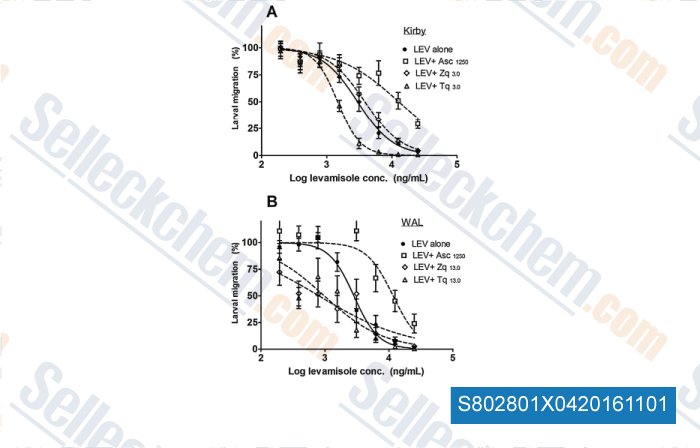
-
, , Vet Parasitol, 2015, 211(1-2):80-8.
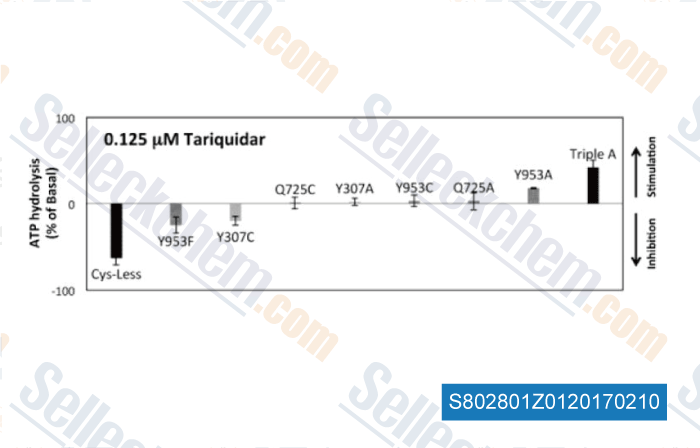
-
Dati da [ , , Biochem Pharmacol, 2016, 101:40-53. ]
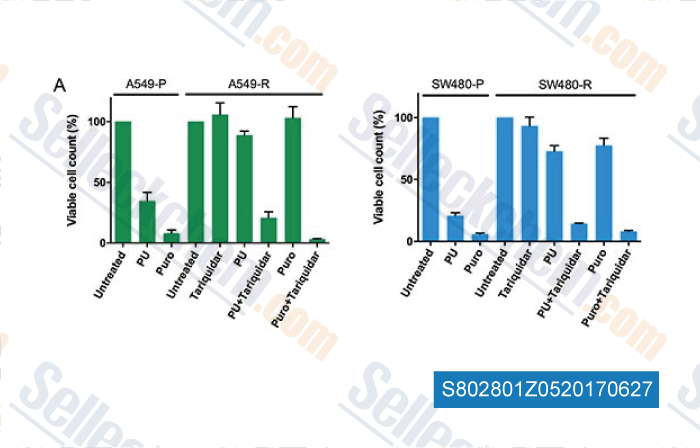
-
Dati da [ , , Oncotarget, 2017, 8(5):7678-7690 ]
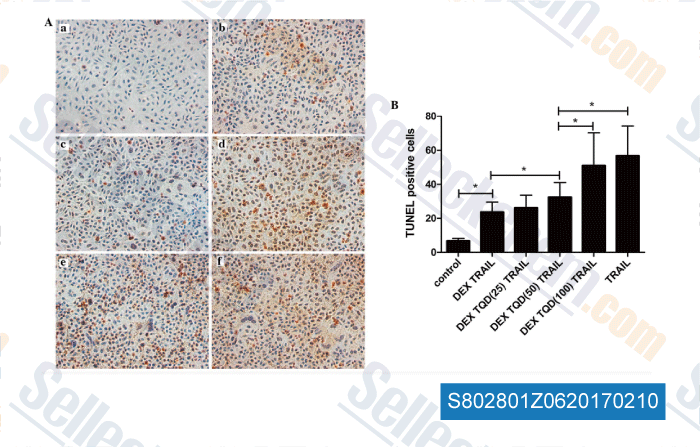
-
Dati da [ , , Mol Med Rep, 2015, 12(6):8093-100. ]
Sellecks Tariquidar (XR9576) È stato citato da 55 Pubblicazioni
| Identification of the Notch ligand DLK1 as an immunotherapeutic target and regulator of tumor cell plasticity and chemoresistance in adrenocortical carcinoma [ Nat Commun, 2025, 16(1):5511] | PubMed: 40595495 |
| Mitochondrial dysfunction fuels drug resistance in adult T-cell acute lymphoblastic leukemia [ J Transl Med, 2025, 23(1):542] | PubMed: 40369632 |
| Fibroblasts Attenuate Anti-Tumor Drug Efficacy in Tumor Cells via Paracrine Interactions with Tumor Cells in 3D Plexiform Neurofibroma Cultures [ Cells, 2025, 14(16)1276] | PubMed: 40862755 |
| Low-Dose Perifosine, a Phase II Phospholipid Akt Inhibitor, Selectively Sensitizes Drug-Resistant ABCB1-Overexpressing Cancer Cells [ Biomol Ther (Seoul), 2025, 33(1):170-181] | PubMed: 39632683 |
| Tumor-acquired somatic mutation affects conformation to abolish ABCG2-mediated drug resistance [ Drug Resist Updat, 2024, 73:101066] | PubMed: 38387283 |
| Enhanced anticancer effect of thymidylate synthase dimer disrupters by promoting intracellular accumulation [ Front Pharmacol, 2024, 15:1477318] | PubMed: 39611169 |
| Zosuquidar: An Effective Molecule for Intracellular Ca2+ Measurement in P-gp Positive Cells [ Int J Mol Sci, 2024, 25(6)3107] | PubMed: 38542082 |
| Cellular uptake of CPX-351 by scavenger receptor class B type 1-mediated nonendocytic pathway [ Exp Hematol, 2024, S0301-472X(24)00516-2] | PubMed: 39362576 |
| Ivermectin Enhances Paclitaxel Efficacy by Overcoming Resistance Through Modulation of ABCB1 in Non-small Cell Lung Cancer [ Anticancer Res, 2024, 44(12):5271-5282] | PubMed: 39626921 |
| The net electrostatic potential and hydration of ABCG2 affect substrate transport [ Nat Commun, 2023, 14(1):5035] | PubMed: 37596258 |
POLITICA DI RESO
La politica di reso incondizionato di Selleck Chemical garantisce ai nostri clienti unesperienza di acquisto online senza problemi. Se non sei in alcun modo soddisfatto del tuo acquisto, puoi restituire qualsiasi articolo entro 7 giorni dalla ricezione. In caso di problemi di qualità del prodotto, sia relativi al protocollo che al prodotto, puoi restituire qualsiasi articolo entro 365 giorni dalla data di acquisto originale. Si prega di seguire le istruzioni seguenti per la restituzione dei prodotti.
SPEDIZIONE E CONSERVAZIONE
I prodotti Selleck vengono trasportati a temperatura ambiente. Se ricevi il prodotto a temperatura ambiente, ti assicuriamo che il Dipartimento di Ispezione Qualità di Selleck ha condotto esperimenti per verificare che la conservazione a temperatura normale per un mese non influirà sullattività biologica dei prodotti in polvere. Dopo la raccolta, conservare il prodotto secondo le indicazioni descritte nella scheda tecnica. La maggior parte dei prodotti Selleck è stabile nelle condizioni raccomandate.
NON PER USO UMANO, DIAGNOSTICO VETERINARIO O TERAPEUTICO.