
Dati tecnici
| Formula | C22H20N2O5 |
||||||
| Peso molecolare | 392.4 | Numero CAS | 86639-52-3 | ||||
| Solubilità (25°C)* | In vitro | DMSO | 50 mg/mL (127.42 mM) | ||||
| Water | Insoluble | ||||||
| Ethanol | Insoluble | ||||||
| In vivo (Aggiungere i solventi al prodotto singolarmente e in ordine.) |
|
||||||
|
* <1 mg/ml significa leggermente solubile o insolubile. * Si prega di notare che Selleck testa la solubilità di tutti i composti internamente e la solubilità effettiva può differire leggermente dai valori pubblicati. Ciò è normale ed è dovuto a leggere variazioni da lotto a lotto. * Spedizione a temperatura ambiente (I test di stabilità mostrano che questo prodotto può essere spedito senza alcuna misura di raffreddamento.) |
|||||||
Preparazione delle soluzioni stock
Attività biologica
| Descrizione | SN-38 (NK012) è un metabolita attivo di CPT-11, inibisce la DNA topoisomerase I, la sintesi del DNA e causa frequenti rotture a singolo filamento del DNA. SN-38 induce l'autophagy. | |
|---|---|---|
| Target |
|
|
| In vitro | SN-38, un metabolita biologicamente attivo di CPT-11. Questo composto causa la più forte inibizione della DNA topoisomerase I, seguita da CPT e poi CPT-11. CPT-11 sposta la posizione del DNA rilassato in modo dose-dipendente nella direzione del DNA intaccato, ma questo composto e CPT non mostrano alcun effetto sulla posizione del DNA rilassato. Inibisce la sintesi del DNA in modo dose-dipendente e tempo-dipendente. I rispettivi valori di IC50 di questa sostanza chimica, nella sintesi del DNA, sono 0,077 μM. L'effetto inibitorio sulla sintesi dell'RNA è inferiore a quello sulla sintesi del DNA e non inibisce la sintesi proteica. Questo metabolita ha causato frequenti rotture a singolo filamento del DNA nelle cellule P388. |
|
| In vivo | Dopo somministrazione orale, le concentrazioni massime di questo composto si verificano entro 1 ora, e la percentuale di lattone non legato nel plasma murino a 1000 ng/mL è del 3,4 +/- 0,67%, mentre a 100 ng/mL la percentuale non legata è dell'1,18 +/- 0,14%. Le AUC del lattone in topi portatori di xenotrapianti di neuroblastoma umano sono maggiori rispetto agli animali non portatori di tumore. |
Protocollo (da riferimento)
| Saggio della chinasi: |
|
|---|---|
| Saggio cellulare: |
|
| Studio sugli animali: |
|
Riferimenti
|
Convalida del prodotto da parte del cliente
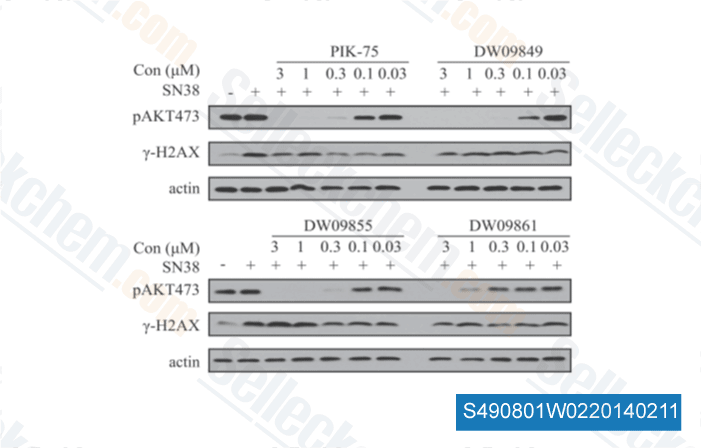
-
Dati da [ J Pharmacol Exp Ther , 2014 , 348(3), 432-41 ]
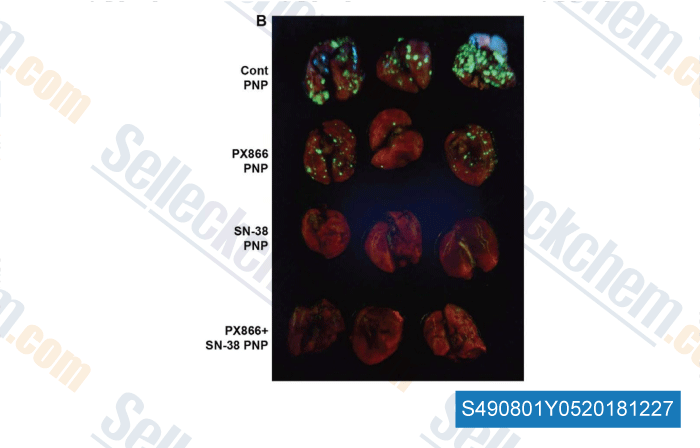
-
Dati da [ , , J Control Release, 2018, 275:85-91 ]
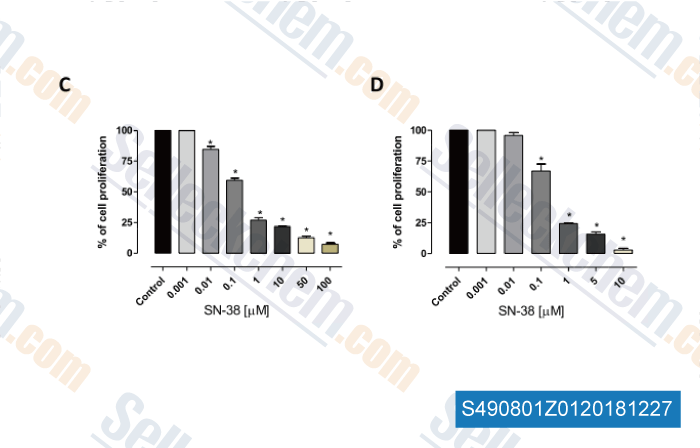
-
Dati da [ , , Cancer Lett, 2017, 411:35-43 ]
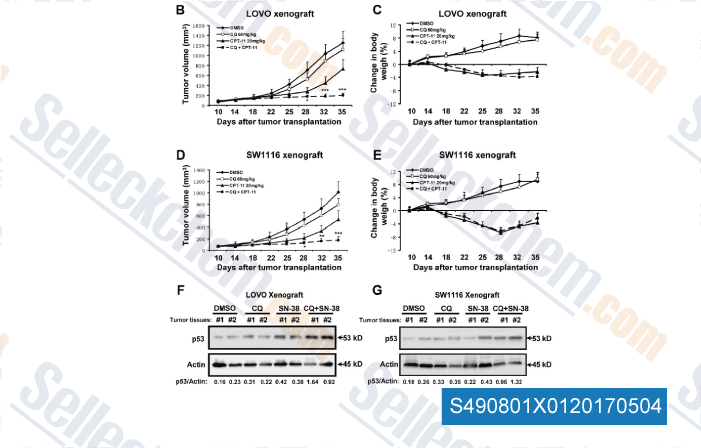
-
Dati da [ , , Free Radic Biol Med, 2017, 104:280-297 ]
Sellecks SN-38 È stato citato da 100 Pubblicazioni
| Activation of lysosomal iron triggers ferroptosis in cancer [ Nature, 2025, 10.1038/s41586-025-08974-4] | PubMed: 40335696 |
| Cisplatin and temozolomide combinatorial treatment triggers hypermutability and immune surveillance in experimental cancer models [ Cancer Cell, 2025, S1535-6108(25)00223-5] | PubMed: 40513578 |
| KEAP1 and STK11/LKB1 alterations enhance vulnerability to ATR inhibition in KRAS mutant non-small cell lung cancer [ Cancer Cell, 2025, 43(8):1530-1548.e9] | PubMed: 40645185 |
| The molecular and functional landscape of resistance to FOLFIRI chemotherapy in metastatic colorectal cancer [ Cancer Discov, 2025, 10.1158/2159-8290.CD-24-0556] | PubMed: 40981426 |
| A patient-derived T cell lymphoma biorepository uncovers pathogenetic mechanisms and host-related therapeutic vulnerabilities [ Cell Rep Med, 2025, S2666-3791(25)00102-8] | PubMed: 40147445 |
| AREG and EREG Are Predictive Biomarkers of Response to EGFR Inhibition in Gastroesophageal Cancer [ Cancer Res, 2025, 85(16):3111-3122] | PubMed: 40637454 |
| Synthesis of carbon dots from spent coffee grounds: transforming waste into potential biomedical tools [ Nanoscale, 2025, 17(16):9947-9962] | PubMed: 40067158 |
| Targeted Inhibition of CHD1L by OTI-611 Reprograms Chemotherapy and Targeted Therapy-Induced Cell Cycle Arrest and Suppresses Proliferation to Produce Synergistic Antitumor Effects in Breast and Colorectal Cancer [ Cells, 2025, 14(5)318] | PubMed: 40072047 |
| ATR Inhibition Synergizes With Alkylating PI Polyamide Targeting MYCN by Suppressing DNA Repair in MYCN-Amplified Neuroblastoma [ Cancer Sci, 2025, 10.1111/cas.70043] | PubMed: 40052411 |
| PD-L1-Targeting Nanoparticles for the Treatment of Triple-Negative Breast Cancer: A Preclinical Model [ Int J Mol Sci, 2025, 26(7)3295] | PubMed: 40244130 |
POLITICA DI RESO
La politica di reso incondizionato di Selleck Chemical garantisce ai nostri clienti unesperienza di acquisto online senza problemi. Se non sei in alcun modo soddisfatto del tuo acquisto, puoi restituire qualsiasi articolo entro 7 giorni dalla ricezione. In caso di problemi di qualità del prodotto, sia relativi al protocollo che al prodotto, puoi restituire qualsiasi articolo entro 365 giorni dalla data di acquisto originale. Si prega di seguire le istruzioni seguenti per la restituzione dei prodotti.
SPEDIZIONE E CONSERVAZIONE
I prodotti Selleck vengono trasportati a temperatura ambiente. Se ricevi il prodotto a temperatura ambiente, ti assicuriamo che il Dipartimento di Ispezione Qualità di Selleck ha condotto esperimenti per verificare che la conservazione a temperatura normale per un mese non influirà sullattività biologica dei prodotti in polvere. Dopo la raccolta, conservare il prodotto secondo le indicazioni descritte nella scheda tecnica. La maggior parte dei prodotti Selleck è stabile nelle condizioni raccomandate.
NON PER USO UMANO, DIAGNOSTICO VETERINARIO O TERAPEUTICO.