
Dati tecnici
| Formula | C22H16N4O3 |
||||||||||||||
| Peso molecolare | 384.39 | Numero CAS | 301836-41-9 | ||||||||||||
| Solubilità (25°C)* | In vitro | DMSO (riscaldato con bagno dacqua a 50 ºC) | 13 mg/mL (33.81 mM) | ||||||||||||
| Ethanol | 3 mg/mL (7.8 mM) | ||||||||||||||
| Water | Insoluble | ||||||||||||||
| In vivo (Aggiungere i solventi al prodotto singolarmente e in ordine.) |
|
||||||||||||||
|
* <1 mg/ml significa leggermente solubile o insolubile. * Si prega di notare che Selleck testa la solubilità di tutti i composti internamente e la solubilità effettiva può differire leggermente dai valori pubblicati. Ciò è normale ed è dovuto a leggere variazioni da lotto a lotto. * Spedizione a temperatura ambiente (I test di stabilità mostrano che questo prodotto può essere spedito senza alcuna misura di raffreddamento.) |
|||||||||||||||
Preparazione delle soluzioni stock
Attività biologica
| Descrizione | SB431542 è un inibitore potente e selettivo di ALK5 con IC50 di 94 nM in un saggio senza cellule, 100 volte più selettivo per ALK5 rispetto a p38 MAPK e altre chinasi. | ||||||
|---|---|---|---|---|---|---|---|
| Target |
|
||||||
| In vitro | SB 431542 inibisce il recettore di tipo I dell'attivina ALK4 e il recettore di tipo I nodale ALK7, che sono responsabili della fosforilazione di Smad2. SB 431542 ha scarso effetto su ALK1, ALK2, ALK3 e ALK6, che mostrano fosforilazione di Smad1. SB 431542 è un inibitore selettivo dell'attivina endogena ma non ha effetti apparenti sulla segnalazione BMP. SB 431542 potrebbe indurre la trascrizione dipendente da Smad2/Smad4 e Smad3/Smad4. Nelle cellule A498, SB 431542 inibisce sia il collagene Iα1 che l'mRNA PAI-1 indotti da TGF-β1 con IC50 rispettivamente di 60 nM e 50 nM. Inoltre, SB 431542 inibisce la produzione di mRNA e proteine di fibronectina indotti da TGF-β1 con IC50 rispettivamente di 62 nM e 22 nM. SB 431542 blocca i fattori di crescita mediati da TGF-β, inclusi PDGF-A, FGF-2 e HB-EGF, portando a un aumento della proliferazione delle cellule MG63. SB 431542 inibisce anche c-Myc e p21 WAF1/CIP1 indotti da TGF-β. SB 431542 sopprime significativamente l'arresto in G1 indotto da TGF-β, portando all'accumulo di cellule nella fase S del ciclo cellulare nelle cellule FET, RIE e Mv1Lu. SB 431542 inibisce anche la transizione epiteliale-mesenchimale (EMT) indotta da TGF-β nelle cellule NMuMG e PANC-1. SB 431542 eleva significativamente l'espressione di CD86 nelle BM-DC e quella di CD83 all'interno delle cellule CD11c+ soppresse da TGF-β. SB 431542 è in grado di indurre l'attività NK attraverso la maturazione funzionale e la produzione di IL-12 delle DC umane. | ||||||
| In vivo | SB 431542 innesca attività dei linfociti T citotossici (CTL) nei modelli di carcinoma del colon-26 ed è molto probabile che produca esiti immunologici antitumorali attraverso l'alterazione della funzione delle DC soppressa da TGF-β. |
Protocollo (da riferimento)
| Saggio della chinasi: [1] |
|
|---|---|
| Saggio cellulare:[4] |
|
| Studio sugli animali:[6] |
|
Riferimenti
|
Convalida del prodotto da parte del cliente
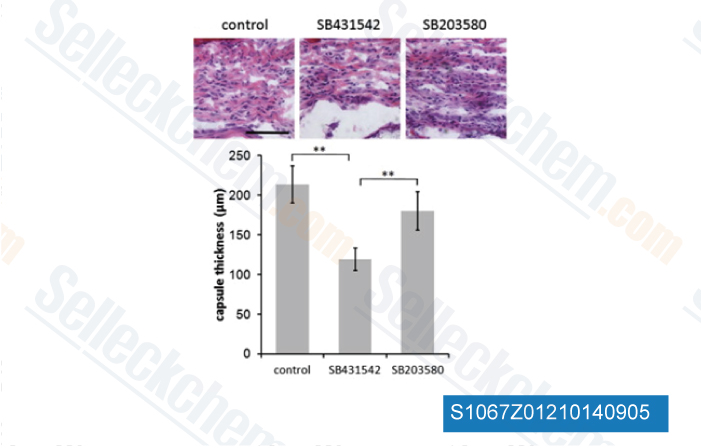
-
Dati da [ Acta Biomater , 2014 , 10(7):3108-16 ]
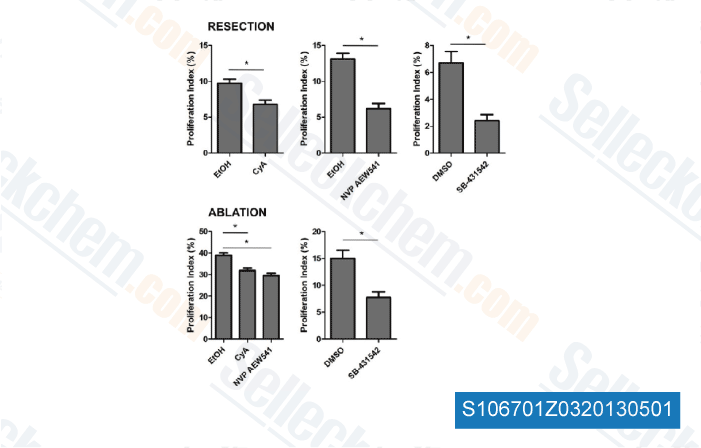
-
Dati da [ Development , 2013 , 140, 660-666 ]
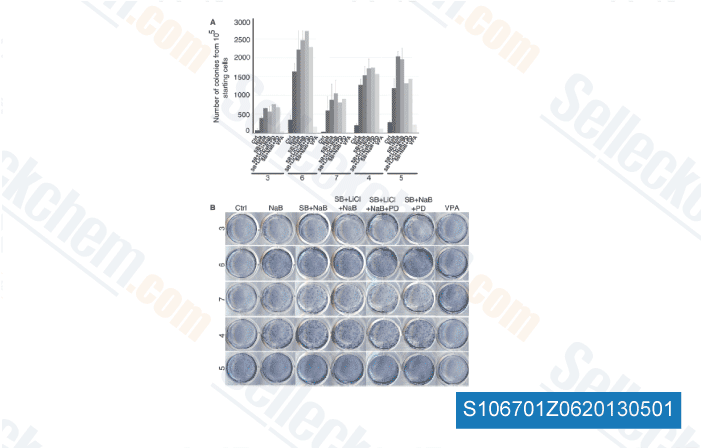
-
Dati da [ Stem Cells Dev , 2013 ]
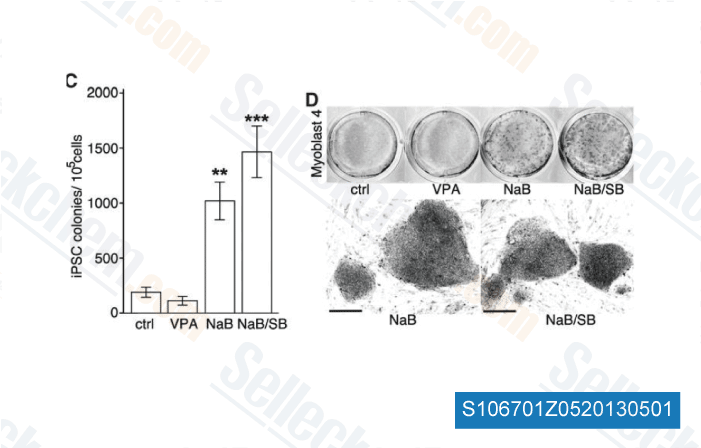
-
Dati da [ Stem Cells Dev , 2013 ]
Sellecks SB431542 È stato citato da 825 Pubblicazioni
| Derivation of embryonic stem cells across avian species [ Nat Biotechnol, 2025, 10.1038/s41587-025-02833-3] | PubMed: 41028831 |
| High fructose consumption aggravates inflammation by promoting effector T cell generation via inducing metabolic reprogramming [ Signal Transduct Target Ther, 2025, 10(1):271] | PubMed: 40854873 |
| Targeting lysozyme 2 in endocardium promotes rapid recovery by modulating remote injury signals [ Cell Stem Cell, 2025, S1934-5909(25)00330-3] | PubMed: 40967223 |
| Sox9 inhibits Activin A to promote biliary maturation and branching morphogenesis [ Nat Commun, 2025, 16(1):1667] | PubMed: 39955269 |
| System- and sample-agnostic isotropic three-dimensional microscopy by weakly physics-informed, domain-shift-resistant axial deblurring [ Nat Commun, 2025, 16(1):745] | PubMed: 39821085 |
| Acute regulation of murine adipose tissue lipolysis and insulin resistance by the TGFβ superfamily protein GDF3 [ Nat Commun, 2025, 16(1):4432] | PubMed: 40360531 |
| Medium from human iPSC-derived primitive macrophages promotes adult cardiomyocyte proliferation and cardiac regeneration [ Nat Commun, 2025, 16(1):3012] | PubMed: 40148355 |
| Highly efficient construction of monkey blastoid capsules from aged somatic cells [ Nat Commun, 2025, 16(1):1130] | PubMed: 39875393 |
| Control of Golgi- V-ATPase through Sac1-dependent co-regulation of PI(4)P and cholesterol [ Nat Commun, 2025, 16(1):7808] | PubMed: 40841558 |
| Heparan sulfate regulates myofibroblast heterogeneity and function to mediate niche homeostasis during alveolar morphogenesis [ Nat Commun, 2025, 16(1):1834] | PubMed: 39979343 |
POLITICA DI RESO
La politica di reso incondizionato di Selleck Chemical garantisce ai nostri clienti unesperienza di acquisto online senza problemi. Se non sei in alcun modo soddisfatto del tuo acquisto, puoi restituire qualsiasi articolo entro 7 giorni dalla ricezione. In caso di problemi di qualità del prodotto, sia relativi al protocollo che al prodotto, puoi restituire qualsiasi articolo entro 365 giorni dalla data di acquisto originale. Si prega di seguire le istruzioni seguenti per la restituzione dei prodotti.
SPEDIZIONE E CONSERVAZIONE
I prodotti Selleck vengono trasportati a temperatura ambiente. Se ricevi il prodotto a temperatura ambiente, ti assicuriamo che il Dipartimento di Ispezione Qualità di Selleck ha condotto esperimenti per verificare che la conservazione a temperatura normale per un mese non influirà sullattività biologica dei prodotti in polvere. Dopo la raccolta, conservare il prodotto secondo le indicazioni descritte nella scheda tecnica. La maggior parte dei prodotti Selleck è stabile nelle condizioni raccomandate.
NON PER USO UMANO, DIAGNOSTICO VETERINARIO O TERAPEUTICO.