
Dati tecnici
| Formula | C18H22N4O4 |
||||||||||
| Peso molecolare | 358.39 | Numero CAS | 1433953-83-3 | ||||||||
| Solubilità (25°C)* | In vitro | DMSO | 72 mg/mL (200.89 mM) | ||||||||
| Water | Insoluble | ||||||||||
| Ethanol | Insoluble | ||||||||||
| In vivo (Aggiungere i solventi al prodotto singolarmente e in ordine.) |
|
||||||||||
|
* <1 mg/ml significa leggermente solubile o insolubile. * Si prega di notare che Selleck testa la solubilità di tutti i composti internamente e la solubilità effettiva può differire leggermente dai valori pubblicati. Ciò è normale ed è dovuto a leggere variazioni da lotto a lotto. * Spedizione a temperatura ambiente (I test di stabilità mostrano che questo prodotto può essere spedito senza alcuna misura di raffreddamento.) |
|||||||||||
Preparazione delle soluzioni stock
Attività biologica
| Descrizione | SAR131675 è un inibitore di VEGFR3 con IC50/Ki di 23 nM/12 nM in saggi acellulari, circa 50 e 10 volte più selettivo per VEGFR3 rispetto a VEGFR1/2, con scarsa attività contro Akt1, CDK, PLK1, EGFR, IGF-1R, c-Met, Flt2 ecc. | ||
|---|---|---|---|
| Target |
|
||
| In vitro | SAR131675 inibisce in modo dose-dipendente la proliferazione delle cellule linfatiche umane primarie, indotta dai ligandi di VEGFR-3 VEGFC e VEGFD, con una IC50 di circa 20 nM. Questo composto inibisce in modo dose-dipendente l'attività di rh-VEGFR-3–TK con una IC50 di 23 nM. Inibisce l'attività di VEGR-3–TK con un Ki di circa 12 nM. Inibisce l'attività di VEGFR-1–TK con una IC50 di > 3 μM e l'attività di VEGFR-2–TK con una IC50 di 235 nM. Inibisce l'autofosforilazione di VEGFR-1 con una IC50 di circa 1 μM e quella di VEGFR-2 con una IC50 di circa 280 nM. Inibisce moderatamente VEGFR-2 e ha un effetto molto scarso su VEGFR-1, mostrando una buona selettività per VEGFR-3. Inibisce la fosforilazione di VEGFR-2 indotta da VEGFA in modo dose-dipendente, con una IC50 di 239 nM. Inibisce potentemente la sopravvivenza delle cellule linfatiche indotta da VEGFC e VEGFD con IC50 di 14 nM e 17 nM, rispettivamente. Inibisce la sopravvivenza indotta da VEGFA con una IC50 di 664 nM. Inibisce significativamente e dose-dipendente la fosforilazione di Erk indotta da VEGFC, con una IC50 di circa 30 nM. |
||
| In vivo | Nell'angiogenesi embrionale utilizzando il modello del pesce zebra, SAR131675 compromette efficacemente la vasculogenesi embrionale. Questo composto a 100 mg/kg/die ha ridotto significativamente i livelli di VEGFR-3 e il contenuto di emoglobina di circa il 50%. Abroga efficacemente la linfangiogenesi e l'angiogenesi indotte in vivo da FGF2. Questa sostanza chimica a una dose di 300 mg/kg è in grado di inibire la segnalazione sia di VEGFR-2 che di VEGFR-3. Nello studio di prevenzione, il trattamento di 5 settimane con questo composto è ben tollerato e il numero di isole angiogeniche nel pancreas di topi trattati con SAR131675 è significativamente diminuito del 42%, rispetto al gruppo trattato con veicolo. Nello studio di intervento, la somministrazione orale giornaliera di questa sostanza chimica dalla settimana 10 alla settimana 12,5 provoca una significativa diminuzione del carico tumorale del 62%. Il trattamento con esso riduce significativamente il volume del tumore del 24% e del 50% a 30 mg/kg/die e 100 mg/kg/die, rispettivamente. |
||
| Caratteristiche | Un potente e selettivo inibitore della tirosina chinasi di VEGFR-3. |
Protocollo (da riferimento)
| Saggio della chinasi: |
|
|---|---|
| Saggio cellulare: |
|
| Studio sugli animali: |
|
Riferimenti
|
Convalida del prodotto da parte del cliente

-
, , Neuroscience, 2015, 290C:90-102.
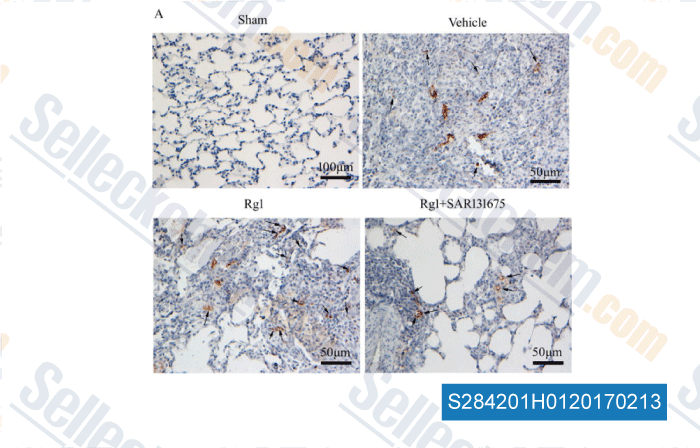
-
Dati da [ , , Clin Exp Metastasis, 2015, 32(8):789-98 ]
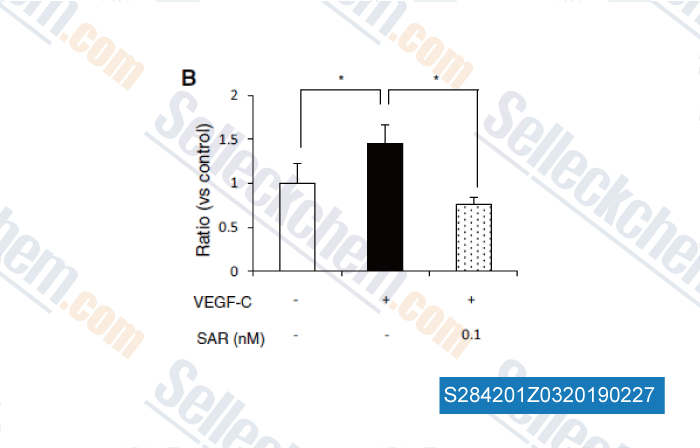
-
Dati da [ , , Biochem Biophys Res Commun, 2016, 472(1):182-8. ]
Sellecks SAR131675 È stato citato da 34 Pubblicazioni
| Inhibition of VEGFR-3 by SAR131675 decreases renal inflammation and lymphangiogenesis in the murine lupus nephritis model [ Cell Death Discov, 2025, 11(1):320] | PubMed: 40651955 |
| VEGFR-3 deficiency in astrocytes exacerbates Japanese encephalitis virus-induced neuroinflammation in mouse brains [ Zool Res, 2025, 46(6):1317-1325] | PubMed: 41224673 |
| Vegfr3 activation of Pkd2l1+ CSF-cNs triggers the neural stem cell response in spinal cord injury [ Cell Signal, 2025, 130:111675] | PubMed: 39986360 |
| Compensatory lymphangiogenesis is required for edema resolution in zebrafish [ Sci Rep, 2025, 15(1):8177] | PubMed: 40065081 |
| Piezo1 regulates meningeal lymphatic vessel drainage and alleviates excessive CSF accumulation [ Nat Neurosci, 2024, 10.1038/s41593-024-01604-8] | PubMed: 38528202 |
| Fibroblasts facilitate lymphatic vessel formation in transplanted heart [ Theranostics, 2024, 14(5):1886-1908] | PubMed: 38505621 |
| VEGFD signaling balances stability and activity-dependent structural plasticity of dendrites [ Cell Mol Life Sci, 2024, 81(1):354] | PubMed: 39158743 |
| Lack of RAMP1 Signaling Suppresses Liver Regeneration and Angiogenesis Following Partial Hepatectomy in Mice [ In Vivo, 2024, 38(5):2261-2270] | PubMed: 39187322 |
| VEGFR-3 signaling restrains the neuron-macrophage crosstalk during neurotropic viral infection [ Cell Rep, 2023, 42(5):112489] | PubMed: 37167063 |
| Rotator cuff healing is regulated by the lymphatic vasculature [ J Orthop Translat, 2023, 38:65-75] | PubMed: 36313978 |
POLITICA DI RESO
La politica di reso incondizionato di Selleck Chemical garantisce ai nostri clienti unesperienza di acquisto online senza problemi. Se non sei in alcun modo soddisfatto del tuo acquisto, puoi restituire qualsiasi articolo entro 7 giorni dalla ricezione. In caso di problemi di qualità del prodotto, sia relativi al protocollo che al prodotto, puoi restituire qualsiasi articolo entro 365 giorni dalla data di acquisto originale. Si prega di seguire le istruzioni seguenti per la restituzione dei prodotti.
SPEDIZIONE E CONSERVAZIONE
I prodotti Selleck vengono trasportati a temperatura ambiente. Se ricevi il prodotto a temperatura ambiente, ti assicuriamo che il Dipartimento di Ispezione Qualità di Selleck ha condotto esperimenti per verificare che la conservazione a temperatura normale per un mese non influirà sullattività biologica dei prodotti in polvere. Dopo la raccolta, conservare il prodotto secondo le indicazioni descritte nella scheda tecnica. La maggior parte dei prodotti Selleck è stabile nelle condizioni raccomandate.
NON PER USO UMANO, DIAGNOSTICO VETERINARIO O TERAPEUTICO.