
Dati tecnici
| Formula | C23H30N8O |
||||||
| Peso molecolare | 434.54 | Numero CAS | 1211441-98-3 | ||||
| Solubilità (25°C)* | In vitro | DMSO | 8 mg/mL (18.41 mM) | ||||
| Water | Insoluble | ||||||
| Ethanol | Insoluble | ||||||
| In vivo (Aggiungere i solventi al prodotto singolarmente e in ordine.) |
|
||||||
|
* <1 mg/ml significa leggermente solubile o insolubile. * Si prega di notare che Selleck testa la solubilità di tutti i composti internamente e la solubilità effettiva può differire leggermente dai valori pubblicati. Ciò è normale ed è dovuto a leggere variazioni da lotto a lotto. * Spedizione a temperatura ambiente (I test di stabilità mostrano che questo prodotto può essere spedito senza alcuna misura di raffreddamento.) |
|||||||
Preparazione delle soluzioni stock
Attività biologica
| Descrizione | Ribociclib è un inibitore di CDK4 e CDK6 altamente specifico e disponibile per via orale con IC50 di 10 nM e 39 nM. Fase 3. | ||||
|---|---|---|---|---|---|
| Target |
|
||||
| In vitro | LEE011, come doppio inibitore di CDK4/CDK6, inibisce significativamente la crescita di 12 delle 17 linee cellulari di neuroblastoma con una IC50 media di 307 nM. L'inibizione della crescita delle linee cellulari di neuroblastoma è principalmente citostatica ed è mediata da un arresto del Cell Cycle in G1 e dalla senescenza cellulare. |
||||
| In vivo | LEE011 (200 mg/kg al giorno, p.o.) provoca un significativo ritardo nella crescita del tumore in topi portatori di xenotrapianti BE2C o 1643 senza perdita di peso o altri segni di tossicità. |
||||
| Caratteristiche | Inibitore selettivo di CDK4/6 biodisponibile per via orale che è stato testato in studi clinici di Fase III per il trattamento del cancro al seno avanzato. |
Protocollo (da riferimento)
| Saggio cellulare: |
|
|---|---|
| Studio sugli animali: |
|
Riferimenti
|
Convalida del prodotto da parte del cliente
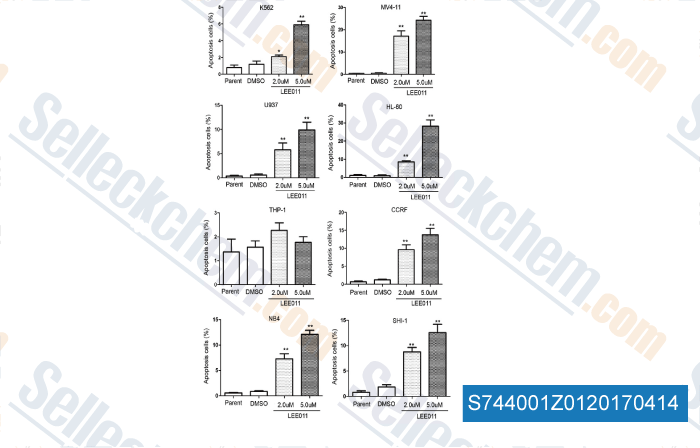
-
, , Cancer Cell Int, 2017, 17:35
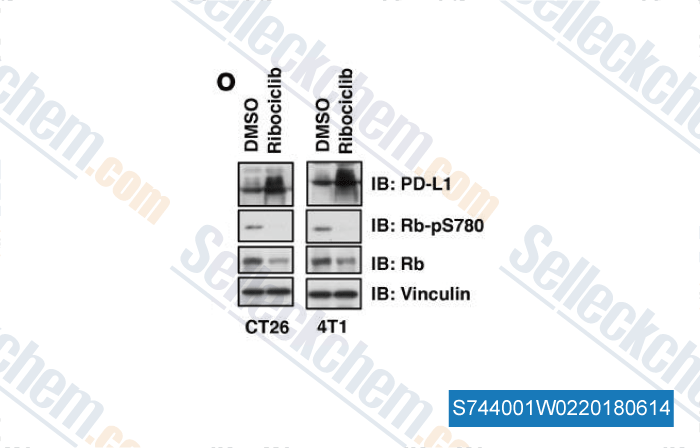
-
Dati da [ , , Nature, 2017, 553(7686):91-95 ]

-
Dati da [ , , Clin Cancer Res, 2017, 23(22):6958-6968 ]
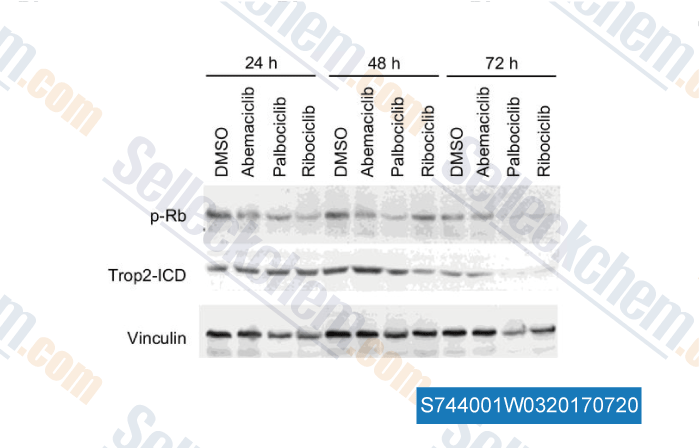
-
Dati da [ , , Cancer Res, 2016, 76(22):6723-6734 ]
Sellecks LEE011 (Ribociclib) È stato citato da 116 Pubblicazioni
| Cellular interactions within the immune microenvironment underpins resistance to cell cycle inhibition in breast cancers [ Nat Commun, 2025, 16(1):2132] | PubMed: 40032842 |
| Combined therapy with DR5-targeting antibody-drug conjugate and CDK inhibitors as a strategy for advanced colorectal cancer [ Cell Rep Med, 2025, S2666-3791(25)00231-9] | PubMed: 40449480 |
| Resistance to CDK7 inhibitors directed by acquired mutation of a conserved residue in cancer cells [ EMBO J, 2025, 10.1038/s44318-025-00554-6] | PubMed: 40921851 |
| Blocking cancer-fibroblast mutualism inhibits proliferation of endocrine therapy resistant breast cancer [ Mol Syst Biol, 2025, 10.1038/s44320-025-00104-6] | PubMed: 40341770 |
| Gene expression analysis in circulating tumour cells to determine resistance to CDK4/6 inhibitors plus endocrine therapy in HR + /HER2- metastatic breast cancer patients [ J Transl Med, 2025, 23(1):400] | PubMed: 40186268 |
| Efficacy of CDK4/6 Inhibition in colorectal cancer and the role of p16 expression in predicting drug resistance [ Cell Oncol (Dordr), 2025, 10.1007/s13402-025-01080-7] | PubMed: 40522623 |
| FLT4 activation promotes acute lymphoid leukemia survival through stabilization of MDM2/MDMX and inactivation of p53 [ Oncogenesis, 2025, 14(1):14] | PubMed: 40316529 |
| Preclinical Evaluation of the Efficacy of a Cyclin-dependent Kinase Inhibitor Ribociclib in Combination with Letrozole Against Patient-Derived Glioblastoma Cells [ Mol Cancer Ther, 2025, 10.1158/1535-7163.MCT-25-0277] | PubMed: 40994426 |
| Investigation of ribociclib, abemaciclib and palbociclib resistance in ER+ breast cancer cells reveal potential therapeutic opportunities` [ Sci Rep, 2025, 15(1):28579] | PubMed: 40764324 |
| Bacterial ubiquitin ligase engineered for small molecule and protein target identification [ bioRxiv, 2025, 2025.03.20.644192] | PubMed: 40166235 |
POLITICA DI RESO
La politica di reso incondizionato di Selleck Chemical garantisce ai nostri clienti unesperienza di acquisto online senza problemi. Se non sei in alcun modo soddisfatto del tuo acquisto, puoi restituire qualsiasi articolo entro 7 giorni dalla ricezione. In caso di problemi di qualità del prodotto, sia relativi al protocollo che al prodotto, puoi restituire qualsiasi articolo entro 365 giorni dalla data di acquisto originale. Si prega di seguire le istruzioni seguenti per la restituzione dei prodotti.
SPEDIZIONE E CONSERVAZIONE
I prodotti Selleck vengono trasportati a temperatura ambiente. Se ricevi il prodotto a temperatura ambiente, ti assicuriamo che il Dipartimento di Ispezione Qualità di Selleck ha condotto esperimenti per verificare che la conservazione a temperatura normale per un mese non influirà sullattività biologica dei prodotti in polvere. Dopo la raccolta, conservare il prodotto secondo le indicazioni descritte nella scheda tecnica. La maggior parte dei prodotti Selleck è stabile nelle condizioni raccomandate.
NON PER USO UMANO, DIAGNOSTICO VETERINARIO O TERAPEUTICO.