
Dati tecnici
| Formula | C19H20F3IN2O5S |
||||||||||||||
| Peso molecolare | 572.34 | Numero CAS | 923032-37-5 | ||||||||||||
| Solubilità (25°C)* | In vitro | DMSO | 100 mg/mL (174.72 mM) | ||||||||||||
| Ethanol | 100 mg/mL (174.72 mM) | ||||||||||||||
| Water | Insoluble | ||||||||||||||
| In vivo (Aggiungere i solventi al prodotto singolarmente e in ordine.) |
|
||||||||||||||
|
* <1 mg/ml significa leggermente solubile o insolubile. * Si prega di notare che Selleck testa la solubilità di tutti i composti internamente e la solubilità effettiva può differire leggermente dai valori pubblicati. Ciò è normale ed è dovuto a leggere variazioni da lotto a lotto. * Spedizione a temperatura ambiente (I test di stabilità mostrano che questo prodotto può essere spedito senza alcuna misura di raffreddamento.) |
|||||||||||||||
Preparazione delle soluzioni stock
Attività biologica
| Descrizione | Refametinib (RDEA119, Bay 86-9766) è un potente inibitore non competitivo dell'ATP e altamente selettivo di MEK1 e MEK2 con IC50 di 19 nM e 47 nM, rispettivamente. | ||||
|---|---|---|---|---|---|
| Target |
|
||||
| In vitro | Refametinib (RDEA119) si lega selettivamente e direttamente a una tasca allosterica degli enzimi MEK1/2 ed è altamente efficace nell'inibire la proliferazione cellulare in diverse linee cellulari tumorali, tra cui A375, SK-MEI-28, Colo205, HT-29 e BxPC3. Inibisce la crescita dipendente dall'ancoraggio di linee cellulari di cancro umano che ospitano la mutazione BRAF V600E con guadagno di funzione con valori di GI50 che vanno da 67 a 89 nM. In condizioni indipendenti dall'ancoraggio, i valori di GI50 per tutte le linee cellulari testate sono simili (40-84 nM). Questo composto mostra una selettività tissutale che riduce il suo potenziale di effetti collaterali correlati al sistema nervoso centrale. Inibisce potentemente la proliferazione delle 4 linee cellulari che ospitavano la mutazione BRAF ma non ha effetti o effetti modesti sulle altre 4 cellule che ospitavano BRAF di tipo selvatico (IC50 di 0,034-0,217 μM contro 1,413-34,120 μM). L'effetto inibitorio di Refametinib nelle linee cellulari selezionate OCUT1 (BRAF V600E(+), PIK3CA H1047R(+)) e SW1376 (BRAF V600E(+)) è potenziato dalla combinazione con l'inibitore di mTOR, temsirolimus. Il Refametinib e il temsirolimus mostrano anche effetti sinergici sulla morte autofagica delle cellule OCUT1 e KAT18 testate selettivamente. | ||||
| In vivo | La somministrazione orale di RDEA119 a 50 mg/kg una volta al giorno per 14 giorni porta a un'inibizione della crescita tumorale (TGI) del 68% nel modello tumorale di melanoma umano A375. Questo composto a 25 mg/kg una volta al giorno per 14 giorni determina una TGI del 123% nel modello tumorale di carcinoma del colon umano Colo205 (una TGI > 100% si verifica quando il tumore si riduce al di sotto del suo volume iniziale). Una dose di 25 mg/kg una volta al giorno per 14 giorni produce una TGI del 56% e 67% per i tumori HT-29 e A431, rispettivamente. |
Protocollo (da riferimento)
| Saggio della chinasi: |
|
|---|---|
| Saggio cellulare: |
|
| Studio sugli animali: |
|
Riferimenti
|
Convalida del prodotto da parte del cliente
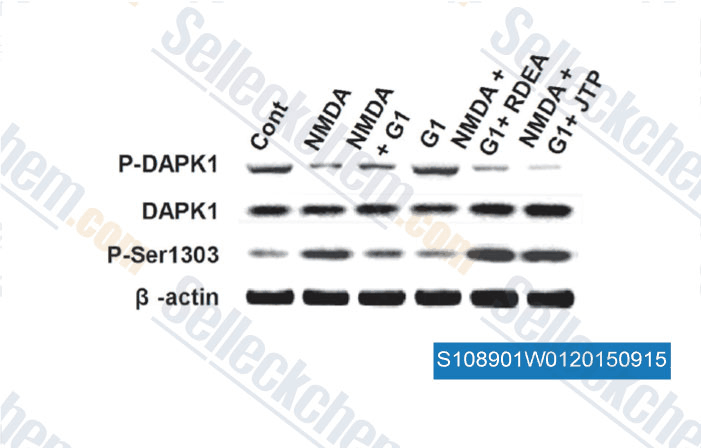
-
Dati da [ , , J Neurosci, 2012, 32(14): 4887-900 ]
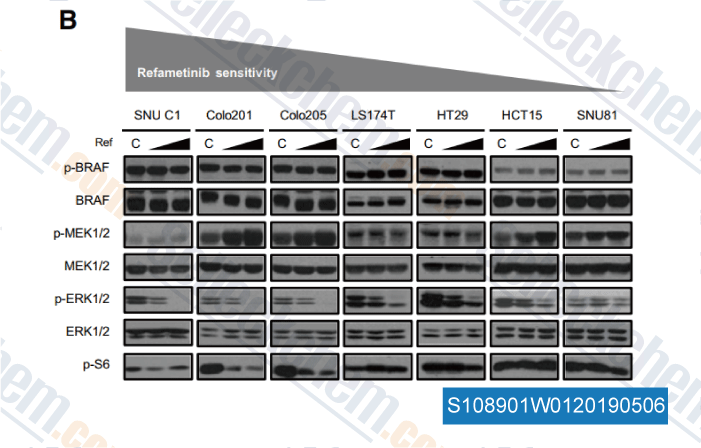
-
Dati da [ , , Mol Oncol, 2018, 12(8):1398-1409 ]
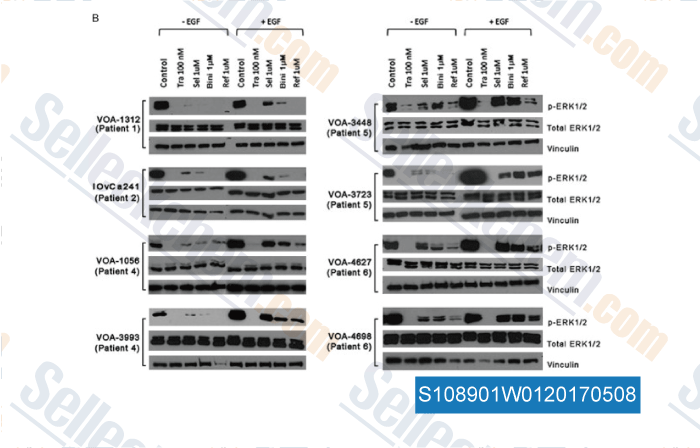
-
Dati da [ , , Am J Cancer Res, 2016, 6(10):2235-2251 ]
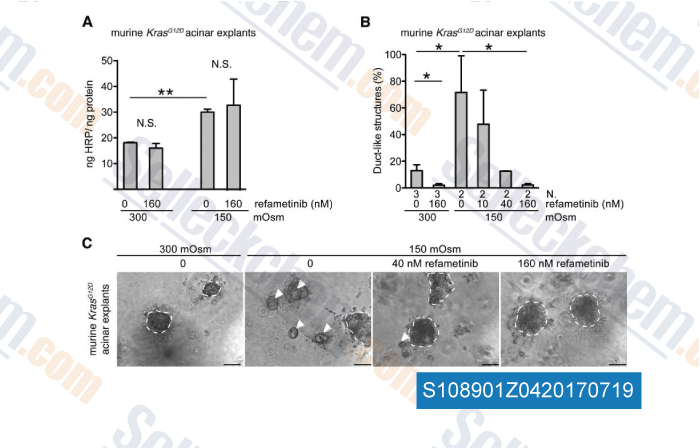
-
Dati da [ , , EBioMedicine, 2017, 15:90-99 ]
Sellecks Refametinib (RDEA119) È stato citato da 29 Pubblicazioni
| System analysis links SMARCD3 regulons to growth signaling and MEK inhibitor response in everolimus-resistant ER+ breast cancer cells [ Cell Rep Med, 2025, 6(11):102425] | PubMed: 41260207 |
| Histone deacetylase inhibitors promote breast cancer metastasis by elevating NEDD9 expression [ Signal Transduct Target Ther, 2023, 8(1):11] | PubMed: 36604412 |
| Salmonella effector SopB reorganizes cytoskeletal vimentin to maintain replication vacuoles for efficient infection [ Nat Commun, 2023, 14(1):478] | PubMed: 36717589 |
| Signaling-induced systematic repression of miRNAs uncovers cancer vulnerabilities and targeted therapy sensitivity [ Cell Rep Med, 2023, S2666-3791(23)00367-1] | PubMed: 37734378 |
| Signaling-induced systematic repression of miRNAs uncovers cancer vulnerabilities and targeted therapy sensitivity [ Cell Rep Med, 2023, 4(10):101200] | PubMed: 37734378 |
| Protein Tyrosine Phosphatase Non-Receptor 11 (PTPN11/Shp2) as a Driver Oncogene and a Novel Therapeutic Target in Non-Small Cell Lung Cancer (NSCLC) [ Int J Mol Sci, 2023, 24(13)10545] | PubMed: 37445722 |
| Anatomic position determines oncogenic specificity in melanoma [ Nature, 2022, 604(7905):354-361] | PubMed: 35355015 |
| NOTCH signaling limits the response of Low Grade Serous Ovarian Cancers to MEK inhibition [ Mol Cancer Ther, 2022, MCT-22-0004] | PubMed: 36198031 |
| Secondary resistance to anti-EGFR therapy by transcriptional reprogramming in patient-derived colorectal cancer models [ Genome Med, 2021, 13(1):116] | PubMed: 34271981 |
| Targeting the PI3K and MAPK pathways to improve response to HER2-targeted therapies in HER2-positive gastric cancer [ J Transl Med, 2021, 19(1):184] | PubMed: 33933113 |
POLITICA DI RESO
La politica di reso incondizionato di Selleck Chemical garantisce ai nostri clienti unesperienza di acquisto online senza problemi. Se non sei in alcun modo soddisfatto del tuo acquisto, puoi restituire qualsiasi articolo entro 7 giorni dalla ricezione. In caso di problemi di qualità del prodotto, sia relativi al protocollo che al prodotto, puoi restituire qualsiasi articolo entro 365 giorni dalla data di acquisto originale. Si prega di seguire le istruzioni seguenti per la restituzione dei prodotti.
SPEDIZIONE E CONSERVAZIONE
I prodotti Selleck vengono trasportati a temperatura ambiente. Se ricevi il prodotto a temperatura ambiente, ti assicuriamo che il Dipartimento di Ispezione Qualità di Selleck ha condotto esperimenti per verificare che la conservazione a temperatura normale per un mese non influirà sullattività biologica dei prodotti in polvere. Dopo la raccolta, conservare il prodotto secondo le indicazioni descritte nella scheda tecnica. La maggior parte dei prodotti Selleck è stabile nelle condizioni raccomandate.
NON PER USO UMANO, DIAGNOSTICO VETERINARIO O TERAPEUTICO.