
Dati tecnici
| Formula | C51H79NO13 |
||||||||||||||
| Peso molecolare | 914.18 | Numero CAS | 53123-88-9 | ||||||||||||
| Solubilità (25°C)* | In vitro | DMSO | 100 mg/mL (109.38 mM) | ||||||||||||
| Ethanol | 100 mg/mL (109.38 mM) | ||||||||||||||
| Water | Insoluble | ||||||||||||||
| In vivo (Aggiungere i solventi al prodotto singolarmente e in ordine.) |
|
||||||||||||||
|
* <1 mg/ml significa leggermente solubile o insolubile. * Si prega di notare che Selleck testa la solubilità di tutti i composti internamente e la solubilità effettiva può differire leggermente dai valori pubblicati. Ciò è normale ed è dovuto a leggere variazioni da lotto a lotto. * Spedizione a temperatura ambiente (I test di stabilità mostrano che questo prodotto può essere spedito senza alcuna misura di raffreddamento.) |
|||||||||||||||
Preparazione delle soluzioni stock
Attività biologica
| Descrizione | La Rapamycin è un inibitore specifico di mTOR con IC50 di ~0.1 nM nelle cellule HEK293. Questo composto si lega a FKBP12 e agisce specificamente come un inibitore allosterico di mTORC1. È un attivatore di Autophagy e un immunosoppressore. | ||
|---|---|---|---|
| Target |
|
||
| In vitro | La Rapamycin inibisce l'attività endogena di mTOR nelle cellule HEK293 con IC50 di ~0.1 nM, più potentemente di iRap e AP21967 con IC50 di ~5 nM e ~10 nM, rispettivamente. In Saccharomyces cerevisiae, il trattamento con questo composto induce un grave arresto del ciclo cellulare G1/S e l'inibizione dell'inizio della traduzione a livelli inferiori al 20% del controllo. Inibisce significativamente la vitalità cellulare di T98G e U87-MG in modo dose-dipendente con IC50 di 2 nM e 1 μM, rispettivamente, mostrando poca attività contro le cellule U373-MG con IC50 di >25 μM nonostante la simile estensione dell'inibizione della segnalazione di mTOR. Questa sostanza chimica (100 nM) induce l'arresto in G1 e l'Autophagy ma non l'apoptosi nelle cellule U87-MG e T98G sensibili alla Rapamycin inibendo la funzione di mTOR. |
||
| In vivo | Il trattamento con Rapamycin in vivo blocca specificamente i bersagli noti per essere a valle di mTOR, come la fosforilazione e l'attivazione della p70S6K e il rilascio dell'inibizione di eIF4E da parte di PHAS-1/4E-BP1, portando al blocco completo degli aumenti ipertrofici del peso del muscolo plantare e della dimensione delle fibre. Il trattamento a breve termine con questo composto, anche alla dose più bassa di 0.16 mg/kg, produce una profonda inibizione dell'attività della p70S6K, che è correlata a un aumento della morte delle cellule tumorali e della necrosi dei tumori renali di Eker. Questo agente chimico inibisce la crescita tumorale metastatica e l'angiogenesi nei modelli di xenotrapianto CT-26 riducendo la produzione di VEGF e bloccando la segnalazione delle cellule endoteliali indotta da VEGF. Il trattamento con questo composto a 4 mg/kg/die riduce significativamente la crescita tumorale degli xenotrapianti C6 e la permeabilità vascolare tumorale. |
Protocollo (da riferimento)
| Saggio della chinasi: |
|
|---|---|
| Saggio cellulare: |
|
| Studio sugli animali: |
|
Riferimenti
|
Convalida del prodotto da parte del cliente
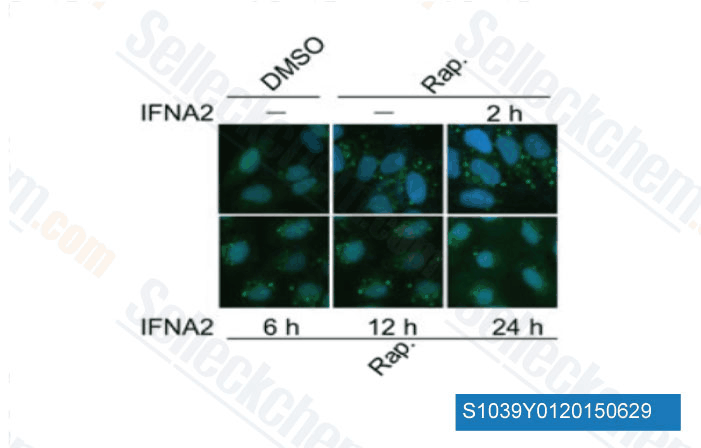
-
Dati da [ Autophagy , 2015 , 11(4), 617-28 ]
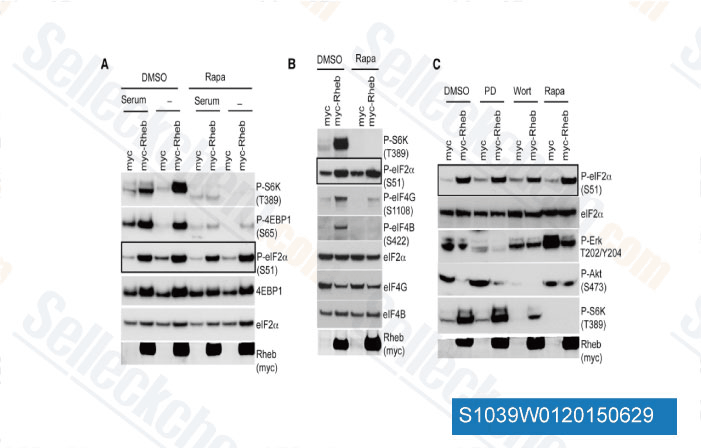
-
Dati da [ Cell Rep , 2015 , 10.1016/j.celrep.2015.01.014 ]

-
Dati da [ Biochem Pharmacol , 2015 , 95(3), 156-69 ]
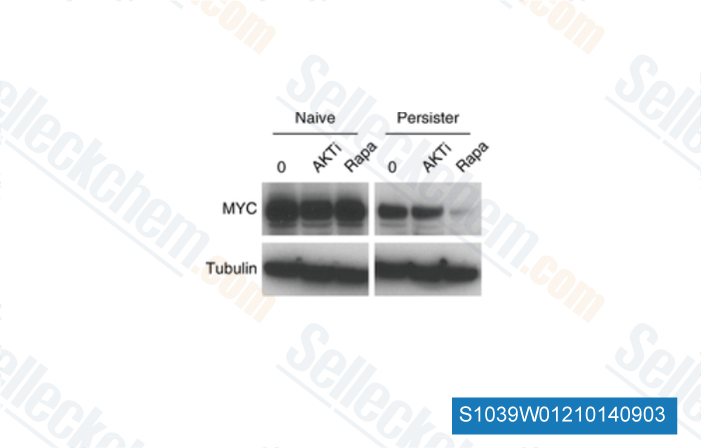
-
Dati da [ Nat Genet , 2014 , 46(4), 364-70 ]
Sellecks Rapamycin (Sirolimus) È stato citato da 1914 Pubblicazioni
| Taurine from tumour niche drives glycolysis to promote leukaemogenesis [ Nature, 2025, 10.1038/s41586-025-09018-7] | PubMed: 40369079 |
| High fructose consumption aggravates inflammation by promoting effector T cell generation via inducing metabolic reprogramming [ Signal Transduct Target Ther, 2025, 10(1):271] | PubMed: 40854873 |
| RIPK1 senses S-adenosylmethionine scarcity to drive cell death and inflammation [ Cell Metab, 2025, S1550-4131(25)00294-3] | PubMed: 40570842 |
| Interferon-responsive intestinal BEST4/CA7+ cells are targets of bacterial diarrheal toxins [ Cell Stem Cell, 2025, S1934-5909(25)00042-6] | PubMed: 40010349 |
| USP5 stabilizes YTHDF1 to control cancer immune surveillance through mTORC1-mediated phosphorylation [ Nat Commun, 2025, 16(1):1313] | PubMed: 39900921 |
| Macrophage-derived amphiregulin induces myofibroblast transition in adipogenic lineage precursors near Staphylococcus aureus abscess in bone marrow [ Nat Commun, 2025, 16(1):8409] | PubMed: 40998791 |
| WNK1 signalling regulates amino acid transport and mTORC1 activity to sustain acute myeloid leukaemia growth [ Nat Commun, 2025, 16(1):4920] | PubMed: 40425534 |
| Lysosomal NKG7 restrains mTORC1 activity to promote CD8+ T cell durability and tumor control [ Nat Commun, 2025, 16(1):1628] | PubMed: 39952956 |
| DRAM1 promotes the stability of lysosomal VAMP8 to enhance autolysosome formation and facilitates the extravasation [ Nat Commun, 2025, 16(1):5826] | PubMed: 40595569 |
| Lipoic acid functions in Paneth cells to prevent human intestinal stem cell aging [ Nat Commun, 2025, 16(1):6016] | PubMed: 40593722 |
POLITICA DI RESO
La politica di reso incondizionato di Selleck Chemical garantisce ai nostri clienti unesperienza di acquisto online senza problemi. Se non sei in alcun modo soddisfatto del tuo acquisto, puoi restituire qualsiasi articolo entro 7 giorni dalla ricezione. In caso di problemi di qualità del prodotto, sia relativi al protocollo che al prodotto, puoi restituire qualsiasi articolo entro 365 giorni dalla data di acquisto originale. Si prega di seguire le istruzioni seguenti per la restituzione dei prodotti.
SPEDIZIONE E CONSERVAZIONE
I prodotti Selleck vengono trasportati a temperatura ambiente. Se ricevi il prodotto a temperatura ambiente, ti assicuriamo che il Dipartimento di Ispezione Qualità di Selleck ha condotto esperimenti per verificare che la conservazione a temperatura normale per un mese non influirà sullattività biologica dei prodotti in polvere. Dopo la raccolta, conservare il prodotto secondo le indicazioni descritte nella scheda tecnica. La maggior parte dei prodotti Selleck è stabile nelle condizioni raccomandate.
NON PER USO UMANO, DIAGNOSTICO VETERINARIO O TERAPEUTICO.