
|
Come citare 1. Per la citazione nel testo (Materiali e Metodi): 2. Per la tabella delle risorse chiave: |
||
|
Numero verde: (877) 796-6397 -- Solo USA e Canada -- |
Fax: +1-832-582-8590 Ordini: +1-832-582-8158 |
Supporto tecnico: +1-832-582-8158 Ext:3 Si prega di fornire il numero dordine nelle-mail. Ci sforziamo di rispondere a tutte le richieste via e-mail entro un giorno lavorativo. |
Descrizione biologica
| Specificità | Phospho-STAT1 (Ser727) Antibody [C14E15] riconosce i livelli endogeni di STAT1 solo quando fosforilato sulla Serina 727. |
|---|---|
| Contesto | Phospho-STAT1 (Ser727) si riferisce alla fosforilazione della serina 727 nella proteina STAT1, un fattore di trascrizione chiave coinvolto nelle risposte cellulari a fattori di stress (ad esempio, radiazioni UV, LPS, TNF-α) e nella segnalazione delle citochine (ad esempio, IFN-γ). STAT1, parte della famiglia Signal Transducer and Activator of Transcription (STAT), contiene un dominio N-terminale, un dominio di legame al DNA, un dominio SH2 (per la dimerizzazione) e un dominio di transattivazione C-terminale (TAD) dove risiede Ser727. La fosforilazione a Ser727, mediata da chinasi attivate dallo stress come p38 MAPK, ERK o PI-3K/Akt, potenzia l'attività trascrizionale reclutando co-attivatori (ad esempio, CBP/p300) e modificatori della cromatina, distinguendosi dalla fosforilazione di Tyr701 (via canonica JAK-dipendente). Questa modificazione è critica per l'integrazione dei segnali di stress e immunitari, amplificando le risposte antimicrobiche nei macrofagi e attivando geni legati all'apoptosi, alla sopravvivenza cellulare e alla memoria immunitaria. Sotto irradiazione UVB, la fosforilazione di Ser727 aumenta l'affinità di legame al DNA di STAT1 e guida le reti geniche sensibili allo stress, mentre nella segnalazione IFN-γ, sinergizza con la fosforilazione di Tyr701 per massimizzare l'espressione genica bersaglio. Una fosforilazione sostenuta di Ser727 dopo la rimozione dello stimolo (ad esempio, IFN-γ) può mantenere la memoria trascrizionale tramite chinasi associate alla cromatina come CDK8. La disregolazione contribuisce all'infiammazione, all'evasione immunitaria e alla carcinogenesi modulando i geni soppressori tumorali e i mediatori pro-infiammatori (ad esempio, iNOS). |
Informazioni sullutilizzo
| Applicazione | WB, IHC | Diluizione |
|
||||
|---|---|---|---|---|---|---|---|
| Reattività | Human, Mouse, Rat | ||||||
| Fonte | Rabbit Monoclonal Antibody | MW | 87 kDa | ||||
| Tampone di conservazione | PBS, pH 7.2+50% Glycerol+0.05% BSA+0.01% NaN3 | Conservazione (Dalla data di ricevimento) |
-20°C (avoid freeze-thaw cycles), 2 years | ||||
| WB |
Experimental Protocol:
Sample preparation
1. Tissue: Lyse the tissue sample by adding an appropriate volume of ice-cold RIPA/NP-40 Lysis Buffer (containing Protease Inhibitor Cocktail),and homogenize the tissue at a low temperature or lyse it by sonication on ice, then incubate on ice for 30 minutes. 2. Adherent cell: Aspirate the culture medium and transfer the cells into an EP tube. Wash the cells with ice-cold PBS twice. Add an appropriate volume of RIPA/NP-40 Lysis Buffer (containing Protease Inhibitor Cocktail), sonicate to lyse the cells, and incubate on ice for 30 minutes. 3. Suspension cell: Transfer the culture medium to a pre-cooled centrifuge tube. Centrifuge and aspirate the supernatant. Wash the cells with ice-cold PBS twice.Add an appropriate volume of RIPA/NP-40 Lysis Buffer (containing Protease Inhibitor Cocktail), sonicate to lyse the cells, and incubate on ice for 30 minutes. 4. Place the lysate into a pre-cooled microcentrifuge tube. Centrifuge at 4°C for 15 min. Collect the supernatant;
5. Remove a small volume of lysate to determine the protein concentration;
6. Combine the lysate with protein loading buffer. Boil 20 µL sample under 95-100°C for 5 min. Centrifuge for 5 min after cool down on ice.
Electrophoretic separation
1. According to the concentration of extracted protein, load appropriate amount of protein sample and marker onto SDS-PAGE gels for electrophoresis. Recommended separating gel (lower gel) concentration: 10%. Reference Table for Selecting SDS-PAGE Separation Gel Concentrations 2. Power up 80V for 30 minutes. Then the power supply is adjusted (110 V~150 V), the Marker is observed, and the electrophoresis can be stopped when the indicator band of the predyed protein Marker where the protein is located is properly separated. (Note that the current should not be too large when electrophoresis, too large current (more than 150 mA) will cause the temperature to rise, affecting the result of running glue. If high currents cannot be avoided, an ice bath can be used to cool the bath.)
Transfer membrane
1. Take out the converter, soak the clip and consumables in the pre-cooled converter;
2. Activate PVDF membrane with methanol for 1 min and rinse with transfer buffer;
3. Install it in the order of "black edge of clip - sponge - filter paper - filter paper - glue -PVDF membrane - filter paper - filter paper - sponge - white edge of clip"; 4. The protein was electrotransferred to PVDF membrane. ( 0.45 µm PVDF membrane is recommended ) Reference Table for Selecting PVDF Membrane Pore Size Specifications Recommended conditions for wet transfer: 200 mA, 120 min. ( Note that the transfer conditions can be adjusted according to the protein size. For high-molecular-weight proteins, a higher current and longer transfer time are recommended. However, ensure that the transfer tank remains at a low temperature to prevent gel melting.)
Block
1. After electrotransfer, wash the film with TBST at room temperature for 5 minutes;
2. Incubate the film in the blocking solution for 1 hour at room temperature;
3. Wash the film with TBST for 3 times, 5 minutes each time.
Antibody incubation
1. Use 5% skim milk powder to prepare the primary antibody working liquid (recommended dilution ratio for primary antibody 1:10000), gently shake and incubate with the film at 4°C overnight; 2. Wash the film with TBST 3 times, 5 minutes each time;
3. Add the secondary antibody to the blocking solution and incubate with the film gently at room temperature for 1 hour;
4. After incubation, wash the film with TBST 3 times for 5 minutes each time.
Antibody staining
1389. Add the prepared ECL luminescent substrate (or select other color developing substrate according to the second antibody) and mix evenly;
2. Incubate with the film for 1 minute, remove excess substrate (keep the film moist), wrap with plastic film, and expose in the imaging system.
|
Riferimenti
|
Dati di applicazione
WB
Validato da Selleck
-
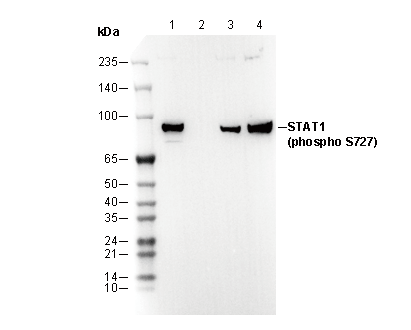 Lane 1: HeLa, Lane 2: HeLa (Alkaline Phosphatase treated), Lane 3: Mouse brain, Lane 4: Rat brain