
Dati tecnici
| Formula | C22H27N5O4 |
||||||||||||||
| Peso molecolare | 425.48 | Numero CAS | 1013101-36-4 | ||||||||||||
| Solubilità (25°C)* | In vitro | DMSO | 85 mg/mL (199.77 mM) | ||||||||||||
| Ethanol | 3 mg/mL (7.05 mM) | ||||||||||||||
| Water | Insoluble | ||||||||||||||
| In vivo (Aggiungere i solventi al prodotto singolarmente e in ordine.) |
|
||||||||||||||
|
* <1 mg/ml significa leggermente solubile o insolubile. * Si prega di notare che Selleck testa la solubilità di tutti i composti internamente e la solubilità effettiva può differire leggermente dai valori pubblicati. Ciò è normale ed è dovuto a leggere variazioni da lotto a lotto. * Spedizione a temperatura ambiente (I test di stabilità mostrano che questo prodotto può essere spedito senza alcuna misura di raffreddamento.) |
|||||||||||||||
Preparazione delle soluzioni stock
Attività biologica
| Descrizione | PF-04691502 (PF4691502) è un doppio inibitore ATP-competitivo di PI3K(α/β/δ/γ)/mTOR con un Ki di 1,8 nM/2,1 nM/1,6 nM/1,9 nM e 16 nM in saggi senza cellule, con scarsa attività contro Vps34, AKT, PDK1, p70S6K, MEK, ERK, p38 o JNK. Questo composto induce apoptosi. Fase 2. | |||||||||||
|---|---|---|---|---|---|---|---|---|---|---|---|---|
| Target |
|
|||||||||||
| In vitro | PF-04691502 inibisce potentemente la PI3K ricombinante di classe I e mTOR in saggi biochimici e sopprime la trasformazione di fibroblasti aviari mediata da PI3K γ, δ di tipo selvaggio o da PI3Kα mutante. Nelle linee cellulari tumorali mutate per PIK3CA e con PTEN deleto, questo composto riduce la fosforilazione di AKT T308 e AKT S473 (IC(50) di 7,5-47 nM e 3,8-20 nM, rispettivamente) e inibisce la proliferazione cellulare (IC(50) di 179-313 nM). Inibisce l'attività di mTORC1 nelle cellule, misurata da un saggio stimolato dai nutrienti indipendente da PI3K, con un IC(50) di 32 nM e inibisce l'attivazione degli effettori a valle di PI3K e mTOR, inclusi AKT, FKHRL1, PRAS40, p70S6K, 4EBP1 e S6RP. L'esposizione a breve termine a questa sostanza chimica inibisce prevalentemente PI3K, mentre l'inibizione di mTOR persiste per 24-48 ore. Questo composto induce un arresto del ciclo cellulare in G(1), concomitante con l'upregulation di p27 Kip1 e la riduzione di Rb. |
|||||||||||
| In vivo | L'attività antitumorale di PF-04691502 è osservata in xenotrapianti di U87 (PTEN nullo), SKOV3 (mutazione PIK3CA) e carcinoma polmonare non a piccole cellule. Questo composto inibisce la crescita tumorale a 7 giorni del 72%. L'imaging FDG-PET ha rivelato che riduce drasticamente il metabolismo del glucosio. I biomarcatori tissutali dell'attività del pathway PI3K/mTOR, p-AKT (S473) e p-RPS6 (S240/244), sono anche drasticamente inibiti dopo il suo trattamento. |
Protocollo (da riferimento)
| Saggio della chinasi: |
|
|---|---|
| Saggio cellulare: |
|
| Studio sugli animali: |
|
Riferimenti
|
Convalida del prodotto da parte del cliente
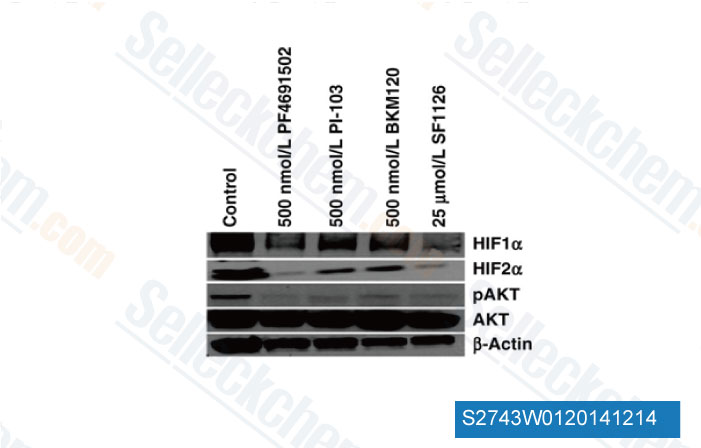
-
Dati da [ Mol Cancer Res , 2014 , 12(10), 1520-31 ]
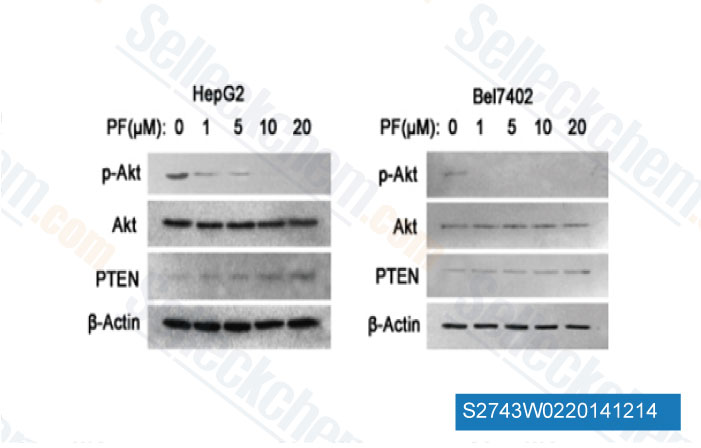
-
Dati da [ Toxicol Lett , 2013 , 220(2), 150-6 ]
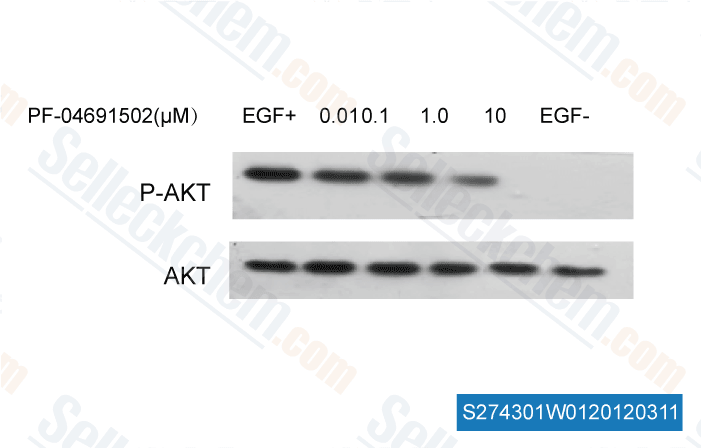
-
, , Dr. Zhang of Tianjin Medical University
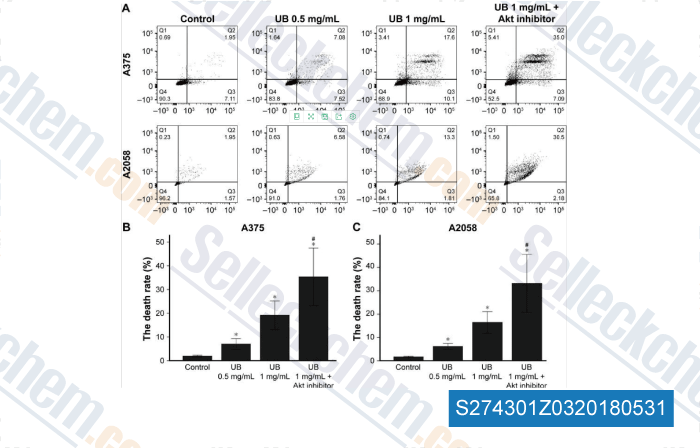
-
Dati da [ , , Onco Targets Ther, 2018, 11:943-953 ]
Sellecks PF-04691502 È stato citato da 52 Pubblicazioni
| ERK1-mediated GLYCTK2 phosphorylation promotes fructolysis to sustain glioblastoma survival under glucose deprivation [ Cell Death Discov, 2025, 11(1):266] | PubMed: 40467571 |
| Inhibitor PF-04691502 works as a senolytic to regulate cellular senescence [ Exp Gerontol, 2024, 186:112359] | PubMed: 38184267 |
| Zebrafish functional xenograft vasculature platform identifies PF-502 as a durable vasculature normalization drug [ iScience, 2023, 26(9):107734] | PubMed: 37680473 |
| Functional restoration of lysosomes and mitochondria through modulation of AKT activity ameliorates senescence [ Exp Gerontol, 2023, 173:112091] | PubMed: 36657533 |
| Glucose metabolic upregulation via phosphorylation of S6 ribosomal protein affects tumor progression in distal cholangiocarcinoma [ BMC Gastroenterol, 2023, 23(1):157] | PubMed: 37193984 |
| RNF43G659fs is an oncogenic colorectal cancer mutation and sensitizes tumor cells to PI3K/mTOR inhibition [ Nature Communications, 2022, 3181-2022)] | PubMed: None |
| RNF43 G659fs is an oncogenic colorectal cancer mutation and sensitizes tumor cells to PI3K/mTOR inhibition [ Nat Commun, 2022, 13(1):3181] | PubMed: 35676246 |
| A novel PI3K inhibitor XH30 suppresses orthotopic glioblastoma and brain metastasis in mice models [ Acta Pharm Sin B, 2022, 12(2):774-786] | PubMed: 35256946 |
| Leveraging patient derived models of FGFR2 fusion positive intrahepatic cholangiocarcinoma to identify synergistic therapies [ NPJ Precis Oncol, 2022, 6(1):75] | PubMed: 36274097 |
| Identification of New Vulnerabilities in Conjunctival Melanoma Using Image-Based High Content Drug Screening [ Cancers (Basel), 2022, 14(6)1575] | PubMed: 35326726 |
POLITICA DI RESO
La politica di reso incondizionato di Selleck Chemical garantisce ai nostri clienti unesperienza di acquisto online senza problemi. Se non sei in alcun modo soddisfatto del tuo acquisto, puoi restituire qualsiasi articolo entro 7 giorni dalla ricezione. In caso di problemi di qualità del prodotto, sia relativi al protocollo che al prodotto, puoi restituire qualsiasi articolo entro 365 giorni dalla data di acquisto originale. Si prega di seguire le istruzioni seguenti per la restituzione dei prodotti.
SPEDIZIONE E CONSERVAZIONE
I prodotti Selleck vengono trasportati a temperatura ambiente. Se ricevi il prodotto a temperatura ambiente, ti assicuriamo che il Dipartimento di Ispezione Qualità di Selleck ha condotto esperimenti per verificare che la conservazione a temperatura normale per un mese non influirà sullattività biologica dei prodotti in polvere. Dopo la raccolta, conservare il prodotto secondo le indicazioni descritte nella scheda tecnica. La maggior parte dei prodotti Selleck è stabile nelle condizioni raccomandate.
NON PER USO UMANO, DIAGNOSTICO VETERINARIO O TERAPEUTICO.