
Dati tecnici
| Formula | C12H7Cl2NO3S2 |
||||||||||
| Peso molecolare | 348.22 | Numero CAS | 882257-11-6 | ||||||||
| Solubilità (25°C)* | In vitro | DMSO | 35 mg/mL (100.51 mM) | ||||||||
| Water | Insoluble | ||||||||||
| Ethanol | Insoluble | ||||||||||
| In vivo (Aggiungere i solventi al prodotto singolarmente e in ordine.) |
|
||||||||||
|
* <1 mg/ml significa leggermente solubile o insolubile. * Si prega di notare che Selleck testa la solubilità di tutti i composti internamente e la solubilità effettiva può differire leggermente dai valori pubblicati. Ciò è normale ed è dovuto a leggere variazioni da lotto a lotto. * Spedizione a temperatura ambiente (I test di stabilità mostrano che questo prodotto può essere spedito senza alcuna misura di raffreddamento.) |
|||||||||||
Preparazione delle soluzioni stock
Attività biologica
| Descrizione | P5091 è un inibitore selettivo e potente della ubiquitin-specific protease 7 (USP7) con EC50 di 4,2 μM e della strettamente correlata USP47. | ||||
|---|---|---|---|---|---|
| Target |
|
||||
| In vitro | P5091 è un tiofene trisostituito con sostituenti diclorofeniltio, nitro e acetilici che mediano l'attività anti-USP7. Questo composto mostra un'attività deubiquitinante potente, specifica e selettiva contro USP7. Al contrario, non inibisce altre DUBs o altre famiglie di cistein proteasi testate (EC50 > 100 mM). Questa sostanza chimica inibisce l'etichettatura di USP7 con HA-UbVME in modo concentrazione-dipendente. La scissione delle catene di poliubiquitina ad alto peso molecolare mediata da USP7 è inibita in modo dose-dipendente da questo composto. Inoltre, inibisce la scissione delle catene di ubiquitina poli-K48-legate mediata da USP7, ma non da USP2 o USP8. L'inibizione di USP7 da parte di questo composto induce la poliubiquitinazione di HDM2 e accelera la degradazione di HDM2. Inibisce l'attività deubiquitinante di USP7, senza bloccare l'attività del proteasoma nelle cellule MM. Questa sostanza chimica induce una diminuzione dose-dipendente della vitalità di varie linee cellulari MM. Supera la crescita delle cellule MM indotta dalle cellule stromali del midollo osseo. Questo composto ha diminuito i livelli di HDM2 e HDMX, oltre ad aver aumentato i livelli di p53 e p21. Nel complesso, la citotossicità indotta da questo composto è mediata in parte dall'asse di segnalazione HDM2-p21 e, sebbene p53 sia sovraregolato in risposta a questo trattamento chimico, l'attività citotossica di esso non dipende da p53. |
||||
| In vivo | Negli studi su modelli animali di tumore, P5091 è ben tollerato, inibisce la crescita tumorale e prolunga la sopravvivenza. La combinazione di questo composto con l'inibitore HDAC SAHA innesca un'attività anti-MM sinergica. |
Protocollo (da riferimento)
| Saggio della chinasi: |
|
|---|---|
| Saggio cellulare: |
|
| Studio sugli animali: |
|
Riferimenti
|
Convalida del prodotto da parte del cliente
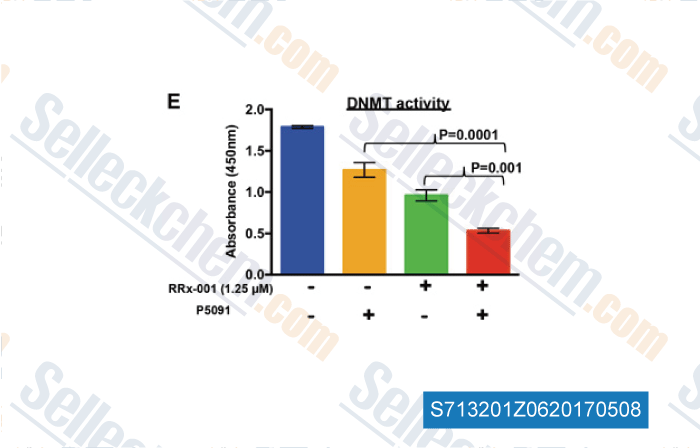
-
Dati da [ , , Leukemia, 2016, 30(11):2187-2197 ]
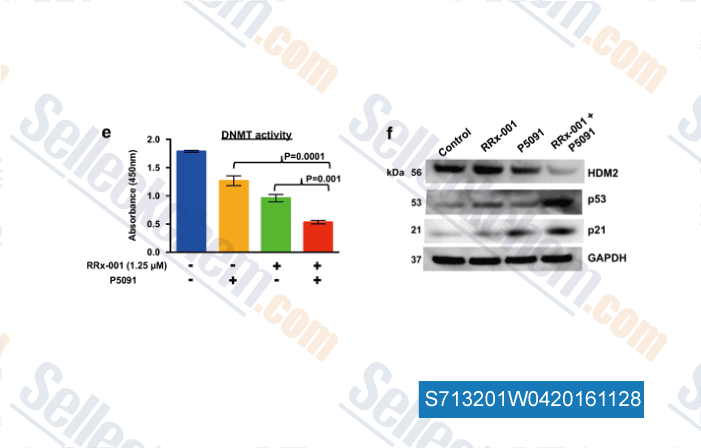
-
Dati da [ , , Leukemia, 2016, 30(11):2187-2197. ]

-
Dati da [ , , Cell Physiol Biochem, 2017, 43(5):1755-1766 ]
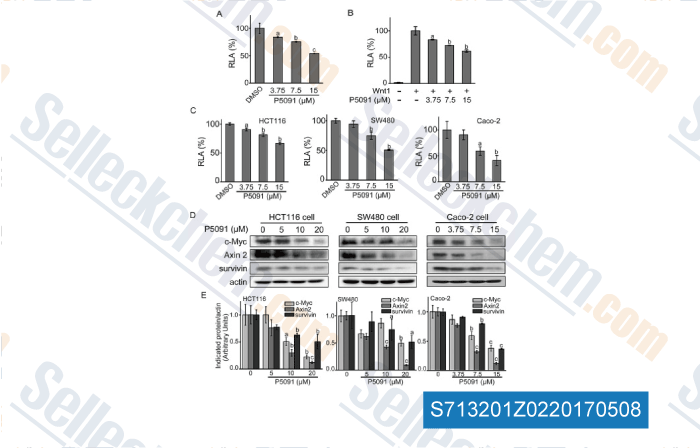
-
Dati da [ , , Biochem Pharmacol, 2017, 131:29-39 ]
Sellecks P5091 È stato citato da 57 Pubblicazioni
| ACC1 is a dual metabolic-epigenetic regulator of Treg stability and immune tolerance [ Mol Metab, 2025, 94:102111] | PubMed: 39929287 |
| The deubiquitinase USP7 stabilizes HER2 expression and promotes breast cancer progression [ Neoplasia, 2025, 66:101192] | PubMed: 40472738 |
| Stabilization of KPNB1 by deubiquitinase USP7 promotes glioblastoma progression through the YBX1-NLGN3 axis [ J Exp Clin Cancer Res, 2024, 43(1):28] | PubMed: 38254206 |
| ER Stress-Activated HSF1 Governs Cancer Cell Resistance to USP7 Inhibitor-Based Chemotherapy through the PERK Pathway [ Int J Mol Sci, 2024, 25(5)2768] | PubMed: 38474017 |
| USP7/Maged1-mediated H2A monoubiquitination in the paraventricular thalamus: an epigenetic mechanism involved in cocaine use disorder [ Nat Commun, 2023, 14(1):8481] | PubMed: 38123574 |
| Engineered Microparticles for Treatment of Murine Brain Metastasis by Reprograming Tumor Microenvironment and Inhibiting MAPK Pathway [ Adv Sci (Weinh), 2023, 10(8):e2206212] | PubMed: 36698296 |
| USP7 promotes non-small-cell lung cancer cell glycolysis and survival by stabilizing and activating c-Abl [ Clin Transl Med, 2023, 13(12):e1509] | PubMed: 38082439 |
| De-ubiquitination of SAMHD1 by USP7 promotes DNA damage repair to overcome oncogenic stress and affect chemotherapy sensitivity [ Oncogene, 2023, 42(22):1843-1856] | PubMed: 37081042 |
| Suppression of USP7 negatively regulates the stability of ETS proto-oncogene 2 protein [ Biomed Pharmacother, 2023, 162:114700] | PubMed: 37062218 |
| USP7 Inhibits Osteoclastogenesis via Dual Effects of Attenuating TRAF6/TAK1 Axis and Stimulating STING Signaling [ Aging Dis, 2023, 14(6):2267-2283] | PubMed: 37199589 |
POLITICA DI RESO
La politica di reso incondizionato di Selleck Chemical garantisce ai nostri clienti unesperienza di acquisto online senza problemi. Se non sei in alcun modo soddisfatto del tuo acquisto, puoi restituire qualsiasi articolo entro 7 giorni dalla ricezione. In caso di problemi di qualità del prodotto, sia relativi al protocollo che al prodotto, puoi restituire qualsiasi articolo entro 365 giorni dalla data di acquisto originale. Si prega di seguire le istruzioni seguenti per la restituzione dei prodotti.
SPEDIZIONE E CONSERVAZIONE
I prodotti Selleck vengono trasportati a temperatura ambiente. Se ricevi il prodotto a temperatura ambiente, ti assicuriamo che il Dipartimento di Ispezione Qualità di Selleck ha condotto esperimenti per verificare che la conservazione a temperatura normale per un mese non influirà sullattività biologica dei prodotti in polvere. Dopo la raccolta, conservare il prodotto secondo le indicazioni descritte nella scheda tecnica. La maggior parte dei prodotti Selleck è stabile nelle condizioni raccomandate.
NON PER USO UMANO, DIAGNOSTICO VETERINARIO O TERAPEUTICO.