
Dati tecnici
| Formula | C8H14N2O4Pt |
|||
| Peso molecolare | 397.29 | Numero CAS | 61825-94-3 | |
| Solubilità (25°C)* | In vitro | Water | 2 mg/mL (5.03 mM) | |
| Ethanol | Insoluble | |||
|
* <1 mg/ml significa leggermente solubile o insolubile. * Si prega di notare che Selleck testa la solubilità di tutti i composti internamente e la solubilità effettiva può differire leggermente dai valori pubblicati. Ciò è normale ed è dovuto a leggere variazioni da lotto a lotto. * Spedizione a temperatura ambiente (I test di stabilità mostrano che questo prodotto può essere spedito senza alcuna misura di raffreddamento.) |
||||
Preparazione delle soluzioni stock
Attività biologica
| Descrizione | Oxaliplatin è un agente alchilante del DNA che attiva l'autophagy. Oxaliplatin inibisce la sintesi del DNA conformando addotti del DNA nelle cellule RT4, TCCSUP, A2780, HT-29, U-373MG, U-87MG, SK-MEL-2 e HT-144.Le soluzioni sono instabili e devono essere preparate al momento. Il DMSO non è raccomandato per sciogliere i farmaci a base di platino, il che può facilmente portare all'inattivazione del farmaco. | |
|---|---|---|
| Target |
|
|
| In vitro | Il principale meccanismo d'azione di Oxaliplatin è mediato dalla formazione di addotti del DNA. Questo composto induce lesioni primarie e secondarie del DNA che portano all'apoptosi cellulare. È attivo contro le linee cellulari di melanoma umano C32 e G361 con IC50 rispettivamente di 0,98 mM e 0,14 mM. Questa sostanza chimica inibisce efficacemente le linee cellulari di carcinoma della vescica RT4 e TCCSUP, la linea cellulare di carcinoma ovarico A2780, la linea cellulare di carcinoma del colon HT-29, le linee cellulari di glioblastoma U-373MG e U-87MG, e le linee cellulari di melanoma SK-MEL-2 e HT-144 con IC50 rispettivamente di 11 μM, 15 μM, 0,17 μM, 0,97 μM, 2,95 μM, 17,6 μM, 30,9 μM e 7,85 μM. |
|
| In vivo | Un'iniezione settimanale i.p. di Oxaliplatin a 10 mg/kg in topi nudi portatori di tumori epatocellulari HCCLM3 riduce significativamente il volume del tumore e l'indice apoptotico. Questo composto (5mg/kg, i.v. nei giorni 1, 5 e 9) è attivo sulla T-leucemia-linfoma L40 AKR con T/C di 1,77. È anche efficace sulla leucemia L1210 trapiantata intracerebralmente, gli xenotrapianti MA 16-C, gli xenotrapianti di melanoma B16, gli xenotrapianti polmonari di Lewis e gli xenotrapianti di carcinoma del colon C26. Questa sostanza chimica induce un'alterazione del trasporto neuronale retrogrado nei topi. |
|
| Caratteristiche | Questo prodotto non è raccomandato per essere sciolto in dimetilsolfossido (DMSO). |
Protocollo (da riferimento)
| Saggio cellulare: |
|
|---|---|
| Studio sugli animali: |
|
Riferimenti
|
Convalida del prodotto da parte del cliente
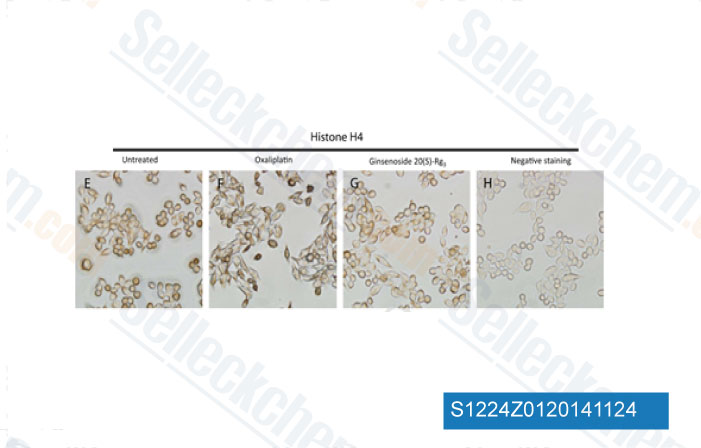
-
Dati da [ J Proteomics , 2014 , 10.1016/j.jprot.2014.10.009 ]
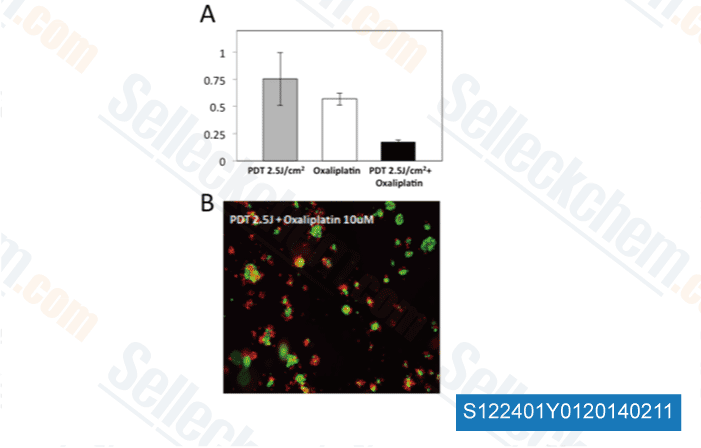
-
Dati da [ Optical Methods for Tumor Treatment and Detection , 2013 , 10.1117/12.2010730 ]
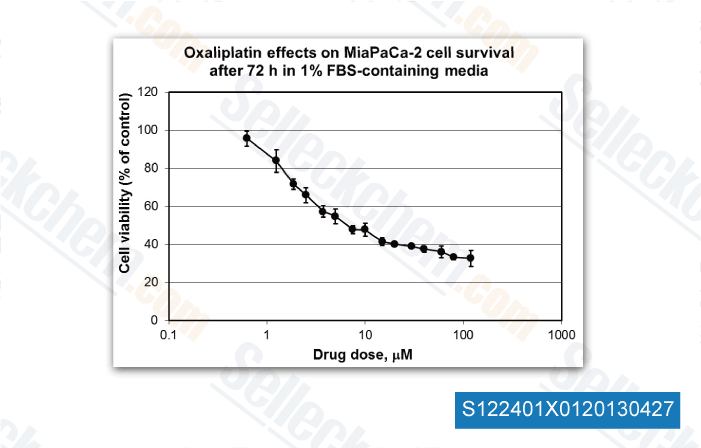
-
, 2013 , Dr. Edita Aksamitiene from Thomas Jefferson University
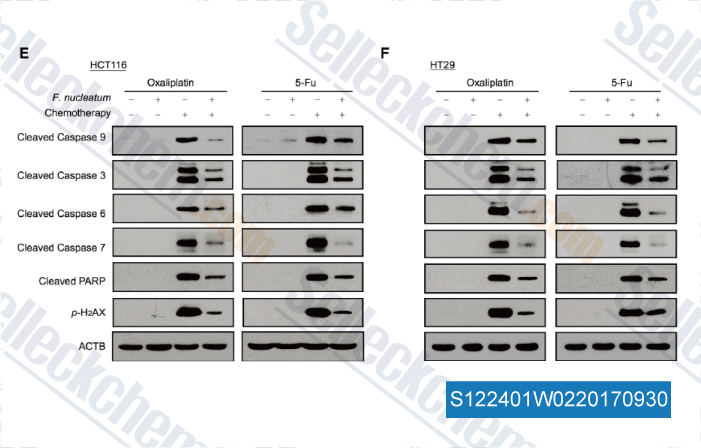
-
Dati da [ , , Cell, 2017, 170(3):548-563.e16 ]
Sellecks Oxaliplatin È stato citato da 282 Pubblicazioni
| Activation of lysosomal iron triggers ferroptosis in cancer [ Nature, 2025, 10.1038/s41586-025-08974-4] | PubMed: 40335696 |
| Cisplatin and temozolomide combinatorial treatment triggers hypermutability and immune surveillance in experimental cancer models [ Cancer Cell, 2025, S1535-6108(25)00223-5] | PubMed: 40513578 |
| The noncanonical function of liver-type phosphofructokinase potentiates the efficacy of HDAC inhibitors in cancer [ Signal Transduct Target Ther, 2025, 10(1):341] | PubMed: 41083431 |
| A pancreatic cancer organoid biobank links multi-omics signatures to therapeutic response and clinical evaluation of statin combination therapy [ Cell Stem Cell, 2025, S1934-5909(25)00265-6] | PubMed: 40812300 |
| Prediction of Patient Drug Response via 3D Bioprinted Gastric Cancer Model Utilized Patient-Derived Tissue Laden Tissue-Specific Bioink [ Adv Sci (Weinh), 2025, 12(10):e2411769] | PubMed: 39748450 |
| Targeting of the G9a, DNMT1 and UHRF1 epigenetic complex as an effective strategy against pancreatic ductal adenocarcinoma [ J Exp Clin Cancer Res, 2025, 44(1):13] | PubMed: 39810240 |
| Unveiling radiobiological traits and therapeutic responses of BRAFV600E-mutant colorectal cancer via patient-derived organoids [ J Exp Clin Cancer Res, 2025, 44(1):92] | PubMed: 40069844 |
| Gemcitabine and ATR inhibitors synergize to kill PDAC cells by blocking DNA damage response [ Mol Syst Biol, 2025, 21(3):231-253] | PubMed: 39838187 |
| Monitoring Response to Combinatorial Immunotherapies by Tracking both T Cells and Natural Killer Cells In Vivo via ImmunoPET-Raman Multimodal Gold Nanostars [ ACS Appl Mater Interfaces, 2025, 10.1021/acsami.5c11312] | PubMed: 41099635 |
| CBX3 promotes multidrug resistance by suppressing ferroptosis in colorectal carcinoma via the CUL3/NRF2/GPX2 axis [ Oncogene, 2025, 10.1038/s41388-025-03337-9] | PubMed: 40089640 |
POLITICA DI RESO
La politica di reso incondizionato di Selleck Chemical garantisce ai nostri clienti unesperienza di acquisto online senza problemi. Se non sei in alcun modo soddisfatto del tuo acquisto, puoi restituire qualsiasi articolo entro 7 giorni dalla ricezione. In caso di problemi di qualità del prodotto, sia relativi al protocollo che al prodotto, puoi restituire qualsiasi articolo entro 365 giorni dalla data di acquisto originale. Si prega di seguire le istruzioni seguenti per la restituzione dei prodotti.
SPEDIZIONE E CONSERVAZIONE
I prodotti Selleck vengono trasportati a temperatura ambiente. Se ricevi il prodotto a temperatura ambiente, ti assicuriamo che il Dipartimento di Ispezione Qualità di Selleck ha condotto esperimenti per verificare che la conservazione a temperatura normale per un mese non influirà sullattività biologica dei prodotti in polvere. Dopo la raccolta, conservare il prodotto secondo le indicazioni descritte nella scheda tecnica. La maggior parte dei prodotti Selleck è stabile nelle condizioni raccomandate.
NON PER USO UMANO, DIAGNOSTICO VETERINARIO O TERAPEUTICO.