
Dati tecnici
| Formula | C28H25F3N6O2.C4H4O |
||||||||||
| Peso molecolare | 650.6 | Numero CAS | 1245537-68-1 | ||||||||
| Solubilità (25°C)* | In vitro | DMSO | 30 mg/mL (46.11 mM) | ||||||||
| Water | Insoluble | ||||||||||
| Ethanol | Insoluble | ||||||||||
| In vivo (Aggiungere i solventi al prodotto singolarmente e in ordine.) |
|
||||||||||
|
* <1 mg/ml significa leggermente solubile o insolubile. * Si prega di notare che Selleck testa la solubilità di tutti i composti internamente e la solubilità effettiva può differire leggermente dai valori pubblicati. Ciò è normale ed è dovuto a leggere variazioni da lotto a lotto. * Spedizione a temperatura ambiente (I test di stabilità mostrano che questo prodotto può essere spedito senza alcuna misura di raffreddamento.) |
|||||||||||
Preparazione delle soluzioni stock
Attività biologica
| Descrizione | BGT226 (NVP-BGT226) maleate è un nuovo inibitore di classe I di PI3K/mTOR per PI3Kα/β/γ con IC50 di 4 nM/63 nM/38 nM. Fase 1/2. | ||||||||
|---|---|---|---|---|---|---|---|---|---|
| Target |
|
||||||||
| In vitro | Gli effetti antiproliferativi e pro-apoptotici di NVP-BGT226 sono indipendenti dallo stato bcr-abl. L'attivazione della cascata di segnale AKT/mTOR è soppressa da NVP-BGT226 in modo dipendente dalla concentrazione e dal tempo. L'analisi citofluorimetrica mostra un accumulo di cellule nella fase G(0)-G(1) con una concomitante perdita nella fase S. NVP-BGT226 mostra una potente attività inibitoria della crescita contro tutte le linee cellulari testate, incluse le linee cellulari SCC4, TU183 e KB, con un IC50 che varia da 7,4 a 30,1 nM. In particolare, sia le cellule Detroit 562 che le HONE-1, che esprimono la mutazione PIK3CA H1047R, sono ancora sensibili all'effetto inibitorio della crescita del trattamento con NVP-BGT226. Inoltre, la sensibilità a NVP-BGT226 tra le cellule HONE-1. I risultati del saggio TUNEL (terminal deoxynucleotidyl transferase-mediated dUTP nick end labeling) e l'analisi di caspasi 3/7 e PARP indicano che NVP-BGT226 induce la morte delle cellule tumorali attraverso una via indipendente dall'apoptosi. NVP-BGT226 induce l'autofagia come indicato dall'aggregazione e dalla sovraregolazione della proteina della catena leggera 3B-II associata ai microtubuli e dalla degradazione di p62. Il silenziamento genico di Beclin1 o il co-trattamento dell'inibitore dell'autofagosoma, 3-metiladenina, inibisce l'autofagia indotta da NVP-BGT226 e porta al recupero della sopravvivenza delle colonie. NVP-BGT226 inibisce la crescita nelle comuni linee cellulari di mieloma e nelle cellule di mieloma primarie (come le linee cellulari NCI-H929, U266, RPMI-8226 e OPM2 MM) a concentrazioni nanomolari in modo tempo-dipendente e dose-dipendente. NVP-BGT226 inibisce la fosforilazione della proteina chinasi B (Akt), P70S6k e 4E-BP-1 in modo tempo-dipendente e dose-dipendente. L'effetto stimolatorio del fattore di crescita insulino-simile 1, dell'interleuchina-6 e del mezzo condizionato delle cellule stromali HS-5 sulla crescita delle cellule di mieloma è completamente abrogato da NVP-BGT226. L'inibizione della fosfoinositolo-3-chinasi/mammalian target of rapamycin da parte di NVP-BGT226 è altamente efficace e NVP-BGT226 rappresenta un potenziale nuovo candidato per la terapia mirata nel mieloma multiplo. L'inibizione combinata di PI3K e mammalian target of rapamycin (mTOR) da parte di NVP-BGT226 si è dimostrata molto efficace in termini di induzione dell'apoptosi e inibizione della proliferazione. In un altro studio, dopo 24 ore, l'86,9% delle cellule MiaPaCa-2 trattate con 100 nM di NVP-BGT226 si arresta nella fase G0/G1 rispetto al 55,6% delle cellule di controllo. |
||||||||
| In vivo | In un modello animale xenotrapiantato, NVP-BGT226 ritarda significativamente la crescita tumorale in modo dose-dipendente, insieme a una soppressione dell'espressione citoplasmatica della p-p70 S6 chinasi e alla presenza di formazione di autofagosomi. NVP-BGT226 inibisce la crescita tumorale in modo dose-dipendente in un modello murino xenotrapiantato con cellule FaDu. La somministrazione orale di NVP-BGT226 a 2,5 e 5 mg/kg per 3 settimane provoca una riduzione del 34,7% e del 76,1% della crescita tumorale al giorno 21, rispettivamente (rispetto al controllo). NVP-BGT226 mostra un'inibizione comparabile contro la crescita tumorale alla rapamicina. Il volume finale di entrambi i gruppi è significativamente inferiore a quelli trattati con LY294002 (un inibitore di PI3K) o il controllo. |
Protocollo (da riferimento)
| Saggio cellulare: |
|
|---|---|
| Studio sugli animali: |
|
Riferimenti
|
Convalida del prodotto da parte del cliente
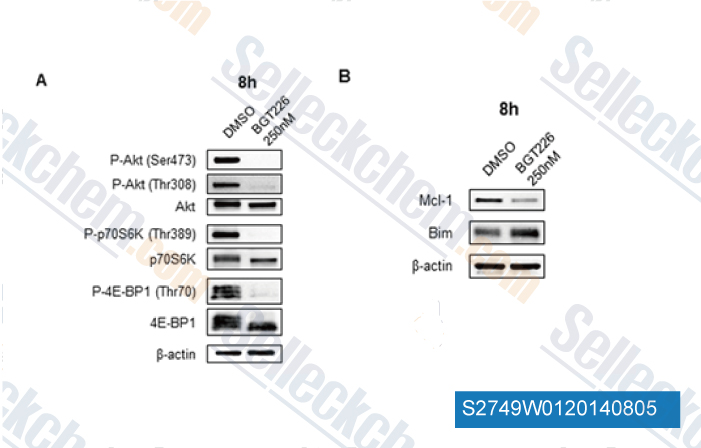
-
Dati da [ Cancer Lett , 2014 , 348(1-2), 38-49 ]
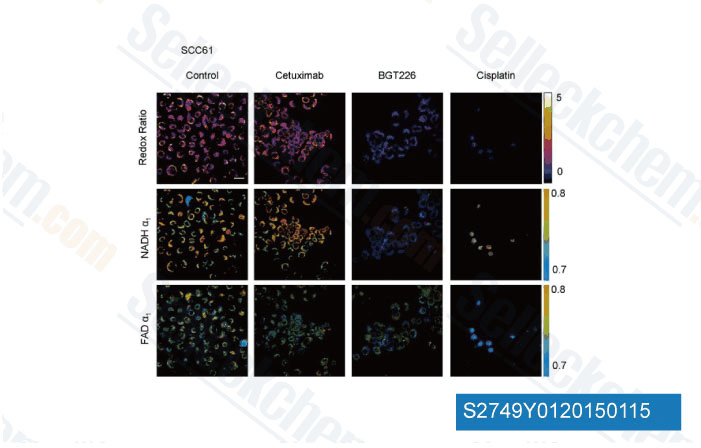
-
Dati da [ PLoS One , 2014 , 9(3), e90746 ]
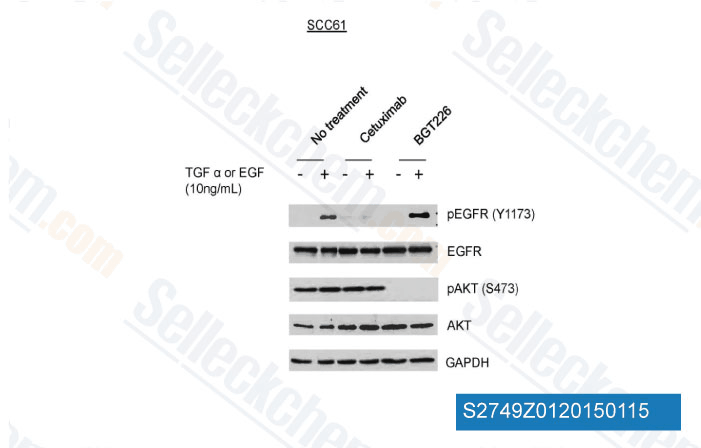
-
Dati da [ PLoS One , 2014 , 9(3), e90746 ]
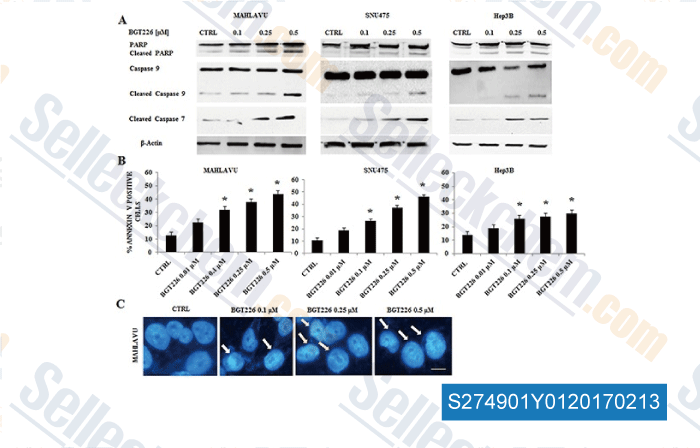
-
Dati da [ , , Oncotarget, 2015, 6(19):17147-60. ]
Sellecks BGT226 (NVP-BGT226) maleate È stato citato da 12 Pubblicazioni
| Heterogeneous Activation of Signaling Pathways and Therapeutic Vulnerabilities in KSHV-Associated Primary Effusion Lymphoma Cell Lines [ J Med Virol, 2025, 97(8):e70534] | PubMed: 40751690 |
| Role of the PI3K/AKT signaling pathway in the cellular response to Tumor Treating Fields (TTFields) [ Cell Death Dis, 2025, 16(1):210] | PubMed: 40148314 |
| PIK Your Poison: The Effects of Combining PI3K and CDK Inhibitors against Metastatic Cutaneous Squamous Cell Carcinoma In Vitro [ Cancers (Basel), 2024, 16(2)370] | PubMed: 38254859 |
| High-throughput and targeted drug screens identify pharmacological candidates against MiT-translocation renal cell carcinoma [ J Exp Clin Cancer Res, 2023, 42(1):99] | PubMed: 37095531 |
| A high-throughput screening platform identifies novel combination treatments for Malignant Peripheral Nerve Sheath Tumors [ Mol Cancer Ther, 2022, molcanther.MCT-21-0947-A.2021] | PubMed: 35511749 |
| Co-targeting PI3K, mTOR, and IGF1R with small molecule inhibitors for treating undifferentiated pleomorphic sarcoma. [ Cancer Biol Ther, 2017, 18(10):816-826] | PubMed: 29099264 |
| Healthy CD4+ T lymphocytes are not affected by targeted therapies against the PI3K/Akt/mTOR pathway in T-cell acute lymphoblastic leukemia. [ Oncotarget, 2016, 7(34):55690-55703] | PubMed: 27494886 |
| Synergistic effects of selective inhibitors targeting the PI3K/AKT/mTOR pathway or NUP214-ABL1 fusion protein in human Acute Lymphoblastic Leukemia. [Simioni C, et al. Oncotarget, 2016, 7(48):79842-79853] | PubMed: 27821800 |
| The PI3K/Akt Pathway Regulates Oxygen Metabolism via Pyruvate Dehydrogenase (PDH)-E1α Phosphorylation [Cerniglia GJ, et al. Mol Cancer Ther, 2015, 14(8):1928-38] | PubMed: 25995437 |
| The novel dual PI3K/mTOR inhibitor NVP-BGT226 displays cytotoxic activity in both normoxic and hypoxic hepatocarcinoma cells. [Simioni C, et al. Oncotarget, 2015, 6(19):17147-60] | PubMed: 26003166 |
POLITICA DI RESO
La politica di reso incondizionato di Selleck Chemical garantisce ai nostri clienti unesperienza di acquisto online senza problemi. Se non sei in alcun modo soddisfatto del tuo acquisto, puoi restituire qualsiasi articolo entro 7 giorni dalla ricezione. In caso di problemi di qualità del prodotto, sia relativi al protocollo che al prodotto, puoi restituire qualsiasi articolo entro 365 giorni dalla data di acquisto originale. Si prega di seguire le istruzioni seguenti per la restituzione dei prodotti.
SPEDIZIONE E CONSERVAZIONE
I prodotti Selleck vengono trasportati a temperatura ambiente. Se ricevi il prodotto a temperatura ambiente, ti assicuriamo che il Dipartimento di Ispezione Qualità di Selleck ha condotto esperimenti per verificare che la conservazione a temperatura normale per un mese non influirà sullattività biologica dei prodotti in polvere. Dopo la raccolta, conservare il prodotto secondo le indicazioni descritte nella scheda tecnica. La maggior parte dei prodotti Selleck è stabile nelle condizioni raccomandate.
NON PER USO UMANO, DIAGNOSTICO VETERINARIO O TERAPEUTICO.