
Dati tecnici
| Formula | C25H19NO3S |
||||||
| Peso molecolare | 413.49 | Numero CAS | 503468-95-9 | ||||
| Solubilità (25°C)* | In vitro | DMSO | 3 mg/mL (7.25 mM) | ||||
| Water | Insoluble | ||||||
| Ethanol | Insoluble | ||||||
| In vivo (Aggiungere i solventi al prodotto singolarmente e in ordine.) |
|
||||||
|
* <1 mg/ml significa leggermente solubile o insolubile. * Si prega di notare che Selleck testa la solubilità di tutti i composti internamente e la solubilità effettiva può differire leggermente dai valori pubblicati. Ciò è normale ed è dovuto a leggere variazioni da lotto a lotto. * Spedizione a temperatura ambiente (I test di stabilità mostrano che questo prodotto può essere spedito senza alcuna misura di raffreddamento.) |
|||||||
Preparazione delle soluzioni stock
Attività biologica
| Descrizione | NU7441 (KU-57788) è un inibitore molto potente e selettivo di DNA-PK con IC50 di 14 nM. Inibisce anche mTOR e PI3K con IC50 di 1,7 μM e 5 μM in saggi senza cellule, rispettivamente, e riduce la frequenza di NHEJ mentre aumenta il tasso di HDR in seguito alla scissione del DNA mediata da Cas9. | ||||||
|---|---|---|---|---|---|---|---|
| Target |
|
||||||
| In vitro | NU7441 (KU-57788) aumenta la persistenza dei foci γH2AX dopo il danno al DNA indotto da radiazioni ionizzanti. Esso (0,5 μM o 1 μM) aumenta notevolmente l'accumulo G2-M indotto da radiazioni ionizzanti e doxorubicina sia nelle cellule SW620 che LoVo. Questo composto causa la persistenza delle rotture del doppio filamento di DNA indotte da doxorubicina e radiazioni ionizzanti e diminuisce anche leggermente l'attività di ricombinazione omologa nelle cellule tumorali umane M059-Fus-1 competenti per DNA-PK e M059 J deficienti per DNA-PK. Inibisce l'iperfosforilazione di RPA p34 indotta da UV in modo dose-dipendente sia nelle cellule prive che nelle cellule che esprimono la polimerasi η. NU7441 aumenta i livelli di foci γH2AX indotti da e riduce corrispondentemente la morte cellulare indotta da nelle cellule di leucemia linfocitica cronica. Inibisce anche l'autofosforilazione e la riparazione di DNA-PKcs indotte da nelle cellule di leucemia linfocitica cronica. Questo composto riduce la frequenza di NHEJ mentre aumenta il tasso di HDR in seguito alla scissione del DNA mediata da Cas9. |
||||||
| In vivo | NU7441 (KU-57788) somministrato per via intraperitoneale alla dose di 10 mg/kg si mantiene per almeno 4 ore, mostra effetti non tossici e aumenta il ritardo della crescita tumorale indotta di 2 volte nei topi portatori di xenotrapianti SW620. |
Protocollo (da riferimento)
| Saggio cellulare: |
|
|---|---|
| Studio sugli animali: |
|
Riferimenti
|
Convalida del prodotto da parte del cliente
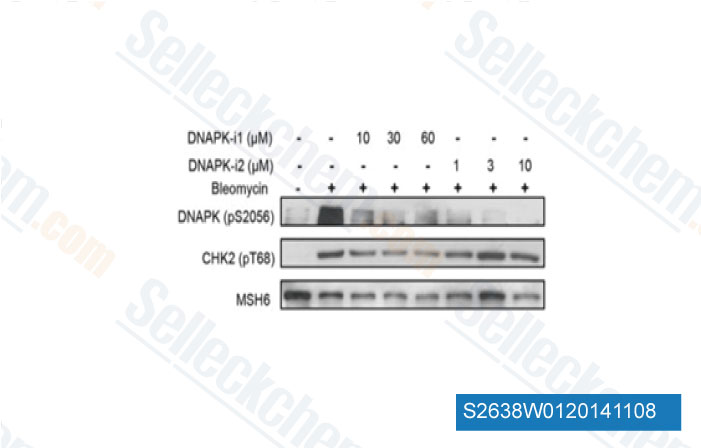
-
Dati da [ Toxicol Sci , 2014 , 10.1093/toxsci/kfu207 ]
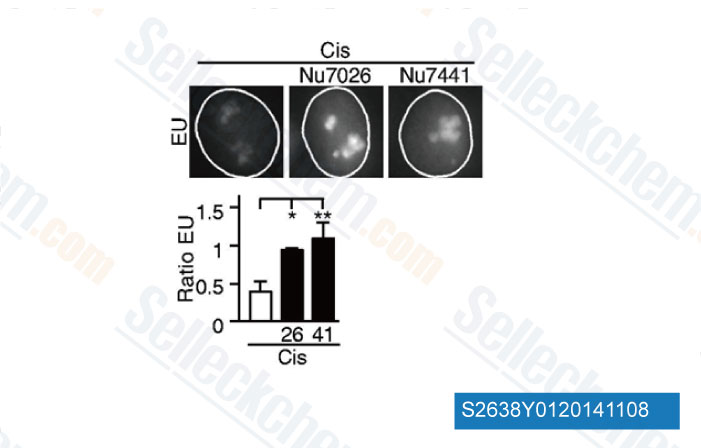
-
Dati da [ Nucleic Acids Res , 2013 , 41(15), 7378-86 ]
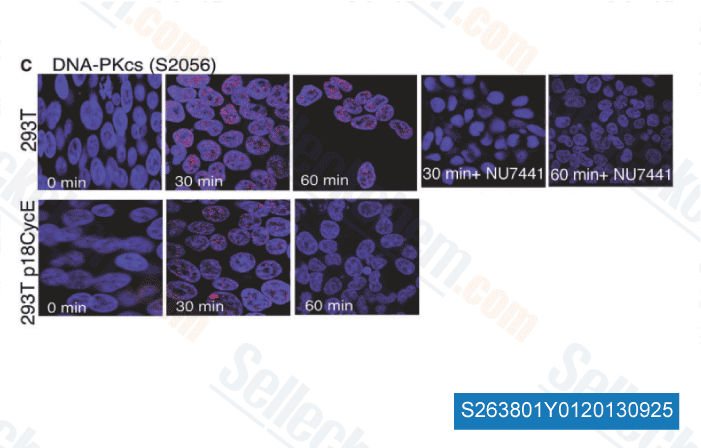
-
Dati da [ Nucleic Acids Res , 2013 , 41, 10157-69 ]
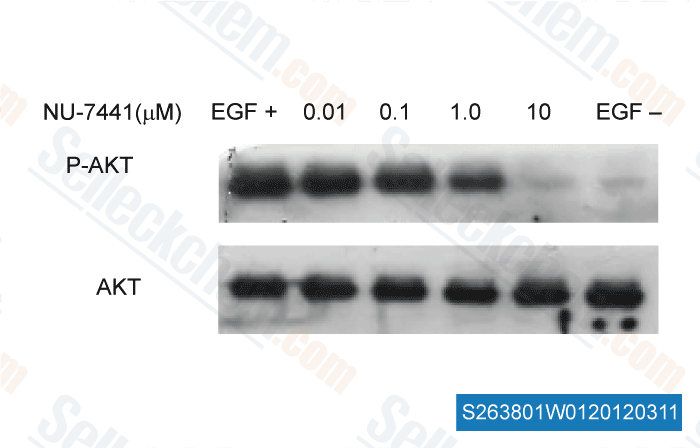
-
, , Dr. Zhang of Tianjin Medical University
Sellecks NU7441 (KU-57788) È stato citato da 309 Pubblicazioni
| Homologous recombination promotes non-immunogenic mitotic cell death upon DNA damage [ Nat Cell Biol, 2025, 27(1):59-72] | PubMed: 39805921 |
| Highly efficient prime editors for mammalian genome editing based on porcine retrovirus reverse transcriptase [ Trends Biotechnol, 2025, S0167-7799(25)00314-2] | PubMed: 40885667 |
| Phosphorylation-dependent WRN-RPA interaction promotes recovery of stalled forks at secondary DNA structure [ Nat Commun, 2025, 16(1):997] | PubMed: 39870632 |
| Autophosphorylation of the Tousled-like kinases TLK1 and TLK2 regulates recruitment to damaged chromatin via PCNA interaction [ Nucleic Acids Res, 2025, 53(4)gkae1279] | PubMed: 39727191 |
| Homeodomain protein PRRX1 anchors the Ku heterodimers at DNA double-strand breaks to promote nonhomologous end-joining [ Nucleic Acids Res, 2025, 53(6)gkaf200] | PubMed: 40114375 |
| ONE-STEP tagging: a versatile method for rapid site-specific integration by simultaneous reagent delivery [ Nucleic Acids Res, 2025, 53(15)gkaf809] | PubMed: 40823809 |
| The inflammasome sensor NLRP3 interacts with REV7 to maintain genome integrity through homologous recombination [ Nucleic Acids Res, 2025, 53(12)gkaf554] | PubMed: 40613708 |
| Nuclear damage-induced DNA damage response coupled with IFI16-driven ECM remodeling underlies dilated cardiomyopathy [ Theranostics, 2025, 15(12):5998-6021] | PubMed: 40365289 |
| Cross-species analysis of the nuclease Artemis highlights its evolving function in domesticating RAG-like transposons and residues that are crucial for activity [ PLoS Biol, 2025, 23(4):e3003056] | PubMed: 40245028 |
| DSCC1 restrains 53BP1/RIF1 signaling at DNA double-strand breaks to promote homologous recombination repair [ Cell Rep, 2025, 44(4):115452] | PubMed: 40117291 |
POLITICA DI RESO
La politica di reso incondizionato di Selleck Chemical garantisce ai nostri clienti unesperienza di acquisto online senza problemi. Se non sei in alcun modo soddisfatto del tuo acquisto, puoi restituire qualsiasi articolo entro 7 giorni dalla ricezione. In caso di problemi di qualità del prodotto, sia relativi al protocollo che al prodotto, puoi restituire qualsiasi articolo entro 365 giorni dalla data di acquisto originale. Si prega di seguire le istruzioni seguenti per la restituzione dei prodotti.
SPEDIZIONE E CONSERVAZIONE
I prodotti Selleck vengono trasportati a temperatura ambiente. Se ricevi il prodotto a temperatura ambiente, ti assicuriamo che il Dipartimento di Ispezione Qualità di Selleck ha condotto esperimenti per verificare che la conservazione a temperatura normale per un mese non influirà sullattività biologica dei prodotti in polvere. Dopo la raccolta, conservare il prodotto secondo le indicazioni descritte nella scheda tecnica. La maggior parte dei prodotti Selleck è stabile nelle condizioni raccomandate.
NON PER USO UMANO, DIAGNOSTICO VETERINARIO O TERAPEUTICO.