
Dati tecnici
| Formula | C23H20N6O |
||||||
| Peso molecolare | 396.44 | Numero CAS | 726169-73-9 | ||||
| Solubilità (25°C)* | In vitro | DMSO | 13 mg/mL (32.79 mM) | ||||
| Water | Insoluble | ||||||
| Ethanol | Insoluble | ||||||
| In vivo (Aggiungere i solventi al prodotto singolarmente e in ordine.) |
|
||||||
|
* <1 mg/ml significa leggermente solubile o insolubile. * Si prega di notare che Selleck testa la solubilità di tutti i composti internamente e la solubilità effettiva può differire leggermente dai valori pubblicati. Ciò è normale ed è dovuto a leggere variazioni da lotto a lotto. * Spedizione a temperatura ambiente (I test di stabilità mostrano che questo prodotto può essere spedito senza alcuna misura di raffreddamento.) |
|||||||
Preparazione delle soluzioni stock
Attività biologica
| Descrizione | Mocetinostat (MGCD0103, MG0103) è un potente inibitore di HDAC con la massima potenza per HDAC1 con IC50 di 0,15 μM in un saggio senza cellule, una selettività da 2 a 10 volte superiore contro HDAC2, 3 e 11, e nessuna attività verso HDAC4, 5, 6, 7 e 8. Mocetinostat (MGCD0103) induce Apoptosis e Autophagy. Fase 2. | ||||||||
|---|---|---|---|---|---|---|---|---|---|
| Target |
|
||||||||
| In vitro | Mocetinostat (MGCD0103) inibisce solo un sottoinsieme delle nove HDAC ricombinanti umane, incluse HDAC1, HDAC2, HDAC3 e HDAC11 a concentrazioni nanomolari o micromolari basse, in modo dose-dipendente. Rivela la più potente attività inibitoria contro gli enzimi HDAC1 e HDAC2 umani in vitro e non inibisce le HDAC di classe II. Il gruppo amminico esociclico in questo composto è necessario per l'attività inibitoria dell'enzima perché l'attività inibitoria di HDAC contro HDAC1 e HDAC2 è completamente abolita con l'analogo desamminico. La sua attività inibitoria raggiunge il plateau massimo a 6 μM, e il pool enzimatico massimo inibibile influenzato da MGCD0103 è il 75% dell'attività enzimatica totale nelle cellule HCT116, mentre NVP-LAQ824 inibisce quasi il 100% di quella in queste cellule. Nelle cellule A549, mostra anche un'inibizione dose-dipendente dell'attività HDAC nelle cellule intere. |
||||||||
| In vivo | Mocetinostat (MGCD0103) inibisce significativamente la crescita di xenotrapianti tumorali umani in topi nudi e l'attività antitumorale correlata all'induzione dell'acetilazione degli istoni nei tumori. L'amministrazione P.O. di questo composto (sale 2HBr) diminuisce significativamente la crescita dei tumori A549 avanzati impiantati in topi nudi in modo dose-dipendente dopo 13 giorni di somministrazione giornaliera. Esso (170 mg/kg per il sale 2HBr, corrispondente a 120 mg/kg di base libera) blocca significativamente la crescita dei tumori rispetto al solo trattamento con veicolo senza alcun cambiamento di peso corporeo. Inoltre, non riduce il numero di globuli bianchi ed è ben tollerato. Il composto è anche attivo per via orale in molti altri modelli di xenotrapianto tumorale umano, incluso l'NSCLC H1437. A 80 mg/kg (base libera), blocca quasi completamente la crescita dei tumori H1437 dopo 13 giorni di somministrazione giornaliera p.o. senza riduzione del peso corporeo negli animali. Riduce la pressione arteriosa polmonare in modo più drammatico. Inoltre, questo composto migliora il tempo di accelerazione dell'arteria polmonare e riduce l'incavo sistolico dell'inviluppo del flusso dell'arteria polmonare, il che suggerisce un impatto positivo dell'inibitore di HDAC sul rimodellamento e l'irrigidimento vascolare polmonare. |
Protocollo (da riferimento)
| Saggio della chinasi: |
|
|---|---|
| Saggio cellulare: |
|
| Studio sugli animali: |
|
Riferimenti
|
Convalida del prodotto da parte del cliente
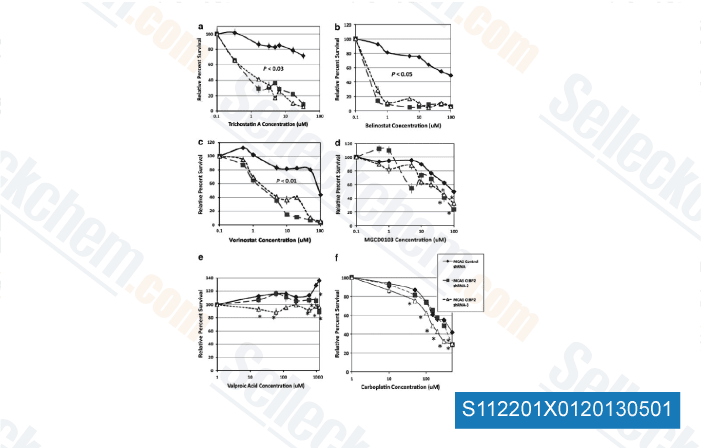
-
Dati da [ Oncogene , 2012 , 32, 3896-903 ]
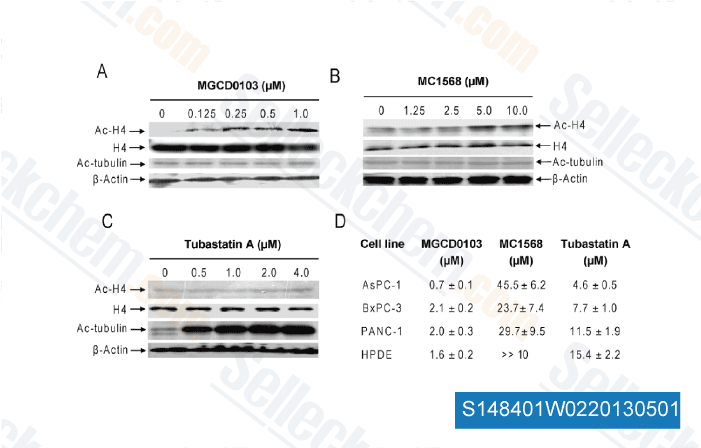
-
Dati da [ PLoS One , 2012 , 7, e52095 ]
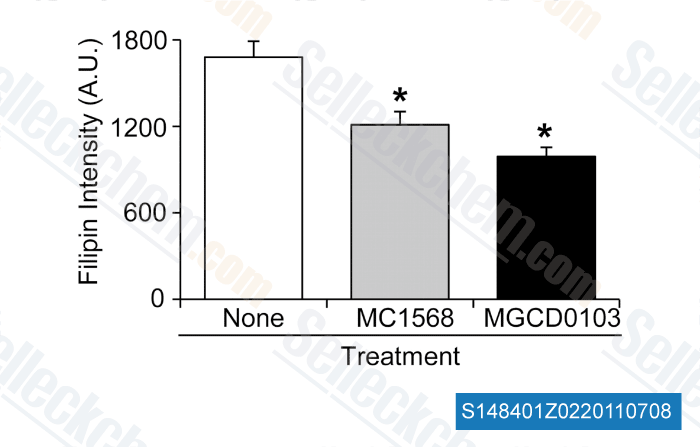
-
Dati da [ J Biol Chem , 2011 , 286, 23842–23851 ]
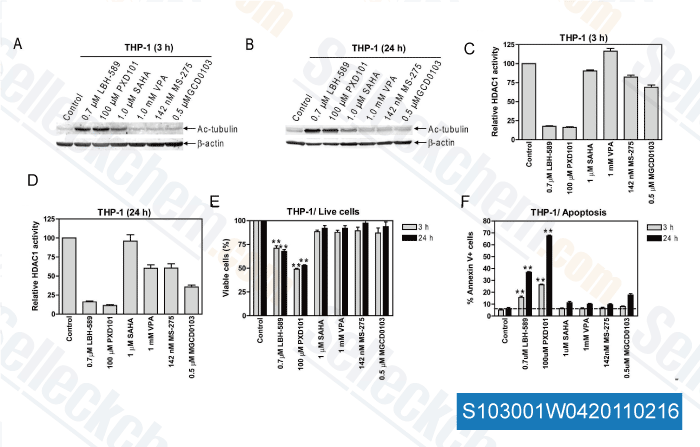
-
Dati da [ PLoS One , 2011 , 6, e17138 ]
Sellecks Mocetinostat (MGCD0103) È stato citato da 119 Pubblicazioni
| Identifying Age-Modulating Compounds Using a Novel Computational Framework for Evaluating Transcriptional Age [ Aging Cell, 2025, e70075] | PubMed: 40307992 |
| Signal transduction pathways controlling Ins2 gene activity and beta cell state transitions [ iScience, 2025, 28(3):112015] | PubMed: 40144638 |
| Inhibition of HDAC6 elicits anticancer effects on head and neck cancer cells through Sp1/SOD3/MKP1 signaling axis to downregulate ERK phosphorylation [ Cell Signal, 2025, 127:111587] | PubMed: 39755348 |
| The microbial metabolite butyrate enhances the effector and memory functions of murine CD8+ T cells and improves anti-tumor activity [ Front Med (Lausanne), 2025, 12:1577906] | PubMed: 40630475 |
| HIV-1 Vpr drives epigenetic remodeling to enhance virus transcription and latency reactivation [ bioRxiv, 2025, 2025.01.31.635859] | PubMed: 39975144 |
| Role of the NuRD complex and altered proteostasis in cancer cell quiescence [ bioRxiv, 2025, 2025.02.10.637435] | PubMed: 39990343 |
| Inhibition of HDAC activity directly reprograms murine embryonic stem cells to trophoblast stem cells [ Dev Cell, 2024, S1534-5807(24)00326-5] | PubMed: 38823394 |
| Inhibition of Selenoprotein I promotes ferroptosis and reverses resistance to platinum chemotherapy by impairing Akt phosphorylation in ovarian cancer [ MedComm (2020), 2024, 5(12):e70033] | PubMed: 39669976 |
| Romidepsin and afatinib abrogate JAK-STAT signaling and elicit synergistic antitumor effects in cutaneous T-cell lymphoma [ J Invest Dermatol, 2024, S0022-202X(23)03210-4] | PubMed: 38219917 |
| Pancreatic cancer acquires resistance to MAPK pathway inhibition by clonal expansion and adaptive DNA hypermethylation [ Clin Epigenetics, 2024, 16(1):13] | PubMed: 38229153 |
POLITICA DI RESO
La politica di reso incondizionato di Selleck Chemical garantisce ai nostri clienti unesperienza di acquisto online senza problemi. Se non sei in alcun modo soddisfatto del tuo acquisto, puoi restituire qualsiasi articolo entro 7 giorni dalla ricezione. In caso di problemi di qualità del prodotto, sia relativi al protocollo che al prodotto, puoi restituire qualsiasi articolo entro 365 giorni dalla data di acquisto originale. Si prega di seguire le istruzioni seguenti per la restituzione dei prodotti.
SPEDIZIONE E CONSERVAZIONE
I prodotti Selleck vengono trasportati a temperatura ambiente. Se ricevi il prodotto a temperatura ambiente, ti assicuriamo che il Dipartimento di Ispezione Qualità di Selleck ha condotto esperimenti per verificare che la conservazione a temperatura normale per un mese non influirà sullattività biologica dei prodotti in polvere. Dopo la raccolta, conservare il prodotto secondo le indicazioni descritte nella scheda tecnica. La maggior parte dei prodotti Selleck è stabile nelle condizioni raccomandate.
NON PER USO UMANO, DIAGNOSTICO VETERINARIO O TERAPEUTICO.