
Dati tecnici
| Formula | C22H21ClFN3O3S |
||||||
| Peso molecolare | 461.94 | Numero CAS | 1010085-13-8 | ||||
| Solubilità (25°C)* | In vitro | DMSO | 92 mg/mL (199.16 mM) | ||||
| Water | Insoluble | ||||||
| Ethanol | Insoluble | ||||||
| In vivo (Aggiungere i solventi al prodotto singolarmente e in ordine.) |
|
||||||
|
* <1 mg/ml significa leggermente solubile o insolubile. * Si prega di notare che Selleck testa la solubilità di tutti i composti internamente e la solubilità effettiva può differire leggermente dai valori pubblicati. Ciò è normale ed è dovuto a leggere variazioni da lotto a lotto. * Spedizione a temperatura ambiente (I test di stabilità mostrano che questo prodotto può essere spedito senza alcuna misura di raffreddamento.) |
|||||||
Preparazione delle soluzioni stock
Attività biologica
| Descrizione | MK-5108 (VX-689) è un inibitore altamente selettivo dell'Aurora A con IC50 di 0,064 nM in un saggio acellulare ed è 220 e 190 volte più selettivo per Aurora A rispetto ad Aurora B/C, mentre inibisce TrkA con meno di 100 volte la selettività. Questo composto induce l'Autophagy. Fase 1. | ||
|---|---|---|---|
| Target |
|
||
| In vitro | MK-5108 inibisce l'attività di Aurora-A in modo ATP-competitivo. Questo composto mostra una robusta selettività contro le altre chinasi della famiglia Aurora-B (220 volte) e Aurora-C (190 volte) nel saggio biochimico. Rivela anche un'elevata selettività per Aurora-A rispetto ad altre protein chinasi. Il composto inibisce solo una chinasi (TrkA) con una selettività <100 volte. Potrebbe essere più selettivo per Aurora-A rispetto a MLN8054. Coerentemente con l'induzione di cellule pHH3-positive, questa sostanza chimica induce l'accumulo di cellule nella fase G2-M. Inibisce la proliferazione delle cellule tumorali, incluse HCC1143, AU565, MCF-7, HCC1806 e CAL85-1 con un IC50 di 0,42 μM, 0,45 μM, 0,52 μM, 0,56μM e 0,74 μM, rispettivamente. Questo composto diminuisce la vitalità cellulare in modo dose-dipendente in tutte e tre le linee cellulari, comprese le cellule LEIO285, LEIO505 e SK-LSM1, con un IC50 di circa 100 nM. L'incubazione con esso in LEIO285 aumenta la proporzione di cellule in G2/M a 48 e 72 ore post-trattamento. Il composto aumenta significativamente l'attività di Caspasi 3/7 rispetto alle colture di controllo trattate con DMSO in entrambi i momenti. Nelle cellule LEIO505, porta a un maggiore accumulo di cellule nelle fasi G2/M a 24 ore, ma non a 48 o 72 ore. |
||
| In vivo | MK-5108 induce cellule pHH3-positive a dosi di 16 mg/kg e 32 mg/kg. La concentrazione plasmatica di questo composto a 8 mg/kg e 16 mg/kg è rispettivamente di 1,7 μM e 4,4 μM. Il trattamento con questo composto provoca l'induzione di pHH3 nei tessuti tumorali e cutanei, che inizia a 2 ore e raggiunge un massimo a 4 ore. I trattamenti chimici a 15 mg/kg e 30 mg/kg comportano una significativa inibizione della crescita tumorale con la variazione del volume tumorale medio per il gruppo di trattamento in percentuale della variazione media nel gruppo di controllo (%T/C) del 10% e −6% al giorno 11, e del 17% e 5% al giorno 18, rispettivamente. È ben tollerato a entrambe le dosi, con una minima riduzione del peso corporeo. Questo composto mostra anche una significativa attività antitumorale attraverso dosaggi intermittenti in ratti nudi portatori di tumori SW48; a 15 mg/kg e 45 mg/kg causa un'inibizione della crescita tumorale dose-dipendente con un %T/C del 35% e 7% al giorno 10, e del 58% e 32% al giorno 27, rispettivamente. |
Protocollo (da riferimento)
| Saggio della chinasi: |
|
|---|---|
| Saggio cellulare: |
|
| Studio sugli animali: |
|
Riferimenti
|
Convalida del prodotto da parte del cliente
-S277001W0220130927.gif)
-
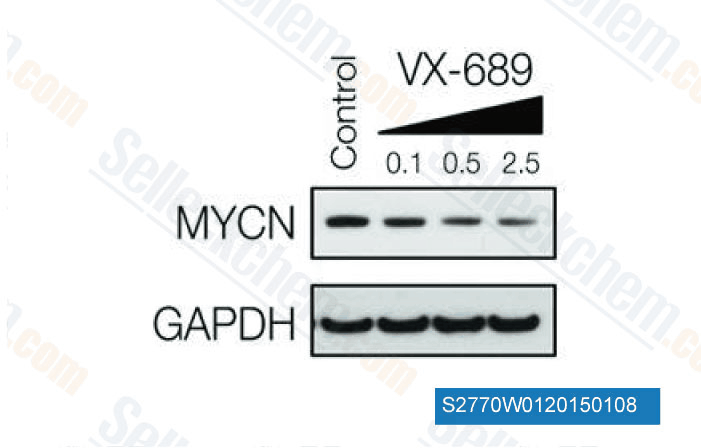
Dati da [ Oncogene , 2014 , 33, 3550-60 ]
-
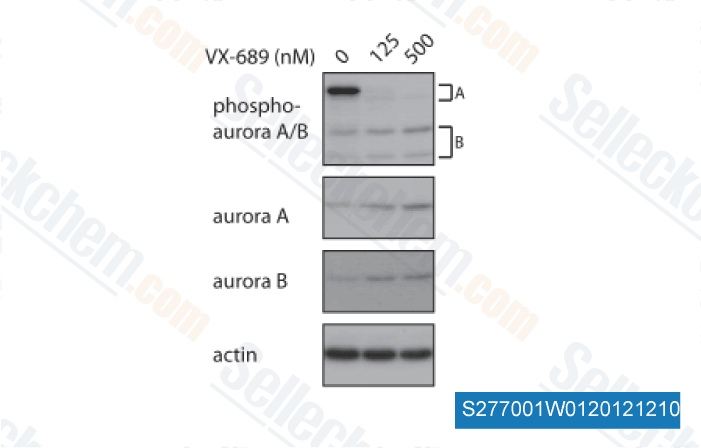
Dati da [ Cancer Discov , 2013 , 10.1158/2159-8290.CD-12-0426 ]
![P53 expression in the 14G2a mAb-treated IMR-32 cell line and after combinatorial treatment with MK-5108 inhibitor. P53 protein content was measured in whole cell-WCE (A), cytoplasmic-CE (C) and nuclear-NE (E) extracts at 2, 6, 24 and 48 h after 14G2a addition (40 ug/ml) into culture media of IMR-32 cells, and normalized to GAPDH levels (for WCE and CE), or TBP (for NE). Mean values of three separate experiments (盨EM) obtained for the 14G2a mAb-treated cells are shown as empty bars, and calculated versus control value, set as 1 (black baseline). ANOVA shows no statistically significant changes of P53 level in time in IMR-32 WCE [F(3, 9) = 1.35, p = 0.3181]. Statistically significant changes of P53 level in time were found in CE [F(3, 6) = 53.76, p = 0.0001], and in NE [F(3, 6) = 63.17, p = 0.0001], as compared to 2 h time point. P53 expression level was measured in whole cell-WCE (B), cytoplasmic-CE (D) and nuclear-NE (F) extracts at 2 and 24 h after the 14G2a mAb treatment alone (white bars with black stripes) or in combination with MK-5108 inhibitor (black bars with white stripes), and normalized to GAPDH levels (for WCE and CE), or TBP (for NE). Below each chart representative immunoblottings are presented; C-control cells; mAb-the 14G2a mAb-treated cells; I + mAb-MK-5108 inhibitor and the mAb-treated cells. P-values for t-test were as follow: p < 0.05 (*), p < 0.01 (**), p < 0.001 (***).](https://file.selleckchem.com/downloads/review/700px/VX-689-S2770W0220150108.gif)
-
Dati da [ Cancer Lett , 2013 , 341(2), 248-64 ]
-
, , Ken Ma Hong Kong University of Science & Technology
Sellecks MK-5108 È stato citato da 41 Pubblicazioni
| Establishment, characterization, and biobanking of 36 pancreatic cancer organoids: prediction of metastasis in resectable pancreatic cancer [ Cell Oncol (Dordr), 2024, 10.1007/s13402-024-00939-5] | PubMed: 38619751 |
| Inhibition of epigenetic and cell cycle-related targets in glioblastoma cell lines reveals that onametostat reduces proliferation and viability in both normoxic and hypoxic conditions [ Sci Rep, 2024, 14(1):4303] | PubMed: 38383756 |
| Exploiting ulnerabilities induced b recurrent mutations in chondrosarcoma and giant cell tumour of bone: therapeutic targeting of the altered epigenome and be [ Leiden University The Netherlands, 2023, ] | PubMed: None |
| Spatially distinct inputs modulate the amount of active Mitotic-phase GAP to locally restrict RhoA signaling for successful cell division [ bioRxiv, 2023, 10.1101/2023.08.08.552464] | PubMed: None |
| Revisiting the Resazurin-Based Sensing of Cellular Viability: Widening the Application Horizon [ Biosensors (Basel), 2022, 12(4)196] | PubMed: 35448256 |
| Culture and multiomic analysis of lung cancer patient-derived pleural effusions revealed distinct druggable molecular types [ Sci Rep, 2022, 12(1):6345] | PubMed: 35428753 |
| 選択的オーロラキナーゼ A 阻害剤 TAS-119 を用いたオーロラキナーゼ A 阻害剤の薬剤感受性マーカーの探索 [ , 2022, ] | PubMed: none |
| Targeting Aurora B kinase prevents and overcomes resistance to EGFR inhibitors in lung cancer by enhancing BIM- and PUMA-mediated apoptosis [ Cancer Cell, 2021, S1535-6108(21)00383-4] | PubMed: 34388376 |
| Multifocal Organoid Capturing of Colon Cancer Reveals Pervasive Intratumoral Heterogenous Drug Responses [ Adv Sci (Weinh), 2021, e2103360] | PubMed: 34918496 |
| Size-Selective VAILase Proteolysis Provides Dynamic Insights into Protein Structures [ Anal Chem, 2021, 93(30):10653-10660] | PubMed: 34291915 |
POLITICA DI RESO
La politica di reso incondizionato di Selleck Chemical garantisce ai nostri clienti unesperienza di acquisto online senza problemi. Se non sei in alcun modo soddisfatto del tuo acquisto, puoi restituire qualsiasi articolo entro 7 giorni dalla ricezione. In caso di problemi di qualità del prodotto, sia relativi al protocollo che al prodotto, puoi restituire qualsiasi articolo entro 365 giorni dalla data di acquisto originale. Si prega di seguire le istruzioni seguenti per la restituzione dei prodotti.
SPEDIZIONE E CONSERVAZIONE
I prodotti Selleck vengono trasportati a temperatura ambiente. Se ricevi il prodotto a temperatura ambiente, ti assicuriamo che il Dipartimento di Ispezione Qualità di Selleck ha condotto esperimenti per verificare che la conservazione a temperatura normale per un mese non influirà sullattività biologica dei prodotti in polvere. Dopo la raccolta, conservare il prodotto secondo le indicazioni descritte nella scheda tecnica. La maggior parte dei prodotti Selleck è stabile nelle condizioni raccomandate.
NON PER USO UMANO, DIAGNOSTICO VETERINARIO O TERAPEUTICO.