
Dati tecnici
| Formula | C13H13N3O3 |
||||||||||
| Peso molecolare | 259.26 | Numero CAS | 191732-72-6 | ||||||||
| Solubilità (25°C)* | In vitro | DMSO | 51 mg/mL (196.71 mM) | ||||||||
| Water | Insoluble | ||||||||||
| Ethanol | Insoluble | ||||||||||
| In vivo (Aggiungere i solventi al prodotto singolarmente e in ordine.) |
|
||||||||||
|
* <1 mg/ml significa leggermente solubile o insolubile. * Si prega di notare che Selleck testa la solubilità di tutti i composti internamente e la solubilità effettiva può differire leggermente dai valori pubblicati. Ciò è normale ed è dovuto a leggere variazioni da lotto a lotto. * Spedizione a temperatura ambiente (I test di stabilità mostrano che questo prodotto può essere spedito senza alcuna misura di raffreddamento.) |
|||||||||||
Preparazione delle soluzioni stock
Attività biologica
| Descrizione | Lenalidomide è un inibitore della secrezione di TNF-α con IC50 di 13 nM nelle PBMC. Lenalidomide (CC-5013) è un ligando dell'ubiquitin E3 ligase cereblon (CRBN) e provoca l'ubiquitinazione selettiva e la degradazione di due fattori di trascrizione linfoidi, IKZF1 e IKZF3, da parte dell'ubiquitin ligase CRBN-CRL4. Lenalidomide promuove l'espressione della cleaved caspase-3 e inibisce l'espressione del VEGF e induce l'apoptosis. | ||||||
|---|---|---|---|---|---|---|---|
| Target |
|
||||||
| In vitro | Lenalidomide strongly induces IL-2 and sIL-2R production. This compound-induced tyrosine phosphorylation of CD28 on T cells is followed by a down-stream activation of NF-κB. This compound and pomalidomide inhibits autoubiquitination of CRBN in HEK293 T cells expressing thalidomide-binding competent wild-type CRBN, but not thalidomide-binding defective CRBN(YW/AA). Overexpression of CRBN wild-type protein, but not CRBN(YW/AA) mutant protein, in KMS12 myeloma cells, amplifies pomalidomide-mediated reductions in c-myc and IRF4 expression and increases in p21(WAF-1) expression. Long-term selection for this compound resistance in H929 myeloma cell lines is accompanied by a reduction in CRBN, while in DF15R myeloma cells resistant to both pomalidomide and this chemical, CRBN protein is undetectable. This chemical prevents induction of defects by down-regulating tumor cell inhibitory molecule expression. It prevents induction of tumor-induced T cell lytic synapse dysfunction. This compound treatment blocks CLL cell-induced T cell actin synapse dysfunction, mimicks antibody blockade, and down-regulates expression of CLL inhibitory ligands and their receptors on T cells. This treatment prevents tumor-induced immune suppression in FL, DLBCL, HL, MM, SCC, and OC and down-regulates immunosuppressive ligand expression on all tumor cells examined. CTL killing function significantly increases following antibody blockade of CLL inhibitory ligands or this chemical treatment compared to control treatments. Treatment of autologous CLL-T cell co-cultures with this agent reverses impaired CD8+ T cell lytic synapse formation and granzyme B trafficking. |
||||||
| In vivo | The induction of angiogenesis by bFGF is significantly inhibited by oral treatment of Lenalidomide in a dose-dependent manner. This compound significantly decreases the percentage of vascularized area from 5.16% (control group) to 2.58% (50 mg/kg). It significantly reduces the calculated total MVL from 21.07 (control) to 8.11 (50 mg/kg). This chemical significantly inhibites HUVEC migration through the fibronectin-coated membranes towards 0.1 ng/mL of bFGF at 100 μM, 1 ng/mL of VEGF at concentrations of 10 μM and 100 μM. |
Protocollo (da riferimento)
| Saggio della chinasi: |
|
|---|---|
| Studio sugli animali: |
|
Riferimenti
|
Convalida del prodotto da parte del cliente
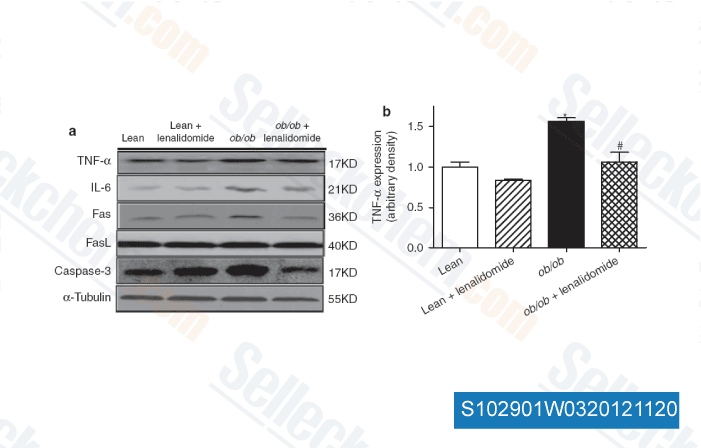
-
Dati da [ Obesity , 2012 , 20, 2174-85 ]

-
, , Harvard Medical School

-
, , Harvard Medical School

-
Dati da [ , , Clin Cancer Res, 2011, 17(10): 3259–71 ]
Selleck's CC-5013 (Lenalidomide) È stato citato da 190 Pubblicazioni
| Dual targeting PD-L1 and 4-1BB to overcome dendritic cell-mediated lenalidomide resistance in follicular lymphoma [ Signal Transduct Target Ther, 2025, 10(1):29] | PubMed: 39828715 |
| IKAROS levels are associated with antigen escape in CD19- and CD22-targeted therapies for B-cell malignancies [ Nat Commun, 2025, 16(1):3800] | PubMed: 40268897 |
| A patient-derived T cell lymphoma biorepository uncovers pathogenetic mechanisms and host-related therapeutic vulnerabilities [ Cell Rep Med, 2025, S2666-3791(25)00102-8] | PubMed: 40147445 |
| Haploinsufficiency of miR-143 and miR-145 reveal targetable dependencies in resistant del(5q) myelodysplastic neoplasm [ Leukemia, 2025, 39(4):917-928] | PubMed: 40000845 |
| The Prolonged Half-Life of the p53 Missense Variant R248Q Promotes Accumulation and Heterotetramer Formation with Wild-Type p53 to Exert the Dominant-Negative Effect [ Cancer Research, 2025, 1978-1996] | PubMed: 40163352 |
| The Prolonged Half-Life of the p53 Missense Variant R248Q Promotes Accumulation and Heterotetramer Formation with Wildtype p53 to Exert the Dominant-Negative Effect [ Cancer Res, 2025, 10.1158/0008-5472.CAN-24-1136] | PubMed: 40163352 |
| Enhancing T cell cytotoxicity in multiple myeloma with bispecific αPD-L1 × αCD3 T cell engager-armed T cells and low-dose bortezomib therapy [ Biomed Pharmacother, 2025, 184:117878] | PubMed: 39891948 |
| Rapid and high-throughput screening of proteolysis targeting chimeras using a dual-reporter system expressing fluorescence protein and luciferase [ BMC Biol, 2025, 23(1):51] | PubMed: 39985000 |
| KAT/3BP: A Metabolism-Targeting Agent with Single and Combination Activity in Aggressive B-Cell Lymphomas [ Cancers (Basel), 2025, 17(12)2034] | PubMed: 40563683 |
| Reposition of lenalidomide as a radiation protector based on LINCS gene expression signatures and its preclinical validation [ Sci Rep, 2025, 15(1):12955] | PubMed: 40234645 |
POLITICA DI RESO
La politica di reso incondizionato di Selleck Chemical garantisce ai nostri clienti un'esperienza di acquisto online senza problemi. Se non sei in alcun modo soddisfatto del tuo acquisto, puoi restituire qualsiasi articolo entro 7 giorni dalla ricezione. In caso di problemi di qualità del prodotto, sia relativi al protocollo che al prodotto, puoi restituire qualsiasi articolo entro 365 giorni dalla data di acquisto originale. Si prega di seguire le istruzioni seguenti per la restituzione dei prodotti.
SPEDIZIONE E CONSERVAZIONE
I prodotti Selleck vengono trasportati a temperatura ambiente. Se ricevi il prodotto a temperatura ambiente, ti assicuriamo che il Dipartimento di Ispezione Qualità di Selleck ha condotto esperimenti per verificare che la conservazione a temperatura normale per un mese non influirà sull'attività biologica dei prodotti in polvere. Dopo la raccolta, conservare il prodotto secondo le indicazioni descritte nella scheda tecnica. La maggior parte dei prodotti Selleck è stabile nelle condizioni raccomandate.
NON PER USO UMANO, DIAGNOSTICO VETERINARIO O TERAPEUTICO.