
Dati tecnici
| Formula | C26H29N3O3 |
||||||
| Peso molecolare | 431.53 | Numero CAS | 897016-82-9 | ||||
| Solubilità (25°C)* | In vitro | DMSO | 86 mg/mL (199.29 mM) | ||||
| Water | Insoluble | ||||||
| Ethanol | Insoluble | ||||||
| In vivo (Aggiungere i solventi al prodotto singolarmente e in ordine.) |
|
||||||
|
* <1 mg/ml significa leggermente solubile o insolubile. * Si prega di notare che Selleck testa la solubilità di tutti i composti internamente e la solubilità effettiva può differire leggermente dai valori pubblicati. Ciò è normale ed è dovuto a leggere variazioni da lotto a lotto. * Spedizione a temperatura ambiente (I test di stabilità mostrano che questo prodotto può essere spedito senza alcuna misura di raffreddamento.) |
|||||||
Preparazione delle soluzioni stock
Attività biologica
| Descrizione | Tirbanibulin, il primo inibitore clinico di Src (classe peptidomimetica) che si lega al sito del substrato peptidico di Src, con GI50 di 9-60 nM in linee cellulari tumorali. Fase 2. | ||||||||
|---|---|---|---|---|---|---|---|---|---|
| Target |
|
||||||||
| In vitro | KX2-391 è un inibitore di Src che si dirige alla tasca del substrato di Src. KX2-391 mostra curve dose-risposta ripide contro Huh7 (GI 50 = 9 nM), PLC/PRF/5 (GI 50 = 13 nM), Hep3B (GI 50 = 26 nM) e HepG2 (GI 50 = 60 nM), quattro linee cellulari di carcinoma epatocellulare (HCC). KX2-391 è stato scoperto inibire alcune cellule leucemiche resistenti ai farmaci attualmente disponibili in commercio, come quelle derivate da cellule leucemiche croniche con la mutazione T3151. KX2-391 è valutato in saggi di crescita cellulare guidata da Src ingegnerizzati in cellule NIH3T3/c-Src527F e SYF/c-Src527F ed esibisce GI50 con 23 nM e 39 nM, rispettivamente. |
||||||||
| In vivo | In modelli animali preclinici di cancro, il KX2-391 somministrato per via orale ha dimostrato di inibire la crescita del tumore primario e di sopprimere la metastasi. |
Protocollo (da riferimento)
| Saggio cellulare: |
|
|---|
Riferimenti
|
Convalida del prodotto da parte del cliente
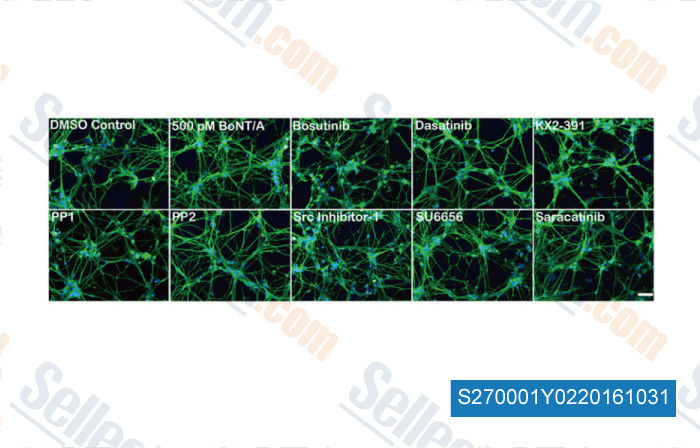
-
, , Neurotox Res, 2015, 27(4):384-98.
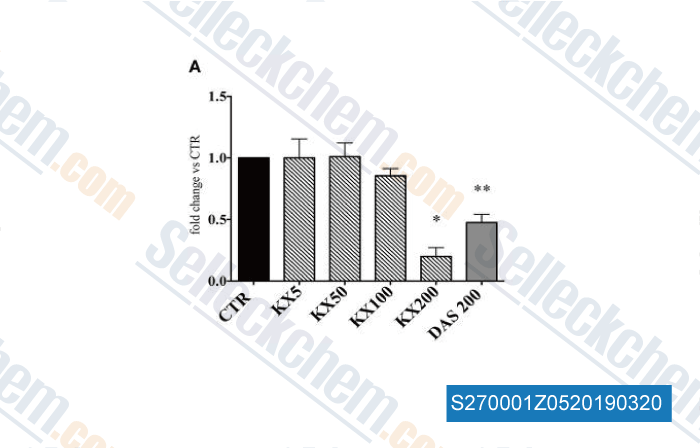
-
Dati da [ , , Front Immunol, 2018, 9:2433 ]
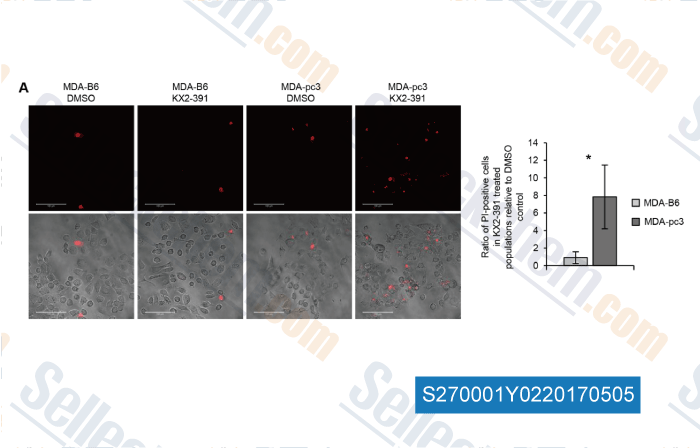
-
Dati da [ , , Oncotarget, 2016, 7(31):50027-50042 ]
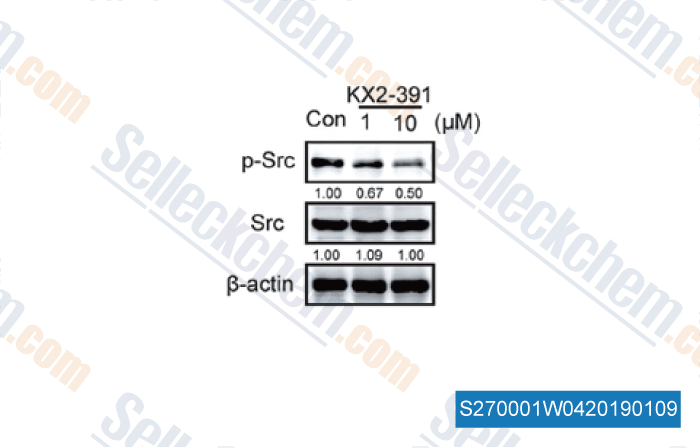
-
Dati da [ , , Acta Pharmacol Sin, 2018, 39(8):1326-1337 ]
Sellecks Tirbanibulin È stato citato da 41 Pubblicazioni
| S1PR3-driven positive feedback loop sustains STAT3 activation and keratinocyte hyperproliferation in psoriasis [ Cell Death Dis, 2025, 16(1):31] | PubMed: 39833165 |
| Src/FN1 pathway activation drives tumor cell cluster formation and metastasis in lung cancer: A promising therapeutic target [ Sci Adv, 2025, 11(28):eadv7377] | PubMed: 40632865 |
| Tirbanibulin (KX2-391) analog KX2-361 inhibits botulinum neurotoxin serotype A mediated SNAP-25 cleavage in pre- and post-intoxication models in cells [ Drug Dev Res, 2024, 85(6):e22248] | PubMed: 39166850 |
| Anti-tumor effects of tirbanibulin in squamous cell carcinoma cells are mediated via disruption of tubulin-polymerization [ Arch Dermatol Res, 2024, 316(7):341] | PubMed: 38847867 |
| Tumor Cell-Intrinsic CD96 Mediates Chemoresistance and Cancer Stemness by Regulating Mitochondrial Fatty Acid β-Oxidation [ Adv Sci (Weinh), 2023, 10(7):e2202956] | PubMed: 36581470 |
| THY1 (CD90) Maintains the Adherens Junctions in Nasopharyngeal Carcinoma via Inhibition of SRC Activation [ Cancers (Basel), 2023, 15(7)2189] | PubMed: 37046850 |
| Intracellular CYTL1, a novel tumor suppressor, stabilizes NDUFV1 to inhibit metabolic reprogramming in breast cancer [ Signal Transduct Target Ther, 2022, 7(1):35] | PubMed: 35115484 |
| Systematic identification of biomarker-driven drug combinations to overcome resistance [ Nat Chem Biol, 2022, 10.1038/s41589-022-00996-7] | PubMed: 35332332 |
| Procr functions as a signaling receptor and is essential for the maintenance and self-renewal of mammary stem cells [ Cell Rep, 2022, 38(12):110548] | PubMed: 35320720 |
| Identification of New Vulnerabilities in Conjunctival Melanoma Using Image-Based High Content Drug Screening [ Cancers (Basel), 2022, 14(6)1575] | PubMed: 35326726 |
POLITICA DI RESO
La politica di reso incondizionato di Selleck Chemical garantisce ai nostri clienti unesperienza di acquisto online senza problemi. Se non sei in alcun modo soddisfatto del tuo acquisto, puoi restituire qualsiasi articolo entro 7 giorni dalla ricezione. In caso di problemi di qualità del prodotto, sia relativi al protocollo che al prodotto, puoi restituire qualsiasi articolo entro 365 giorni dalla data di acquisto originale. Si prega di seguire le istruzioni seguenti per la restituzione dei prodotti.
SPEDIZIONE E CONSERVAZIONE
I prodotti Selleck vengono trasportati a temperatura ambiente. Se ricevi il prodotto a temperatura ambiente, ti assicuriamo che il Dipartimento di Ispezione Qualità di Selleck ha condotto esperimenti per verificare che la conservazione a temperatura normale per un mese non influirà sullattività biologica dei prodotti in polvere. Dopo la raccolta, conservare il prodotto secondo le indicazioni descritte nella scheda tecnica. La maggior parte dei prodotti Selleck è stabile nelle condizioni raccomandate.
NON PER USO UMANO, DIAGNOSTICO VETERINARIO O TERAPEUTICO.