
|
Come citare 1. Per la citazione nel testo (Materiali e Metodi): 2. Per la tabella delle risorse chiave: |
||
|
Numero verde: (877) 796-6397 -- Solo USA e Canada -- |
Fax: +1-832-582-8590 Ordini: +1-832-582-8158 |
Supporto tecnico: +1-832-582-8158 Ext:3 Si prega di fornire il numero dordine nelle-mail. Ci sforziamo di rispondere a tutte le richieste via e-mail entro un giorno lavorativo. |
Descrizione biologica
| Specificità | Insulin Antibody [K13G15] riconosce i livelli endogeni della proteina Insulin totale. |
|---|---|
| Contesto | L'insulina è un ormone peptidico composto da 51 amminoacidi, secreto dalle cellule β del pancreas. Svolge un ruolo vitale nel mantenimento dell'omeostasi del glucosio legandosi al recettore dell'insulina (IR), una Protein Tyrosine Kinase transmembrana composta da due subunità α extracellulari responsabili del legame del ligando e due subunità β intracellulari che mediano la trasduzione del segnale. Dopo l'interazione con l'insulina, il recettore subisce autofosforilazione sui suoi residui di tirosina, attivando la sua attività chinasica. Questo porta alla fosforilazione dei substrati del recettore dell'insulina (IRS), che a loro volta reclutano e attivano la fosfoinositide 3-chinasi (PI3K). La PI3K attivata genera fosfatidilinositolo (3,4,5)-trifosfato (PIP3), che facilita l'attivazione di AKT (protein kinase B). L'AKT attivata regola diversi processi metabolici a valle: promuove l'assorbimento del glucosio nel muscolo scheletrico e nel tessuto adiposo inducendo la traslocazione del trasportatore di glucosio GLUT4 alla membrana cellulare, sopprime la produzione epatica di glucosio fosforilando e inibendo il fattore di trascrizione FOXO1 e migliora l'immagazzinamento del glicogeno inibendo la glicogeno sintasi chinasi 3 (GSK3). Inoltre, la segnalazione dell'insulina inibisce la lipolisi attraverso la soppressione mediata da PDE3B e ABHD15 della lipasi trigliceride adipocitaria (ATGL) e della lipasi sensibile agli ormoni (HSL), promuovendo contemporaneamente la lipogenesi e la sintesi proteica tramite l'attivazione del complesso mTORC1. L'insulino-resistenza si verifica quando le cellule diventano meno responsive alla segnalazione dell'insulina, spesso a causa di compromissioni a più livelli della via. Questi possono includere una diminuzione del numero di recettori dell'insulina, una fosforilazione difettosa dell'IRS o una segnalazione PI3K/AKT interrotta. I fattori che contribuiscono includono l'infiammazione cronica, lo stress ossidativo e l'accumulo di intermedi lipidici come i diacilgliceroli e le ceramidi, che interferiscono con l'attività di IRS-1 e AKT. Inoltre, la deposizione ectopica di lipidi in tessuti come il fegato e il muscolo scheletrico può attivare chinasi legate allo stress, tra cui JNK e PKCθ, portando alla fosforilazione della serina delle proteine IRS e alla conseguente inibizione della segnalazione dell'insulina. La disfunzione mitocondriale e lo stress del reticolo endoplasmatico (ER) contribuiscono anche all'alterazione del metabolismo del glucosio, guidando l'iperglicemia persistente e la disfunzione progressiva delle cellule β – segni distintivi del diabete di tipo 2. |
Informazioni sullutilizzo
| Applicazione | WB, IHC, IF, FCM | Diluizione |
|
||||||||
|---|---|---|---|---|---|---|---|---|---|---|---|
| Reattività | Human, Mouse, Rat | ||||||||||
| Fonte | Rabbit Monoclonal Antibody | MW | 12 kDa | ||||||||
| Tampone di conservazione | PBS, pH 7.2+50% Glycerol+0.05% BSA+0.01% NaN3 | Conservazione (Dalla data di ricevimento) |
-20°C (avoid freeze-thaw cycles), 2 years | ||||||||
| IF |
Experimental Protocol:
Specimen Preparation
1. Aspirate liquid, then cover cells to a depth of 2–3 mm with 4% Paraformaldehyde diluted in 1X PBS.
NOTE: Paraformaldehyde is toxic, use only in a fume hood.
2. Fix cells for 15 min at room temperature.
3. Aspirate fixative, rinse three times in 1X PBS for 5 min each.
4. Proceed with Immunostaining.
Immunostaining
1. Add theblocking buffer and incubate for 60 min at RT.
2. Prepare primary antibody diluent in antibody dilution buffer as recommended .
3. Aspirate blocking solution, apply diluted primary antibody.
4. Incubate overnight at 4°C.
5. Rinse three times in 1X PBS for 5 min each.
6. Incubate specimens in fluorochrome-conjugated secondary antibody diluted in antibody dilution buffer for 1–2 hr at room temperature in the dark.
7. Rinse three times in 1X PBS for 5 min each.
8. Mount slides usingmounting medium with DAPI and cover with coverslips.
9. For best results, allow mountant to cure overnight at room temperature. For long-term storage, store slides flat at 23°C protected from light.
|
| IHC |
Experimental Protocol:
Deparaffinization/Rehydration
1. Deparaffinize/hydrate sections:
2. Incubate sections in three washes of xylene for 5 min each.
3. Incubate sections in two washes of 100% ethanol for 10 min each.
4. Incubate sections in two washes of 95% ethanol for 10 min each.
5. Wash sections two times in dH2O for 5 min each.
6.Antigen retrieval: For Citrate: Heat slides in a microwave submersed in 1X citrate unmasking solution until boiling is initiated; continue with 10 min at a sub-boiling temperature (95°-98°C). Cool slides on bench top for 30 min.
Staining
1. Wash sections in dH2O three times for 5 min each.
2. Incubate sections in 3% hydrogen peroxide for 10 min.
3. Wash sections in dH2O two times for 5 min each.
4. Wash sections in wash buffer for 5 min.
5. Block each section with 100–400 µl of blocking solution for 1 hr at room temperature.
6. Remove blocking solution and add 100–400 µl primary antibody diluent in to each section. Incubate overnight at 4°C.
7. Remove antibody solution and wash sections with wash buffer three times for 5 min each.
8. Cover section with 1–3 drops HRPas needed. Incubate in a humidified chamber for 30 min at room temperature.
9. Wash sections three times with wash buffer for 5 min each.
10. Add DAB Chromogen Concentrate to DAB Diluent and mix well before use.
11. Apply 100–400 µl DAB to each section and monitor closely. 1–10 min generally provides an acceptable staining intensity.
12. Immerse slides in dH2O.
13. If desired, counterstain sections with hematoxylin.
14. Wash sections in dH2O two times for 5 min each.
15. Dehydrate sections: Incubate sections in 95% ethanol two times for 10 sec each; Repeat in 100% ethanol, incubating sections two times for 10 sec each; Repeat in xylene, incubating sections two times for 10 sec each.
16. Mount sections with coverslips and mounting medium.
|
| IF |
Experimental Protocol:
Sample Preparation
1. Adherent Cells: Place a clean, sterile coverslip in a culture dish. Once the cells grow to near confluence as a monolayer, remove the coverslip for further use.
2. Suspension Cells: Seed the cells onto a clean, sterile slide coated with poly-L-lysine.
3. Frozen Sections: Allow the slide to thaw at room temperature. Wash it with pure water or PBS for 2 times, 3 minutes each time.
4. Paraffin Sections: Deparaffinization and rehydration. Wash the slide with pure water or PBS for 3 times, 3 minutes each time. Then perform antigen retrieval.
Fixation
1. Fix the cell coverslips/spots or tissue sections at room temperature using a fixative such as 4% paraformaldehyde (4% PFA) for 10-15 minutes.
2. Wash the sample with PBS for 3 times, 3 minutes each time.
Permeabilization
1.Add a detergent such as 0.1–0.3% Triton X-100 to the sample and incubate at room temperature for 10–20 minutes.
(Note: This step is only required for intracellular antigens. For antigens expressed on the cell membrane, this step is unnecessary.)
Wash the sample with PBS for 3 times, 3 minutes each time.
Blocking
Add blocking solution and incubate at room temperature for at least 1 hour. (Common blocking solutions include: serum from the same source as the secondary antibody, BSA, or goat serum.)
Note: Ensure the sample remains moist during and after the blocking step to prevent drying, which can lead to high background.
Immunofluorescence Staining (Day 1)
1. Remove the blocking solution and add the diluted primary antibody.
2. Incubate the sample in a humidified chamber at 4°C overnight.
Immunofluorescence Staining (Day 2)
1. Remove the primary antibody and wash with PBST for 3 times, 5 minutes each time.
2. Add the diluted fluorescent secondary antibody and incubate in the dark at 4°C for 1–2 hours.
3. Remove the secondary antibody and wash with PBST for 3 times, 5 minutes each time.
4. Add diluted DAPI and incubate at room temperature in the dark for 5–10 minutes.
5. Wash with PBST for 3 times, 5 minutes each time.
Mounting
1. Mount the sample with an anti-fade mounting medium.
2. Allow the slide to dry at room temperature overnight in the dark.
3. Store the slide in a slide storage box at 4°C, protected from light.
|
Riferimenti
|
Dati di applicazione
WB
Validato da Selleck
-
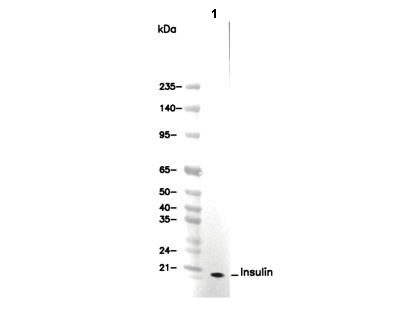 Lane 1: INS-1