
Dati tecnici
| Formula |
C22H21N3O4
|
||||||
| Peso molecolare | 391.42 | Numero CAS | 610798-31-7 | ||||
| Solubilità (25°C)* | In vitro | DMSO | 78 mg/mL (199.27 mM) | ||||
| Ethanol | 7 mg/mL (17.88 mM) | ||||||
| Water | Insoluble | ||||||
| In vivo (Aggiungere i solventi al prodotto singolarmente e in ordine.) |
|
||||||
|
* <1 mg/ml significa leggermente solubile o insolubile. * Si prega di notare che Selleck testa la solubilità di tutti i composti internamente e la solubilità effettiva può differire leggermente dai valori pubblicati. Ciò è normale ed è dovuto a leggere variazioni da lotto a lotto. * Spedizione a temperatura ambiente (I test di stabilità mostrano che questo prodotto può essere spedito senza alcuna misura di raffreddamento.) |
|||||||
Preparazione delle soluzioni stock
Attività biologica
| Descrizione | Icotinib (BPI-2009H) è un potente e specifico inibitore di EGFR con IC50 di 5 nM, e mira a EGFR, EGFR(L858R), EGFR(L861Q), EGFR(T790M) e EGFR(T790M, L858R). | ||
|---|---|---|---|
| Target |
|
||
| In vitro | Icotinib (BPI-2009H) inibisce l'attività dell'EGFR in modo dose-dipendente, con un valore di IC50 di 5 nM e un'inibizione completa a 62,5 nM. Inibisce selettivamente e unicamente i membri dell'EGFR, inclusi il tipo selvatico e i mutanti, con efficacie di inibizione del 61-99%. Questo composto blocca la fosforilazione della tirosina intracellulare mediata dall'EGFR nelle cellule di carcinoma epidermoide umano A431 in modo dose-dipendente. Nel frattempo, nel nostro saggio di proliferazione eseguito sulle linee cellulari A431, BGC-823, A549, H460, HCT8, KB e Bel-7402, abbiamo riscontrato che la sensibilità relativa delle linee cellulari a Icotinib è A431 > BGC-823 > A549 > H460 > KB > HCT8 e Bel-7402. Esibisce un ampio spettro di attività antitumorale ed è particolarmente efficace contro i tumori che esprimono livelli più elevati di EGFR. | ||
| In vivo | Icotinib (BPI-2009H) mostra un effetto antitumorale in diversi tipi di xenotrapianti. A una dose di 120 mg/kg, inibisce la crescita tumorale a un tasso del 51,5%, 31,0% e 67,4% negli xenotrapianti A431, A549 e H460, rispettivamente. |
Protocollo (da riferimento)
| Saggio della chinasi:[1] |
|
|---|---|
| Saggio cellulare:[1] |
|
| Studio sugli animali:[1] |
|
Riferimenti
|
Convalida del prodotto da parte del cliente
![<p>B. Effect of Icotinib treatment on the subcellular localization of ABCG2 in NCI-H460/MX20 cell. ABCG2 staining is shown in green. DAPI (blue) counterstains the nuclei. C. Effect of Icotinib on the ATPase activity of ABCG2: The BeFx-sensitive specific ATPase activity of ABCG2 was determined in the presence of 0-5 μM of Icotinib as described in supplemental methods. The activity in the absence of Icotinib (basal activity) was considered to be 100%, and % -fold stimulation ± S.D. (Y-axis) was plotted as a function of indicated concentrations of Icotinib (X-axis). D. Effect of Icotinib on the photolabeling of ABCG2 with [125I]-IAAP: Crude membranes from ABCG2 expressing MCF7-FLV1000 cells were photo-crosslinked with [125I]-IAAP in the presence and absence of 0-50 μM of Icotinib as described in supplemental methods. [125I]-IAAP incorporated in ABCG2 band was quantified using ImageQuant software and plotted as % [125I]-IAAP incorporated ± S.D. (Y-axis) as a function of varying concentration of Icotinib (X-axis). The upper panel shows a representative autoradiogram from three independent experiments and the arrow represents the ABCG2 band photo-crosslinked with [125I]-IAAP.</p>](https://file.selleckchem.com/downloads/review/700px/Icotinib-S292201Y0120161107.gif)
-
, , Oncotarget, 2015, 5(12):4529-42.
-
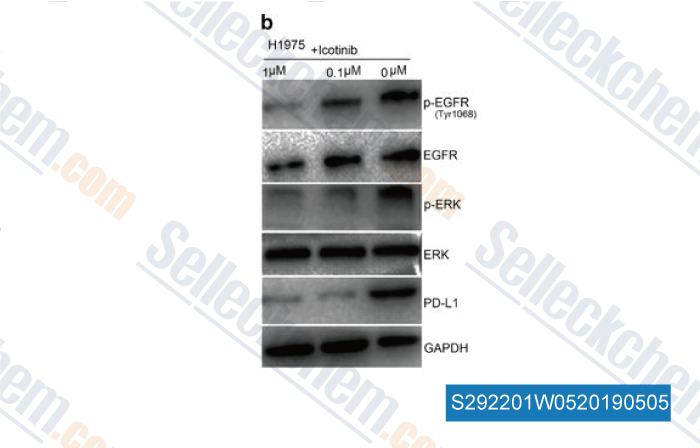
Dati da [ , , Oncogene, 2017, 36(45):6235-6243 ]
Sellecks Icotinib (BPI-2009H) È stato citato da 10 Pubblicazioni
| Patient-derived rhabdomyosarcoma cells recapitulate the genetic and transcriptomic landscapes of primary tumors [ iScience, 2024, 27(10):110862] | PubMed: 39319271 |
| Genetic alterations predict poor efficacy, outcomes and resistance to second-line osimertinib treatment in non-small cell lung cancer [ Am J Cancer Res, 2024, 14(1):33-51] | PubMed: 38323283 |
| A community challenge for a pancancer drug mechanism of action inference from perturbational profile data [ Cell Rep Med, 2022, 3(1):100492] | PubMed: 35106508 |
| Defining the sensitivity landscape of EGFR variants to tyrosine kinase inhibitors [ Transl Res, 2022, S1931-5244(22)00244-4] | PubMed: 36347492 |
| Sensitivity analysis of EGFR L861Q mutation to six tyrosine kinase inhibitors [ Clin Transl Oncol, 2022, 10.1007/s12094-022-02854-3] | PubMed: 35666454 |
| A positive feedback loop formed by NGFR and FOXP3 contributes to the resistance of non-small cell lung cancer to icotinib [ Transl Cancer Res, 2020, 9(2):1044-1052] | PubMed: 35117449 |
| HER2 recruits AKT1 to disrupt STING signalling and suppress antiviral defence and antitumour immunity. [ Nat Cell Biol, 2019, 21(8):1027-1040] | PubMed: 31332347 |
| BIN1 reverses PD-L1-mediated immune escape by inactivating the c-MYC and EGFR/MAPK signaling pathways in non-small cell lung cancer [Wang J Oncogene, 2017, 36(45):6235-6243] | PubMed: 28714960 |
| CD166-mediated epidermal growth factor receptor phosphorylation promotes the growth of oral squamous cell carcinoma [Guodong Jia, et al. Oral Oncology, 2016, 10.1016/j.oraloncology.2016.05.010] | |
| Icotinib antagonizes ABCG2-mediated multidrug resistance, but not the pemetrexed resistance mediated by thymidylate synthase and ABCG2. [Wang DS, et al. Oncotarget, 2015, 5(12):4529-42] | PubMed: 24980828 |
POLITICA DI RESO
La politica di reso incondizionato di Selleck Chemical garantisce ai nostri clienti unesperienza di acquisto online senza problemi. Se non sei in alcun modo soddisfatto del tuo acquisto, puoi restituire qualsiasi articolo entro 7 giorni dalla ricezione. In caso di problemi di qualità del prodotto, sia relativi al protocollo che al prodotto, puoi restituire qualsiasi articolo entro 365 giorni dalla data di acquisto originale. Si prega di seguire le istruzioni seguenti per la restituzione dei prodotti.
SPEDIZIONE E CONSERVAZIONE
I prodotti Selleck vengono trasportati a temperatura ambiente. Se ricevi il prodotto a temperatura ambiente, ti assicuriamo che il Dipartimento di Ispezione Qualità di Selleck ha condotto esperimenti per verificare che la conservazione a temperatura normale per un mese non influirà sullattività biologica dei prodotti in polvere. Dopo la raccolta, conservare il prodotto secondo le indicazioni descritte nella scheda tecnica. La maggior parte dei prodotti Selleck è stabile nelle condizioni raccomandate.
NON PER USO UMANO, DIAGNOSTICO VETERINARIO O TERAPEUTICO.