
Dati tecnici
| Formula | C25H22N2O2 |
||||||
| Peso molecolare | 382.45 | Numero CAS | 890842-28-1 | ||||
| Solubilità (25°C)* | In vitro | DMSO | 76 mg/mL (198.71 mM) | ||||
| Water | Insoluble | ||||||
| Ethanol | Insoluble | ||||||
| In vivo (Aggiungere i solventi al prodotto singolarmente e in ordine.) |
|
||||||
|
* <1 mg/ml significa leggermente solubile o insolubile. * Si prega di notare che Selleck testa la solubilità di tutti i composti internamente e la solubilità effettiva può differire leggermente dai valori pubblicati. Ciò è normale ed è dovuto a leggere variazioni da lotto a lotto. * Spedizione a temperatura ambiente (I test di stabilità mostrano che questo prodotto può essere spedito senza alcuna misura di raffreddamento.) |
|||||||
Preparazione delle soluzioni stock
Attività biologica
| Descrizione | GSK650394 è un inibitore della chinasi-1 regolata dal siero e dai glucocorticoidi con IC50 di 62 nM e 103 nM rispettivamente per SGK1 e SGK2. | ||||
|---|---|---|---|---|---|
| Target |
|
||||
| In vitro | GSK650394 inibisce il trasporto epiteliale mediato da SGK1 con un IC50 di 0,6 μM nel test SCC. Nelle cellule LNCaP, questo composto inibisce l'aumento della fosforilazione di Nedd4-2 mediato dagli androgeni e la crescita cellulare mediata dagli androgeni.Questa sostanza chimica contrasta la diminuzione della neurogenesi indotta dal cortisolo, i cambiamenti nella segnalazione Hedgehog e la traslocazione nucleare del GR. [2] Inibisce la replicazione del virus dell'influenza compromettendo l'esportazione delle vRNP dell'influenza nel citoplasma delle cellule A549. |
Protocollo (da riferimento)
| Saggio della chinasi:[1] |
|
|---|---|
| Saggio cellulare:[1] |
|
Riferimenti
|
Convalida del prodotto da parte del cliente
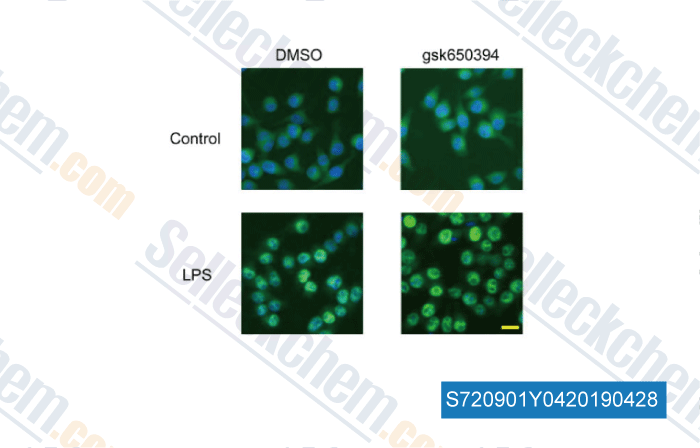
-
Dati da [ , , Biochem Biophys Res Commun, 2016, 478(1):53-59 ]
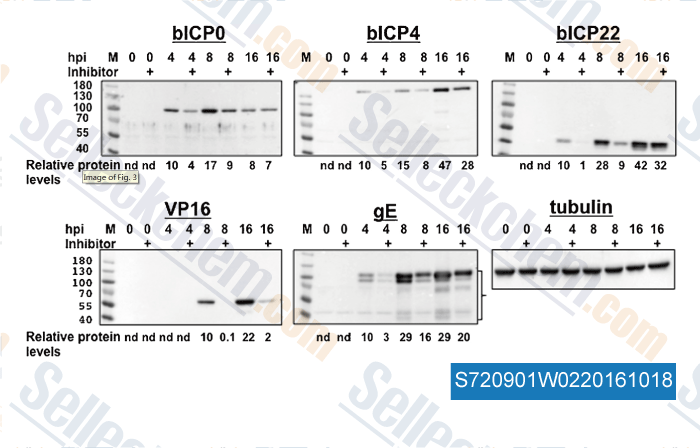
-
Dati da [ , , Virus Res, 2016, 222:106-112. ]
Sellecks GSK650394 È stato citato da 24 Pubblicazioni
| Patient-derived enteroids provide a platform for the development of therapeutic approaches in microvillus inclusion disease [ J Clin Invest, 2023, 133(20)e169234] | PubMed: 37643022 |
| Bacterial DNA promoting inflammation via the Sgk1/Nedd4L/Syk pathway in mast cells contributes to antihistamine non-responsive CSU [ J Leukoc Biol, 2023, qiad025] | PubMed: 36857592 |
| Estrogen-sensitive activation of SGK1 induces M2 macrophages with anti-inflammatory properties and a Th2 response at the maternal-fetal interface [ Reprod Biol Endocrinol, 2023, 21(1):50] | PubMed: 37226177 |
| Inhibition of SGK1 potentiates the anticancer activity of PI3K inhibitor in NSCLC cells through modulation of mTORC1, p‑ERK and β‑catenin signaling [ Biomed Rep, 2023, 19(6):94] | PubMed: 37901878 |
| Therapy Development for Microvillus Inclusion Disease using Patient-derived Enteroids [ bioRxiv, 2023, 2023.01.28.526036] | PubMed: 36747680 |
| Activation of Serum/Glucocorticoid Regulated Kinase 1/Nuclear Factor-κB Pathway Are Correlated with Low Sensitivity to Bortezomib and Ixazomib in Resistant Multiple Myeloma Cells [ Biomedicines, 2021, 9(1)E33] | PubMed: 33406639 |
| Identification and Kinetic Characterization of Serum- and Glucocorticoid-Regulated Kinase Inhibitors Using a Fluorescence Polarization-Based Assay [ SLAS Discov, 2021, 24725552211002465] | PubMed: 33783250 |
| Crosstalk between Hedgehog pathway and the glucocorticoid receptor pathway as a basis for combination therapy in T-cell acute lymphoblastic leukemia [ Oncogene, 2020, 10.1038/s41388-020-01453-2] | PubMed: 32917954 |
| Convergent genomic and pharmacological evidence of PI3K/GSK3 signaling alterations in neurons from schizophrenia patients [ Neuropsychopharmacology, 2020, 10.1038/s41386-020-00924-0] | PubMed: 33288841 |
| Targeting histone K4 trimethylation for treatment of cognitive and synaptic deficits in mouse models of Alzheimer's disease [ Sci Adv, 2020, 6(50)eabc8096] | PubMed: 33298440 |
POLITICA DI RESO
La politica di reso incondizionato di Selleck Chemical garantisce ai nostri clienti unesperienza di acquisto online senza problemi. Se non sei in alcun modo soddisfatto del tuo acquisto, puoi restituire qualsiasi articolo entro 7 giorni dalla ricezione. In caso di problemi di qualità del prodotto, sia relativi al protocollo che al prodotto, puoi restituire qualsiasi articolo entro 365 giorni dalla data di acquisto originale. Si prega di seguire le istruzioni seguenti per la restituzione dei prodotti.
SPEDIZIONE E CONSERVAZIONE
I prodotti Selleck vengono trasportati a temperatura ambiente. Se ricevi il prodotto a temperatura ambiente, ti assicuriamo che il Dipartimento di Ispezione Qualità di Selleck ha condotto esperimenti per verificare che la conservazione a temperatura normale per un mese non influirà sullattività biologica dei prodotti in polvere. Dopo la raccolta, conservare il prodotto secondo le indicazioni descritte nella scheda tecnica. La maggior parte dei prodotti Selleck è stabile nelle condizioni raccomandate.
NON PER USO UMANO, DIAGNOSTICO VETERINARIO O TERAPEUTICO.