
Dati tecnici
| Formula | C23H28N2O2.2HCl |
||||||
| Peso molecolare | 437.4 | Numero CAS | 1902123-72-1 | ||||
| Solubilità (25°C)* | In vitro | Water | 44 mg/mL (100.59 mM) | ||||
| DMSO | 29 mg/mL (66.3 mM) | ||||||
| Ethanol | Insoluble | ||||||
| In vivo (Aggiungere i solventi al prodotto singolarmente e in ordine.) |
|
||||||
|
* <1 mg/ml significa leggermente solubile o insolubile. * Si prega di notare che Selleck testa la solubilità di tutti i composti internamente e la solubilità effettiva può differire leggermente dai valori pubblicati. Ciò è normale ed è dovuto a leggere variazioni da lotto a lotto. * Spedizione a temperatura ambiente (I test di stabilità mostrano che questo prodotto può essere spedito senza alcuna misura di raffreddamento.) |
|||||||
Preparazione delle soluzioni stock
Attività biologica
| Descrizione | GSK2879552 2HCl è un inibitore di LSD1 potente, selettivo, biodisponibile per via orale e irreversibile con Kiapp di 1,7 μM. Fase 1. | ||
|---|---|---|---|
| Target |
|
||
| In vitro | In 165 linee cellulari, GSK2879552 inibisce la crescita di 9/28 linee di carcinoma polmonare a piccole cellule (SCLC) e 20/29 linee di AML, con una percentuale che varia dal 40% al 100%. Il sottogruppo di linee SCLC e campioni primari che subiscono l'inibizione della crescita in risposta a GSK2879552 mostrano ipometilazione del DNA di un set di sonde distintivo. | ||
| In vivo | Nei topi portatori di xenotrapianti di SCLC, GSK2879552 (1,5 mg/kg, p.o.) dimostra un'inibizione della crescita tumorale del 17%-83%. |
Protocollo (da riferimento)
| Saggio della chinasi:[1] |
|
|---|---|
| Saggio cellulare:[1] |
|
Riferimenti
|
Convalida del prodotto da parte del cliente
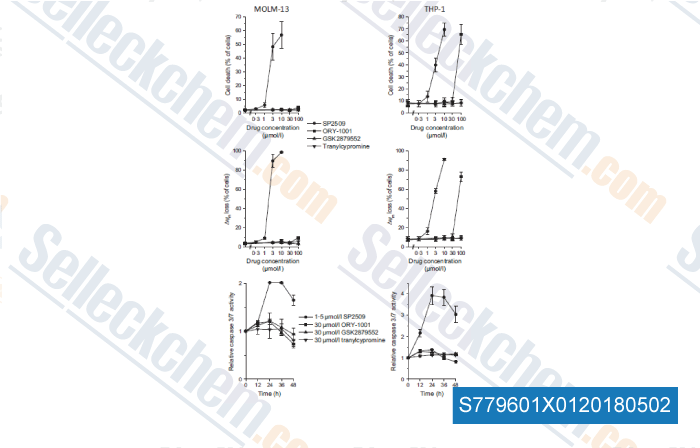
-
Dati da [ , , Br J Haematol, 2017, doi: 10.1111/bjh.14983 ]
Sellecks GSK2879552 Dihydrochloride È stato citato da 29 Pubblicazioni
| Dual targeting of CDK6 and LSD1 is synergistic and overcomes differentiation blockade in AML [ EMBO Mol Med, 2025, 10.1038/s44321-025-00296-2] | PubMed: 40883610 |
| A CRISPR-Cas9 screen reveals genetic determinants of the cellular response to decitabine [ EMBO Rep, 2025, 10.1038/s44319-025-00385-w] | PubMed: 39930152 |
| The lncRNA ELDR suppresses tumorigenicity of AML by interfering with DNA replication and chromatin accessibility [ Blood Adv, 2025, bloodadvances.2024015427] | PubMed: 40921006 |
| A Model of Traumatic Brain Injury Oligomerizes Tau in Cortical Organoids and Induces Clinically Relevant Pathologies that Synergize with MAPT Mutation [ J Neurotrauma, 2025, 10.1177/08977151251374286] | PubMed: 40900146 |
| Epigenetic modifiers to treat retinal degenerative diseases [ bioRxiv, 2025, 2025.05.22.655558] | PubMed: 40501782 |
| LSD1 inhibition improves efficacy of adoptive T cell therapy by enhancing CD8+ T cell responsiveness [ Nat Commun, 2024, 15(1):7366] | PubMed: 39191730 |
| Transposable elements-mediated recruitment of KDM1A epigenetically silences HNF4A expression to promote hepatocellular carcinoma [ Nat Commun, 2024, 15(1):5631] | PubMed: 38965210 |
| Pharmacological inhibition of LSD1 suppresses growth of hepatocellular carcinoma by inducing GADD45B [ MedComm (2020), 2023, 4(3):e269] | PubMed: 37250145 |
| E3 ligase Trim35 inhibits LSD1 demethylase activity through K63-linked ubiquitination and enhances anti-tumor immunity in NSCLC [ Cell Rep, 2023, 10.1016/j.celrep.2023.113477] | PubMed: 37979167 |
| Crucial Role of Lysine-Specific Histone Demethylase 1 in RANKL-Mediated Osteoclast Differentiation [ Int J Mol Sci, 2023, 24(4)3605] | PubMed: 36835016 |
POLITICA DI RESO
La politica di reso incondizionato di Selleck Chemical garantisce ai nostri clienti unesperienza di acquisto online senza problemi. Se non sei in alcun modo soddisfatto del tuo acquisto, puoi restituire qualsiasi articolo entro 7 giorni dalla ricezione. In caso di problemi di qualità del prodotto, sia relativi al protocollo che al prodotto, puoi restituire qualsiasi articolo entro 365 giorni dalla data di acquisto originale. Si prega di seguire le istruzioni seguenti per la restituzione dei prodotti.
SPEDIZIONE E CONSERVAZIONE
I prodotti Selleck vengono trasportati a temperatura ambiente. Se ricevi il prodotto a temperatura ambiente, ti assicuriamo che il Dipartimento di Ispezione Qualità di Selleck ha condotto esperimenti per verificare che la conservazione a temperatura normale per un mese non influirà sullattività biologica dei prodotti in polvere. Dopo la raccolta, conservare il prodotto secondo le indicazioni descritte nella scheda tecnica. La maggior parte dei prodotti Selleck è stabile nelle condizioni raccomandate.
NON PER USO UMANO, DIAGNOSTICO VETERINARIO O TERAPEUTICO.