
Dati tecnici
| Formula | C25H24N4O2 |
||||||
| Peso molecolare | 412.48 | Numero CAS | 133052-90-1 | ||||
| Solubilità (25°C)* | In vitro | DMSO | 82 mg/mL (198.79 mM) | ||||
| Water | Insoluble | ||||||
| Ethanol | Insoluble | ||||||
| In vivo (Aggiungere i solventi al prodotto singolarmente e in ordine.) |
|
||||||
|
* <1 mg/ml significa leggermente solubile o insolubile. * Si prega di notare che Selleck testa la solubilità di tutti i composti internamente e la solubilità effettiva può differire leggermente dai valori pubblicati. Ciò è normale ed è dovuto a leggere variazioni da lotto a lotto. * Spedizione a temperatura ambiente (I test di stabilità mostrano che questo prodotto può essere spedito senza alcuna misura di raffreddamento.) |
|||||||
Preparazione delle soluzioni stock
Attività biologica
| Descrizione | Bisindolylmaleimide I (GF109203X, GO 6850) è un potente inibitore della PKC con valori di IC50 di 20 nM, 17 nM, 16 nM e 20 nM per PKC , PKC I, PKC II e PKC in saggi acellulari, rispettivamente. Questo composto mostra una selettività più di 3000 volte superiore per la PKC rispetto a EGFR, PDGFR e recettore dell'insulina. | ||||||||
|---|---|---|---|---|---|---|---|---|---|
| Target |
|
||||||||
| In vitro | Bisindolylmaleimide I (GF109203X) è un inibitore di PKC competitivo dell'ATP che previene l'aggregazione piastrinica indotta da stimoli che attivano la PKC e ha il potenziale come strumento per studiare il coinvolgimento della PKC nelle vie di trasduzione del segnale. Produce anche attività di inversione sulla resistenza multifarmaco mediata dalla P-glicoproteina e dall'MRP. L'inibizione della PKC da parte di questo composto riduce significativamente l'attivazione di ERK1/2 stimolata dal carbacholo e la successiva proliferazione delle cellule di cancro del colon SNU-407. | ||||||||
| In vivo | Bisindolylmaleimide I (GF109203X) inibisce dose-dipendente l'allodinia meccanica indotta da BK nei ratti Wistar a una dose di 10 μg/topo (i.pl.). | ||||||||
| Caratteristiche | Maggiore selettività rispetto all'inibitore di PKC staurosporina. GF109203X è una sonda chimica per lo studio delle vie di trasduzione del segnale di PKC. Potenziale per l'uso in una varietà di tumori. |
Protocollo (da riferimento)
| Saggio della chinasi: |
|
|---|---|
| Saggio cellulare: |
|
| Studio sugli animali: |
|
Riferimenti
|
Convalida del prodotto da parte del cliente
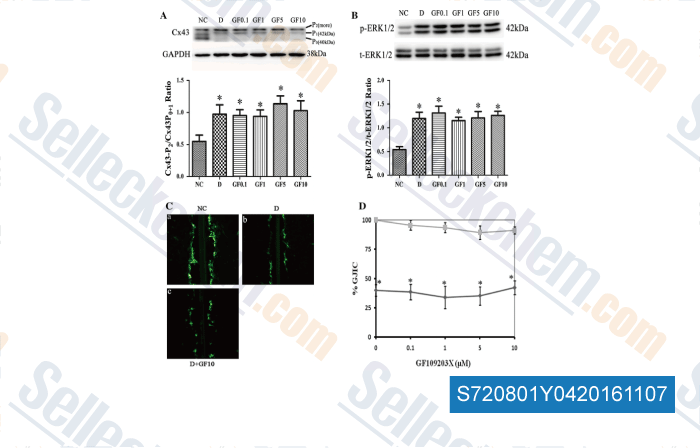
-
, , Mol Cell Biochem, 2015, 400(1-2):213-22.
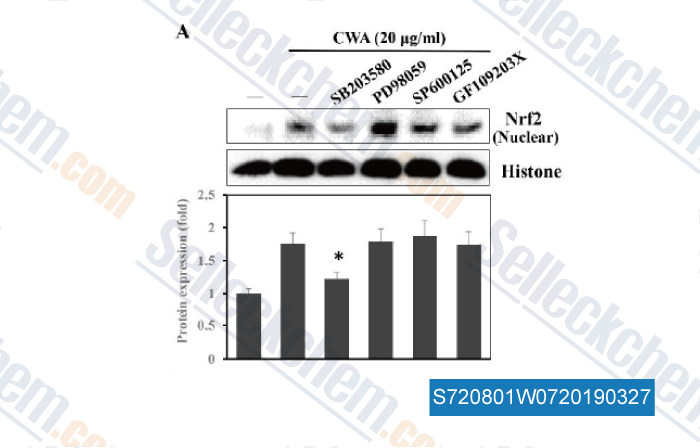
-
Dati da [ , , Free Radic Biol Med, 2018, 129:338-353 ]
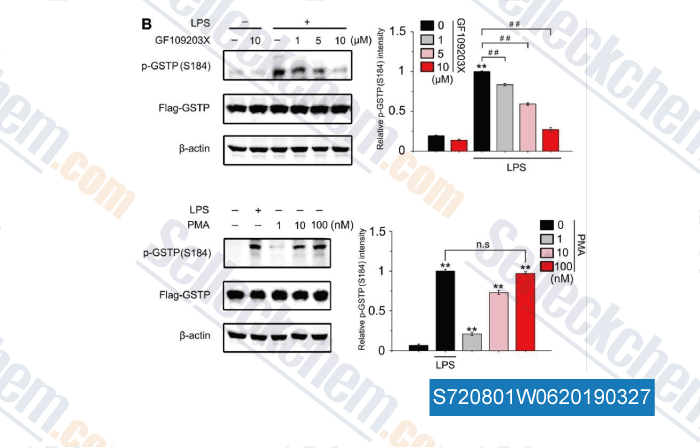
-
Dati da [ , , Front Immunol, 2018, 9:268 ]
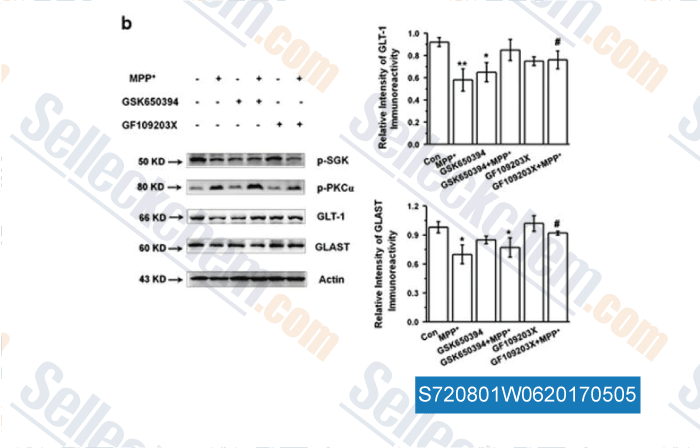
-
Dati da [ , , Cell Death Dis, 2017, 8(2):e2574 ]
Sellecks Bisindolylmaleimide I (GF109203X) È stato citato da 64 Pubblicazioni
| Dynamic phosphorylation of Fascin-1 orchestrates microglial phagocytosis and neurological recovery after spinal cord injury [ J Neuroinflammation, 2025, 22(1):121] | PubMed: 40281563 |
| HEP14-activated PKC-ERK1/2 pathway boosts HEP14-empowered hADSCs for ovarian regeneration and functional restoration [ Commun Biol, 2025, 8(1):1267] | PubMed: 40849553 |
| ELK3 destabilization by speckle-type POZ protein suppresses prostate cancer progression and docetaxel resistance [ Cell Death Dis, 2024, 15(4):274] | PubMed: 38632244 |
| Transcription of microRNAs is regulated by developmental signaling pathways and transcription factors [ Front Cell Dev Biol, 2024, 12:1356589] | PubMed: 38721525 |
| Downregulation of PIK3IP1/TrIP on T cells is controlled by TCR signal strength, PKC, and metalloprotease-mediated cleavage [ J Biol Chem, 2024, 300(12):107930] | PubMed: 39454954 |
| Epithelial TNF controls cell differentiation and CFTR activity to maintain intestinal mucin homeostasis [ J Clin Invest, 2023, 10.1172/JCI163591] | PubMed: 37643009 |
| Lysine methylation promotes NFAT5 activation and determines temozolomide efficacy in glioblastoma [ Nat Commun, 2023, 14(1):4062] | PubMed: 37429858 |
| Neurokinin-1 receptor drives PKCɑ-AURKA/N-Myc signaling to facilitate the neuroendocrine progression of prostate cancer [ Cell Death Dis, 2023, 14(6):384] | PubMed: 37385990 |
| HDAC Inhibition Restores Response to HER2-Targeted Therapy in Breast Cancer via PHLDA1 Induction [ Int J Mol Sci, 2023, 24(7)6228] | PubMed: 37047202 |
| Epicardial Adipose Tissue-Derived Leptin Promotes Myocardial Injury in Metabolic Syndrome Rats Through PKC/NADPH Oxidase/ROS Pathway [ J Am Heart Assoc, 2023, 12(15):e029415] | PubMed: 37489731 |
POLITICA DI RESO
La politica di reso incondizionato di Selleck Chemical garantisce ai nostri clienti unesperienza di acquisto online senza problemi. Se non sei in alcun modo soddisfatto del tuo acquisto, puoi restituire qualsiasi articolo entro 7 giorni dalla ricezione. In caso di problemi di qualità del prodotto, sia relativi al protocollo che al prodotto, puoi restituire qualsiasi articolo entro 365 giorni dalla data di acquisto originale. Si prega di seguire le istruzioni seguenti per la restituzione dei prodotti.
SPEDIZIONE E CONSERVAZIONE
I prodotti Selleck vengono trasportati a temperatura ambiente. Se ricevi il prodotto a temperatura ambiente, ti assicuriamo che il Dipartimento di Ispezione Qualità di Selleck ha condotto esperimenti per verificare che la conservazione a temperatura normale per un mese non influirà sullattività biologica dei prodotti in polvere. Dopo la raccolta, conservare il prodotto secondo le indicazioni descritte nella scheda tecnica. La maggior parte dei prodotti Selleck è stabile nelle condizioni raccomandate.
NON PER USO UMANO, DIAGNOSTICO VETERINARIO O TERAPEUTICO.