
Dati tecnici
| Formula | C22H24ClFN4O3 |
||||||
| Peso molecolare | 446.90 | Numero CAS | 184475-35-2 | ||||
| Solubilità (25°C)* | In vitro | DMSO | 89 mg/mL (199.14 mM) | ||||
| Ethanol | 4 mg/mL (8.95 mM) | ||||||
| Water | Insoluble | ||||||
| In vivo (Aggiungere i solventi al prodotto singolarmente e in ordine.) |
|
||||||
|
* <1 mg/ml significa leggermente solubile o insolubile. * Si prega di notare che Selleck testa la solubilità di tutti i composti internamente e la solubilità effettiva può differire leggermente dai valori pubblicati. Ciò è normale ed è dovuto a leggere variazioni da lotto a lotto. * Spedizione a temperatura ambiente (I test di stabilità mostrano che questo prodotto può essere spedito senza alcuna misura di raffreddamento.) |
|||||||
Preparazione delle soluzioni stock
Attività biologica
| Descrizione | Gefitinib è un inibitore di EGFR per Tyr1173, Tyr992, Tyr1173 e Tyr992 nelle cellule NR6wtEGFR e NR6W con IC50 di 37 nM, 37 nM, 26 nM e 57 nM, rispettivamente. Questo composto promuove l'autophagy e l'apoptosis delle cellule di cancro al polmone tramite il blocco della via PI3K/AKT/mTOR. | ||||||||
|---|---|---|---|---|---|---|---|---|---|
| Target |
|
||||||||
| In vitro | Gefitinib inibisce efficacemente tutti i siti di fosforilazione della tirosina su EGFR sia nelle linee cellulari che esprimono EGFR ad alta che a bassa espressione, incluse le linee cellulari NR6, NR6M e NR6W. I siti di fosforilazione Tyr1173 e Tyr992 sono meno sensibili, richiedendo concentrazioni più elevate di questo composto per l'inibizione. Blocca efficacemente la fosforilazione di PLC-γ, con IC50 di 27 nM, nelle cellule NR6W. Le linee cellulari NR6wtEGFR e NR6M hanno bassi livelli di fosforilazione di PLC-γ ma il livello nella linea cellulare NR6M è più resistente all'inibizione da parte di questa sostanza chimica con IC50 di 43 nM e 369 nM, rispettivamente. Questo composto inibisce le fosforilazioni di Akt, con IC50 di 220 e 263 nM, nelle linee cellulari che esprimono basso EGFR e EGFRvIII, rispettivamente. Nell'intervallo di dosi da 0,1 a 0,5 μM facilita significativamente, piuttosto che abrogare, la formazione di colonie di cellule NR6M. Tuttavia, a una concentrazione di 2 μM questa sostanza chimica blocca completamente la formazione di colonie NR6M. Inibisce rapidamente e in modo dose-dipendente la fosforilazione di EGFR e ERK fino a 72 ore dopo la stimolazione con EGF in entrambe le linee cellulari che esprimono EGFR ad alta e bassa espressione. Questo composto è la crescita monocouche di queste cellule MCF10A non trasformate indotte da EGF con una IC50 di 20 nM. La combinazione di questa sostanza chimica (0,2 μM e 0,5 μM) con l'irradiazione porta a una significativa inibizione della crescita nelle cellule LoVo, rispetto alla sola radiazione. |
||||||||
| In vivo | Gefitinib (100 mg/kg) migliora l'effetto antitumorale della radioterapia negli xenotrapianti tumorali LoVo. Il trattamento di topi nudi portatori di xenotrapianti di cancro al colon umano GEO stabiliti con questo composto rivela un'inibizione reversibile dose-dipendente della crescita tumorale perché i tumori GEO riprendono il tasso di crescita dei controlli alla fine del trattamento. |
||||||||
| Caratteristiche | Un potente inibitore della tirosina chinasi EGFR. |
Protocollo (da riferimento)
| Saggio cellulare: |
|
|---|---|
| Studio sugli animali: |
|
Riferimenti
|
Convalida del prodotto da parte del cliente
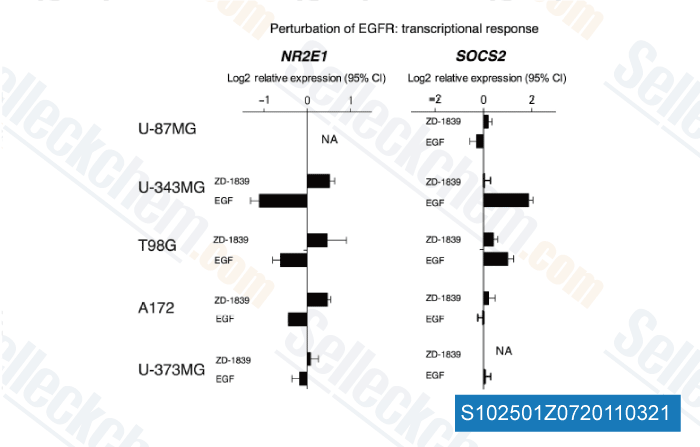
-
Dati da [ Mol Syst Biol , 2011 , 7, 486 ]
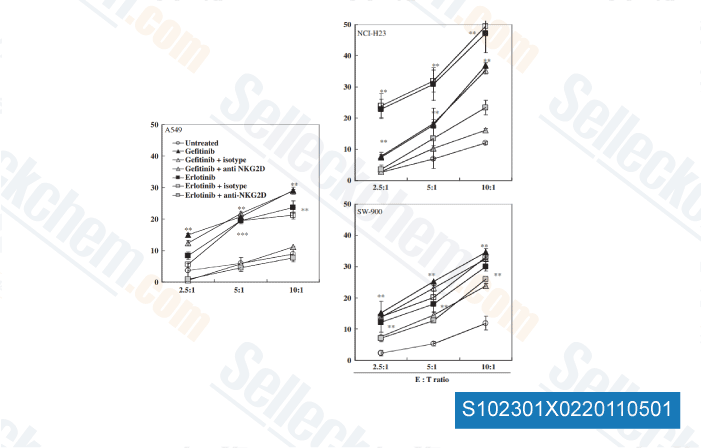
-
Dati da [ J Immunother , 2011 , 34(4), 372-81 ]
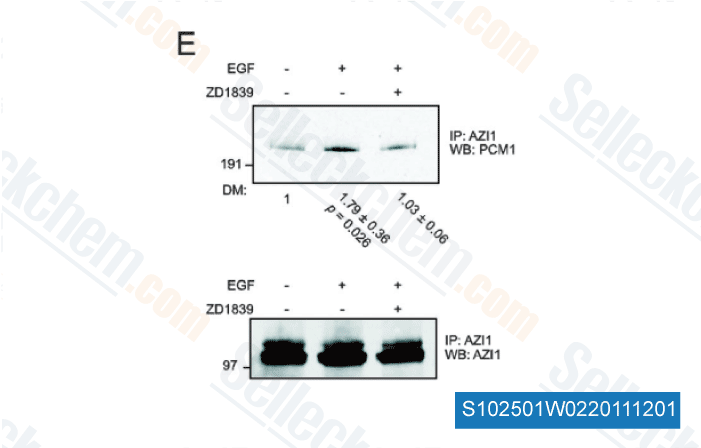
-
Dati da [ Mol Biosyst , 2011 , 7, 3223-33 ]
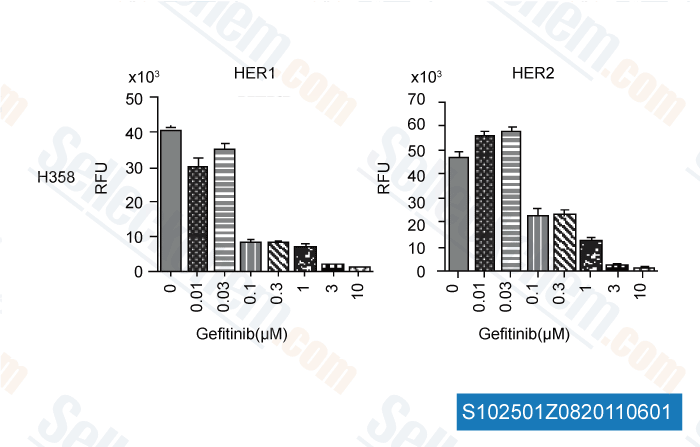
-
Dati da [ Int J Proteomics , 2011 , 215496 ]
Sellecks Gefitinib (ZD1839) È stato citato da 789 Pubblicazioni
| Galectin-3-integrin α5β1 phase separation disrupted by advanced glycation end-products impairs diabetic wound healing in rodents [ Nat Commun, 2025, 16(1):7287] | PubMed: 40775187 |
| Androgen receptor promotes arachidonic acid metabolism and angiogenic microenvironment in AFP-negative hepatocellular carcinoma [ Nat Commun, 2025, 16(1):6451] | PubMed: 40651942 |
| The potential of lazertinib and amivantamab combination therapy as a treatment strategy for uncommon EGFR-mutated NSCLC [ Cell Rep Med, 2025, 6(2):101929] | PubMed: 39874964 |
| Anti-galectin-9 therapy synergizes with EGFR inhibition to reprogram the tumor microenvironment and overcome immune evasion [ J Immunother Cancer, 2025, 13(7)e010926] | PubMed: 40664443 |
| Separase Inhibition Enhances Gefitinib Sensitivity of Lung Cancer via PTBP1/TAK1/RIPK1-Mediated PANoptosis [ MedComm (2020), 2025, 6(11):e70432] | PubMed: 41122447 |
| METTL1/WDR4-mediated m7G Hypermethylation of SCLT1 mRNA Promotes Gefitinib Resistance in NSCLC [ Genomics Proteomics Bioinformatics, 2025, qzaf076] | PubMed: 40857569 |
| N6-methyladenosine-modified GPX2 impacts cancer cell stemness and TKI resistance through regulating of redox metabolism [ Cell Death Dis, 2025, 16(1):458] | PubMed: 40533443 |
| Antitumor activity of afatinib in EGFR T790M-negative human oral cancer therapeutically targets mTOR/Mcl-1 signaling axis [ Cell Oncol (Dordr), 2025, 48(1):123-138] | PubMed: 38888847 |
| Efficacy of Conventional and Novel Tyrosine Kinase Inhibitors for Uncommon EGFR Mutations-An In Vitro Study [ Cells, 2025, 14(17)1386] | PubMed: 40940797 |
| Glimepiride overcomes acquired resistance to EGFR TKIs in lung cancer via the AMPK/ERK/MMP7 signaling pathway [ Biochem Pharmacol, 2025, 241:117162] | PubMed: 40659128 |
POLITICA DI RESO
La politica di reso incondizionato di Selleck Chemical garantisce ai nostri clienti unesperienza di acquisto online senza problemi. Se non sei in alcun modo soddisfatto del tuo acquisto, puoi restituire qualsiasi articolo entro 7 giorni dalla ricezione. In caso di problemi di qualità del prodotto, sia relativi al protocollo che al prodotto, puoi restituire qualsiasi articolo entro 365 giorni dalla data di acquisto originale. Si prega di seguire le istruzioni seguenti per la restituzione dei prodotti.
SPEDIZIONE E CONSERVAZIONE
I prodotti Selleck vengono trasportati a temperatura ambiente. Se ricevi il prodotto a temperatura ambiente, ti assicuriamo che il Dipartimento di Ispezione Qualità di Selleck ha condotto esperimenti per verificare che la conservazione a temperatura normale per un mese non influirà sullattività biologica dei prodotti in polvere. Dopo la raccolta, conservare il prodotto secondo le indicazioni descritte nella scheda tecnica. La maggior parte dei prodotti Selleck è stabile nelle condizioni raccomandate.
NON PER USO UMANO, DIAGNOSTICO VETERINARIO O TERAPEUTICO.