
Dati tecnici
| Formula | C53H83NO14 |
||||||
| Peso molecolare | 958.22 | Numero CAS | 159351-69-6 | ||||
| Solubilità (25°C)* | In vitro | DMSO | 100 mg/mL (104.36 mM) | ||||
| Ethanol | 100 mg/mL (104.36 mM) | ||||||
| Water | Insoluble | ||||||
| In vivo (Aggiungere i solventi al prodotto singolarmente e in ordine.) |
|
||||||
|
* <1 mg/ml significa leggermente solubile o insolubile. * Si prega di notare che Selleck testa la solubilità di tutti i composti internamente e la solubilità effettiva può differire leggermente dai valori pubblicati. Ciò è normale ed è dovuto a leggere variazioni da lotto a lotto. * Spedizione a temperatura ambiente (I test di stabilità mostrano che questo prodotto può essere spedito senza alcuna misura di raffreddamento.) |
|||||||
Preparazione delle soluzioni stock
Attività biologica
| Descrizione | Everolimus è un inibitore di mTOR di FKBP12 con IC50 di 1,6-2,4 nM in un saggio senza cellule. Everolimus induce l'apoptosi e l'autofagia cellulare e inibisce la proliferazione delle cellule tumorali. | ||||
|---|---|---|---|---|---|
| Target |
|
||||
| In vitro | Everolimus mostra un'attività immunosoppressiva paragonabile a quella della rapamicina. Questo composto compete con FK 506 immobilizzato per il legame con FKBP12 biotinilata e mostra l'effetto inibitorio su una MLR bidirezionale eseguita con cellule spleniche di topi BALB/c e CBA con IC50 di 0,12-1,8 nM. Mostra anche effetti antiangiogenici/vascolari nella proliferazione di HUVEC indotta da VEGF con IC50 di 0,12 nM e nella proliferazione di HUVEC indotta da bFGF con IC50 di 0,8 nM, rispettivamente. Uno studio recente mostra che questa sostanza chimica presenta effetti inibitori dose-dipendenti sia sulle cellule totali che sulle cellule staminali della linea cellulare BT474 e sulle cellule primarie di cancro al seno con IC50 di 156 nM nelle cellule totali delle cellule primarie di cancro al seno e di 71 nM nelle cellule totali delle cellule BT474. Inoltre, il trattamento combinato con questo composto e trastuzumab produce un'inibizione significativamente aumentata della crescita delle cellule staminali tumorali con un tasso di inibizione aumentato di oltre il 50 %. | ||||
| In vivo | Everolimus (da 0,1 a 10 mg/kg) inibisce in modo dose-dipendente la crescita delle metastasi primarie (orecchio) e dei linfonodi del melanoma B16/BL6, con una diminuzione del numero totale di vasi e una riduzione dei vasi maturi. In un modello animale di xenotrapianto di cellule staminali BT474, questo composto mostra significative riduzioni delle dimensioni medie del tumore (590,6 mm3), rispetto al gruppo di controllo con una dimensione del tumore di 698 mm3. Inoltre, il trattamento combinato con questo composto e trastuzumab diminuisce significativamente la dimensione del tumore del xenotrapianto (410,8 mm3) più del trattamento con questo composto da solo. |
Protocollo (da riferimento)
| Saggio della chinasi:[1] |
|
|---|---|
| Saggio cellulare:[3] |
|
| Studio sugli animali:[3] |
|
Riferimenti
|
Convalida del prodotto da parte del cliente
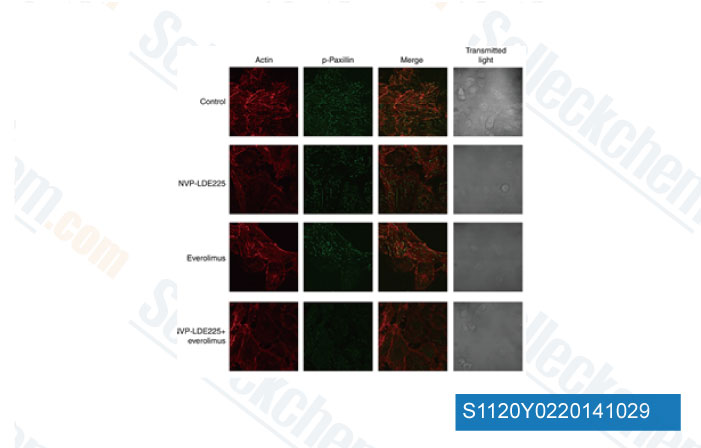
-
Dati da [ Br J Cancer , 2014 , 111(6), 1168-79 ]
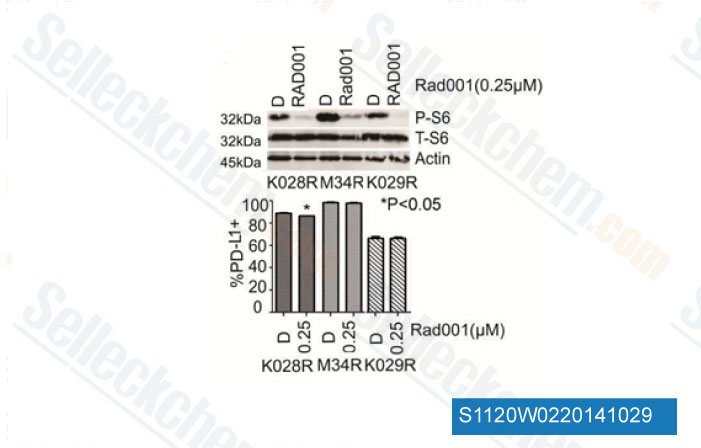
-
Dati da [ Clin Cancer Res , 2013 , 19(3),598-609 ]
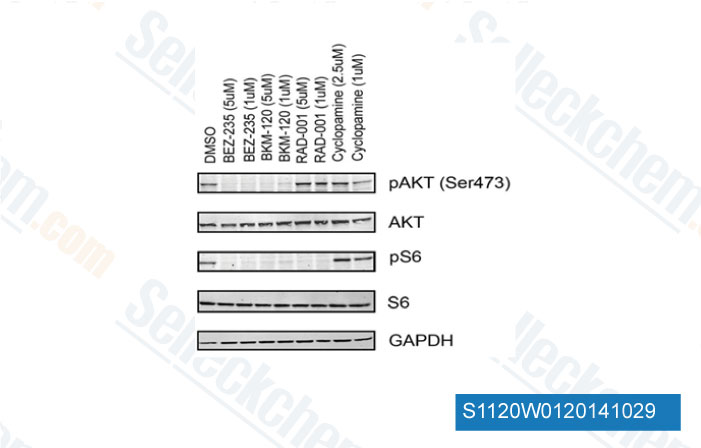
-
Dati da [ Cancer Cell , 2012 , 21(2), 155-67 ]
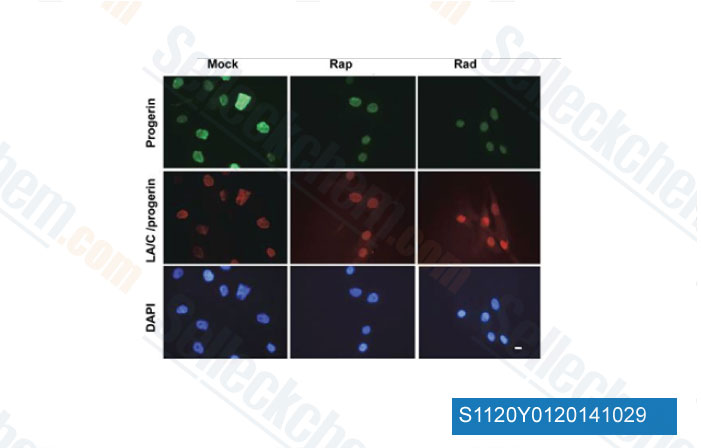
-
Dati da [ Aging (Albany NY) , 2012 , 4(2), 119-32 ]
Sellecks RAD001 (Everolimus) È stato citato da 798 Pubblicazioni
| Proteogenomic characterization of non-functional pancreatic neuroendocrine tumors unravels clinically relevant subgroups [ Cancer Cell, 2025, 43(4):776-796.e14] | PubMed: 40185092 |
| Ataluren improves hematopoietic and pancreatic disorders in Shwachman-Diamond syndrome patients: a compassionate program case-series [ Nat Commun, 2025, 16(1):8189] | PubMed: 40897730 |
| System analysis links SMARCD3 regulons to growth signaling and MEK inhibitor response in everolimus-resistant ER+ breast cancer cells [ Cell Rep Med, 2025, 6(11):102425] | PubMed: 41260207 |
| Haploinsufficiency of miR-143 and miR-145 reveal targetable dependencies in resistant del(5q) myelodysplastic neoplasm [ Leukemia, 2025, 39(4):917-928] | PubMed: 40000845 |
| Pancreatic Neuroendocrine Tumors Secrete Apolipoprotein E to Induce Tip Endothelial Cells That Remodel the Tumor-Stroma Ratio and Promote Cancer Progression [ Cancer Res, 2025, 85(15):2805-2819] | PubMed: 40623046 |
| Targeting the MYC oncogene with a selective bi-steric mTORC1 inhibitor elicits tumor regression in MYC-driven cancers [ Cell Chem Biol, 2025, 32(8):994-1012.e11] | PubMed: 40803322 |
| YAP1 promoter-associated noncoding RNA affects Ewing sarcoma cell tumorigenicity by regulating YAP1 expression [ Cell Mol Biol Lett, 2025, 30(1):63] | PubMed: 40414844 |
| Increased fatty acid delivery by tumor endothelium promotes metastatic outgrowth [ JCI Insight, 2025, 10(9)e187531] | PubMed: 40198126 |
| Molecular control of PDPNhi macrophage subset induction by ADAP as a host defense in sepsis [ JCI Insight, 2025, e186456] | PubMed: 39903516 |
| A phase II trial of mTORC1/2 inhibition in STK11 deficient non small cell lung cancer [ NPJ Precis Oncol, 2025, 9(1):67] | PubMed: 40069402 |
POLITICA DI RESO
La politica di reso incondizionato di Selleck Chemical garantisce ai nostri clienti unesperienza di acquisto online senza problemi. Se non sei in alcun modo soddisfatto del tuo acquisto, puoi restituire qualsiasi articolo entro 7 giorni dalla ricezione. In caso di problemi di qualità del prodotto, sia relativi al protocollo che al prodotto, puoi restituire qualsiasi articolo entro 365 giorni dalla data di acquisto originale. Si prega di seguire le istruzioni seguenti per la restituzione dei prodotti.
SPEDIZIONE E CONSERVAZIONE
I prodotti Selleck vengono trasportati a temperatura ambiente. Se ricevi il prodotto a temperatura ambiente, ti assicuriamo che il Dipartimento di Ispezione Qualità di Selleck ha condotto esperimenti per verificare che la conservazione a temperatura normale per un mese non influirà sullattività biologica dei prodotti in polvere. Dopo la raccolta, conservare il prodotto secondo le indicazioni descritte nella scheda tecnica. La maggior parte dei prodotti Selleck è stabile nelle condizioni raccomandate.
NON PER USO UMANO, DIAGNOSTICO VETERINARIO O TERAPEUTICO.