
Dati tecnici
| Formula | C31H34F2N6O2 |
||||||
| Peso molecolare | 560.64 | Numero CAS | 1108743-60-7 | ||||
| Solubilità (25°C)* | In vitro | DMSO | 100 mg/mL (178.36 mM) | ||||
| Ethanol | 25 mg/mL (44.59 mM) | ||||||
| Water | Insoluble | ||||||
| In vivo (Aggiungere i solventi al prodotto singolarmente e in ordine.) |
|
||||||
|
* <1 mg/ml significa leggermente solubile o insolubile. * Si prega di notare che Selleck testa la solubilità di tutti i composti internamente e la solubilità effettiva può differire leggermente dai valori pubblicati. Ciò è normale ed è dovuto a leggere variazioni da lotto a lotto. * Spedizione a temperatura ambiente (I test di stabilità mostrano che questo prodotto può essere spedito senza alcuna misura di raffreddamento.) |
|||||||
Preparazione delle soluzioni stock
Attività biologica
| Descrizione | Entrectinib è un inibitore pan-TrkA/B/C, ROS1 e ALK biodisponibile per via orale con IC50 che vanno da 0,1 a 1,7 nM. Entrectinib (RXDX-101) induce l'autophagy. Fase 2. | |||||
|---|---|---|---|---|---|---|
| Target |
|
|||||
| In vitro | Entrectinib blocca selettivamente la proliferazione delle linee cellulari dipendenti da ALK e inibisce potentemente la segnalazione dipendente da ALK. Questo composto inibisce anche fortemente la crescita cellulare della linea cellulare NSCLC NCI-H2228 che presenta il riarrangiamento EML4-ALK. |
|||||
| In vivo | In topi portatori di xenotrapianti Karpas-299 e SR-786, Entrectinib (p.o.) induce una regressione tumorale completa. In topi transgenici NPM-ALK, questo composto induce una regressione completa delle masse tumorali osservate nel timo e nei linfonodi. Nel modello di xenotrapianto NB, il co-trattamento con questo composto ha potenziato l'efficacia della chemioterapia convenzionale. |
Protocollo (da riferimento)
Riferimenti
|
Convalida del prodotto da parte del cliente
-
Dati da [ , , Clin Cancer Res, 2018, 24(10):2357-2369 ]
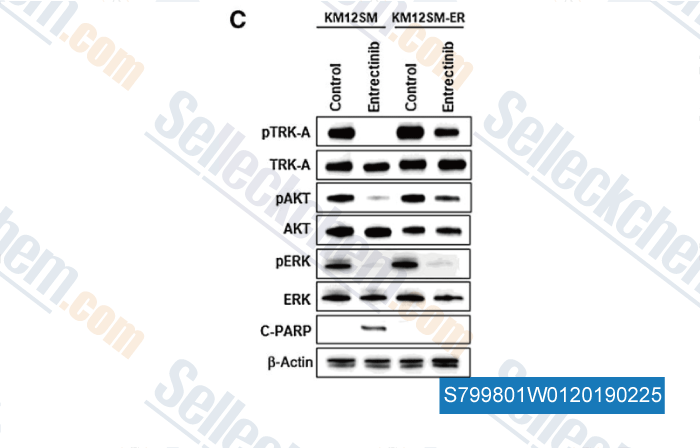
![(A) We transfected the EGFP/Eluc gene into KM12SM cells to establish KM12SM/Eluc cells. KM12SM/Eluc cells were inoculated into the brain of SCID mice. The mice were treated daily with or without entrectinib (15 mg/kg) for 37 days until the bioluminescence increased. Mean ± SE of total flux are shown in the lower panel. Then, the entrectinib-treated brain tumor was harvested at the point indicated by the orange triangle and cultured in vitro. The expanded tumor cells were named KM12SM-ER. (B) The sensitivity of KM12SM-ER and KM12SM cells to entrectinib was determined through cell viability assays, using a CCK-8 kit. The data (mean ± standard deviation [SD] of triplicate cultures) shown are representative of three independent experiments with similar results. (C) Tumor cells were treated with entrectinib (10 nmol/L) for 4 h or c-PARP for 48 h, and harvested lysates were assessed by western blotting. Data shown are representative of three independent experiments with similar results.](https://file.selleckchem.com/downloads/review/700px/Entrectinib-S799801W0120180502.gif)
-
Dati da [ , , Clin Cancer Res, 2018, doi: 10.1158/1078-0432.CCR-17-1623 ]
-
Dati da [ , , Cancer Med, 2017, 6(12):2972-2983 ]
-
Dati da [ , , Cancer Med, 2017, 6(12):2972-2983 ]
Sellecks Entrectinib (Rxdx-101) È stato citato da 61 Pubblicazioni
| Targeting proteostasis in multiple myeloma through inhibition of LTK [ Leukemia, 2025, 10.1038/s41375-025-02682-8] | PubMed: 40634511 |
| Methylstat sensitizes ovarian cancer cells to PARP-inhibition by targeting the histone demethylases JMJD1B/C [ Cancer Gene Ther, 2025, 10.1038/s41417-025-00874-z] | PubMed: 39915607 |
| Zidesamtinib Selective Targeting of Diverse ROS1 Drug-Resistant Mutations [ Mol Cancer Ther, 2025, 10.1158/1535-7163.MCT-25-0025] | PubMed: 40299789 |
| Development of PROTACs for targeted degradation of oncogenic TRK fusions [ bioRxiv, 2025, 2025.06.18.660465] | PubMed: 40666929 |
| Clinical efficacy and identification of factors confer resistance to afatinib (tyrosine kinase inhibitor) in EGFR-overexpressing esophageal squamous cell carcinoma [ Signal Transduct Target Ther, 2024, 9(1):153] | PubMed: 38937446 |
| Pharmacological inhibition of PDGF-C/neuropilin-1 interaction: A novel strategy to reduce melanoma metastatic potential [ Biomed Pharmacother, 2024, 176:116766] | PubMed: 38788599 |
| Acquired NF2 mutation confers resistance to TRK inhibition in an ex vivo LMNA::NTRK1-rearranged soft-tissue sarcoma cell model [ J Pathol, 2024, 10.1002/path.6282] | PubMed: 38613194 |
| Acquired NF2 mutation confers resistance to TRK inhibition in an ex vivo LMNA::NTRK1-rearranged soft-tissue sarcoma cell model [ J Pathol, 2024, 263(2):257-269] | PubMed: 38613194 |
| LTK mutations responsible for resistance to lorlatinib in non-small cell lung cancer harboring CLIP1-LTK fusion [ Commun Biol, 2024, 7(1):412] | PubMed: 38575808 |
| Patient-derived rhabdomyosarcoma cells recapitulate the genetic and transcriptomic landscapes of primary tumors [ iScience, 2024, 27(10):110862] | PubMed: 39319271 |
POLITICA DI RESO
La politica di reso incondizionato di Selleck Chemical garantisce ai nostri clienti unesperienza di acquisto online senza problemi. Se non sei in alcun modo soddisfatto del tuo acquisto, puoi restituire qualsiasi articolo entro 7 giorni dalla ricezione. In caso di problemi di qualità del prodotto, sia relativi al protocollo che al prodotto, puoi restituire qualsiasi articolo entro 365 giorni dalla data di acquisto originale. Si prega di seguire le istruzioni seguenti per la restituzione dei prodotti.
SPEDIZIONE E CONSERVAZIONE
I prodotti Selleck vengono trasportati a temperatura ambiente. Se ricevi il prodotto a temperatura ambiente, ti assicuriamo che il Dipartimento di Ispezione Qualità di Selleck ha condotto esperimenti per verificare che la conservazione a temperatura normale per un mese non influirà sullattività biologica dei prodotti in polvere. Dopo la raccolta, conservare il prodotto secondo le indicazioni descritte nella scheda tecnica. La maggior parte dei prodotti Selleck è stabile nelle condizioni raccomandate.
NON PER USO UMANO, DIAGNOSTICO VETERINARIO O TERAPEUTICO.