
Dati tecnici
| Formula | C25H29Cl2F3N2O4S |
||||||
| Peso molecolare | 581.47 | Numero CAS | 754240-09-0 | ||||
| Solubilità (25°C)* | In vitro | DMSO | 100 mg/mL (171.97 mM) | ||||
| Water | 100 mg/mL (171.97 mM) | ||||||
| Ethanol | Insoluble | ||||||
| In vivo (Aggiungere i solventi al prodotto singolarmente e in ordine.) |
|
||||||
|
* <1 mg/ml significa leggermente solubile o insolubile. * Si prega di notare che Selleck testa la solubilità di tutti i composti internamente e la solubilità effettiva può differire leggermente dai valori pubblicati. Ciò è normale ed è dovuto a leggere variazioni da lotto a lotto. * Spedizione a temperatura ambiente (I test di stabilità mostrano che questo prodotto può essere spedito senza alcuna misura di raffreddamento.) |
|||||||
Preparazione delle soluzioni stock
Attività biologica
| Descrizione | EHT 1864 2HCl è un potente inibitore della Rac family GTPase con Kd di 40 nM, 50 nM, 60 nM e 250 nM per Rac1, Rac1b, Rac2 e Rac3, rispettivamente. | ||||||||
|---|---|---|---|---|---|---|---|---|---|
| Target |
|
||||||||
| In vitro | EHT 1864 inibisce selettivamente la formazione di lamellipodi indotta da Rac e inverte specificamente la trasformazione cellulare indotta da mutanti costitutivamente attivati di Rac1 e Tiam1. EHT 1864 compromette fortemente la proliferazione cellulare indotta dal Ras oncogenico in cellule NIH 3T3 che esprimono stabilmente la proteina H-Ras(61L). EHT 1864 riduce anche i livelli extracellulari e intracellulari di peptidi Aβ inibendo il clivaggio di APP dipendente dalla γ-secretasi. Nei neuroni piramidali ippocampali in coltura, EHT 1864, tramite l'inibizione di Rac1, salva il fenotipo indotto dal knock-down di Rich2. | ||||||||
| In vivo | EHT 1864 (40 mg/kg i.p.) riduce significativamente i livelli di Abeta 40 e Abeta 42 nel cervello di cavia. |
Protocollo (da riferimento)
| Saggio della chinasi:[1] |
|
|---|---|
| Saggio cellulare:[1] |
|
| Studio sugli animali:[2] |
|
Riferimenti
|
Convalida del prodotto da parte del cliente
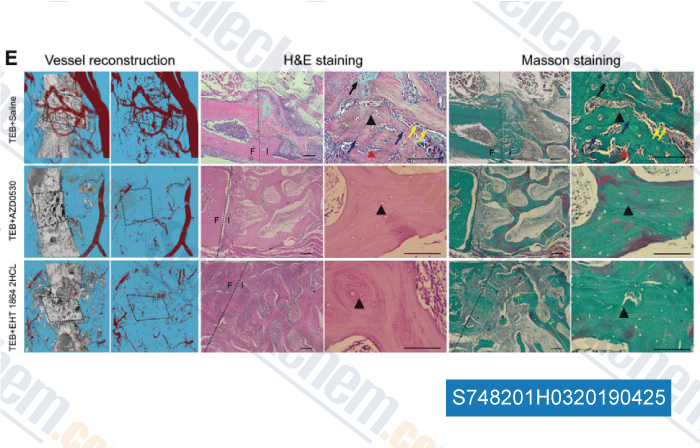
-
Dati da [ , , FASEB J, 2018, 32(4):2197-2211 ]

-
Dati da [ , , Am J Cancer Res, 2018, 8(1):70-80 ]
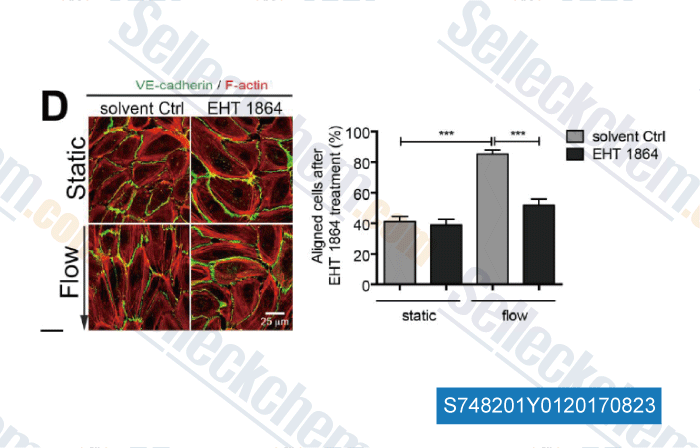
-
Dati da [ , , Mol Biol Cell, 2017, 28(13):1745-1753 ]
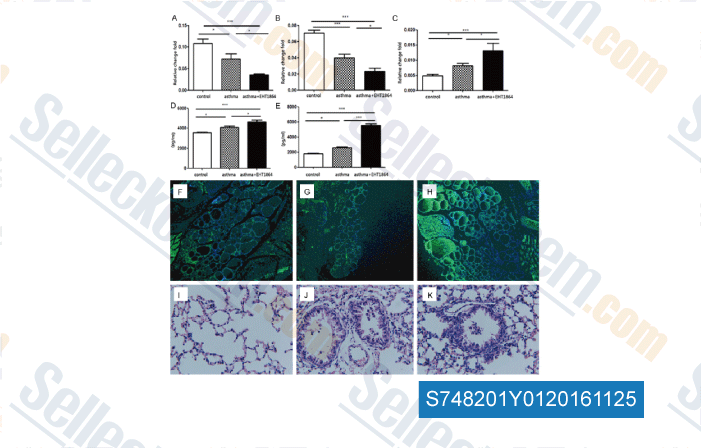
-
Dati da [ , , Int J Clin Exp Pathol, 2016, 9(6):5902-5911. ]
Sellecks EHT 1864 2HCl È stato citato da 26 Pubblicazioni
| PI(3,4,5)P3-mediated Cdc42 activation regulates macrophage podosome assembly [ Cell Mol Life Sci, 2025, 82(1):127] | PubMed: 40126693 |
| Hyperlipidemia drives tumor growth in a mouse model of obesity-accelerated breast cancer growth [ Cancer Metab, 2025, 13(1):39] | PubMed: 40877972 |
| Formation control between leader and migratory follower tissues allows coordinated growth [ Sci Adv, 2025, 11(31):eads2310] | PubMed: 40737421 |
| Gadd45g insufficiency drives the pathogenesis of myeloproliferative neoplasms [ Nat Commun, 2024, 15(1):2989] | PubMed: 38582902 |
| Oct4 controls basement membrane development during human embryogenesis [ Dev Cell, 2024, S1534-5807(24)00175-8] | PubMed: 38579716 |
| RAC1 inhibition ameliorates IBSP-induced bone metastasis in lung adenocarcinoma [ Cell Rep, 2024, 43(8):114528] | PubMed: 39052477 |
| Allometrically scaling tissue forces drive pathological foreign-body responses to implants via Rac2-activated myeloid cells [ Nat Biomed Eng, 2023, 10.1038/s41551-023-01091-5] | PubMed: 37749310 |
| The PMA phorbol ester tumor promoter increases canonical Wnt signaling via macropinocytosis [ Elife, 2023, 12RP89141] | PubMed: 37902809 |
| High-Content and High-Throughput Clonogenic Survival Assay Using Fluorescence Barcoding [ Cancers -Basel), 2023, 15(19)4772] | PubMed: 37835466 |
| Inhibition of exchange proteins directly activated by cAMP as a strategy for broad-spectrum antiviral development [ J Biol Chem, 2023, 299(6):104749] | PubMed: 37100284 |
POLITICA DI RESO
La politica di reso incondizionato di Selleck Chemical garantisce ai nostri clienti unesperienza di acquisto online senza problemi. Se non sei in alcun modo soddisfatto del tuo acquisto, puoi restituire qualsiasi articolo entro 7 giorni dalla ricezione. In caso di problemi di qualità del prodotto, sia relativi al protocollo che al prodotto, puoi restituire qualsiasi articolo entro 365 giorni dalla data di acquisto originale. Si prega di seguire le istruzioni seguenti per la restituzione dei prodotti.
SPEDIZIONE E CONSERVAZIONE
I prodotti Selleck vengono trasportati a temperatura ambiente. Se ricevi il prodotto a temperatura ambiente, ti assicuriamo che il Dipartimento di Ispezione Qualità di Selleck ha condotto esperimenti per verificare che la conservazione a temperatura normale per un mese non influirà sullattività biologica dei prodotti in polvere. Dopo la raccolta, conservare il prodotto secondo le indicazioni descritte nella scheda tecnica. La maggior parte dei prodotti Selleck è stabile nelle condizioni raccomandate.
NON PER USO UMANO, DIAGNOSTICO VETERINARIO O TERAPEUTICO.