
Dati tecnici
| Formula | C20H19F2N3O5 |
||||||
| Peso molecolare | 419.38 | Numero CAS | 1051375-16-6 | ||||
| Solubilità (25°C)* | In vitro | DMSO | 83 mg/mL (197.91 mM) | ||||
| Water | Insoluble | ||||||
| Ethanol | Insoluble | ||||||
| In vivo (Aggiungere i solventi al prodotto singolarmente e in ordine.) |
|
||||||
|
* <1 mg/ml significa leggermente solubile o insolubile. * Si prega di notare che Selleck testa la solubilità di tutti i composti internamente e la solubilità effettiva può differire leggermente dai valori pubblicati. Ciò è normale ed è dovuto a leggere variazioni da lotto a lotto. * Spedizione a temperatura ambiente (I test di stabilità mostrano che questo prodotto può essere spedito senza alcuna misura di raffreddamento.) |
|||||||
Preparazione delle soluzioni stock
Attività biologica
| Descrizione | Dolutegravir è un inibitore della integrase dell'HIV a legame bimetallico con IC50 di 2,7 nM in un saggio senza cellule, attività modesta contro i mutanti firma resistenti al raltegravir Y143R, Q148K, N155H e G140S/Q148H. | ||
|---|---|---|---|
| Target |
|
||
| In vitro | Dolutegravir (GSK1349572) shows a potent inhibitory effect on nine clinical isolates from integrase inhibitor-naive HIV-2-infected patients with EC50 ranging from 0.2 nM to 1.4 nM. In vitro, it inhibits recombinant HIV-1 integrase-catalyzed strand transfer with an IC50 of 2.7 nM. Furthermore, this compound potently inhibits HIV replication in cells such as peripheral blood mononuclear cells (PBMCs), MT-4 cells, and CIP4 cells infected with a self-inactivating PHIV lentiviral vector, with EC50 values of 0.51 nM, 0.71 nM, and 2.2 nM, respectively. In vitro, it also exhibits potent activity against five different nonnucleoside reverse transcription inhibitor-resistant or nucleoside reverse transcription inhibitor-resistant viruses, with EC50 ranging from 1.3 nM to 2.1 nM. Similarly to its activity against wild-type virus, it shows equivalent efficacy against two protease inhibitor-resistant viruses, with EC50 values of 0.36 nM and 0.37 nM, respectively. |
||
| In vivo | Dolutegravir (GSK1349572), a first-line antiretroviral drug (ARV) used in combination therapy for HIV-1, inhibits MMP activity and has the potential to affect prenatal and postnatal neurodevelopment. |
||
| Caratteristiche | Un inibitore del trasferimento del filamento dell'Integrase dell'HIV di nuova generazione e a due legami metallici. |
Protocollo (da riferimento)
| Saggio della chinasi: |
|
|---|---|
| Saggio cellulare: |
|
| Studio sugli animali: |
|
Riferimenti
|
Convalida del prodotto da parte del cliente
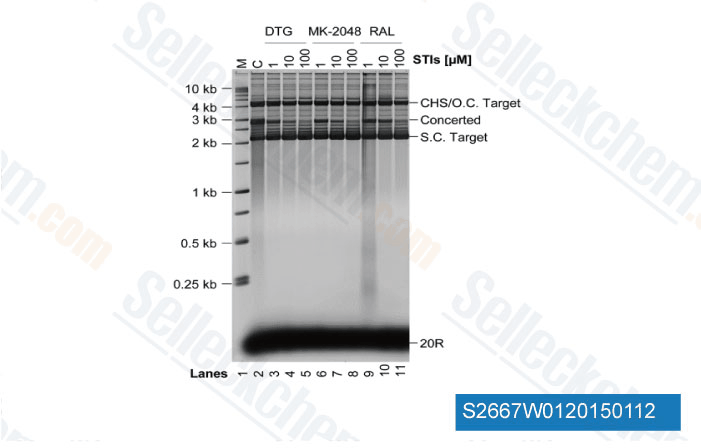
-
Dati da [ J Biol Chem , 2014 , 289(28), 19648-58 ]
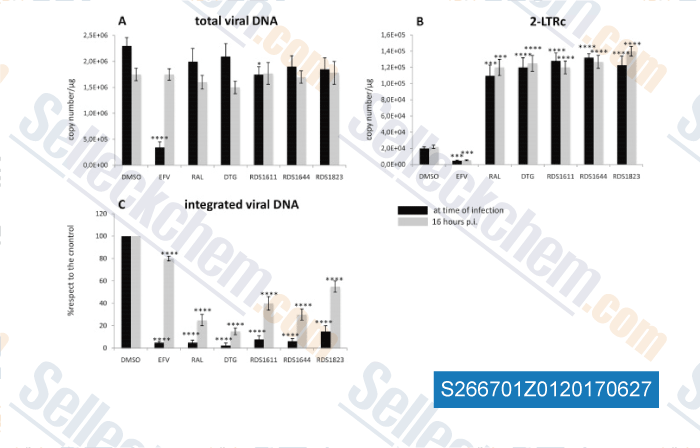
-
Dati da [ , , Antiviral Res, 2016, 134:236-243 ]
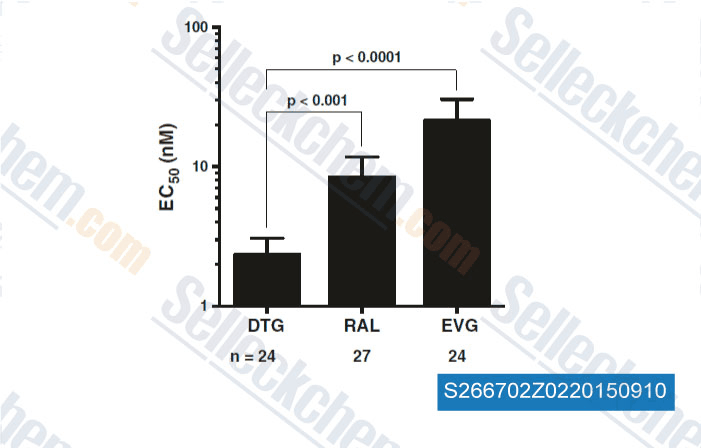
-
Dati da [ , , Retrovirology, 2015, 10.1186/s12977-015-0146-8 ]
Selleck's GSK1349572 (Dolutegravir) È stato citato da 42 Pubblicazioni
| Ultra-long-actingremovabledrugdeliverysystemforHIVtreatmentandprevention [ NatureCommunications, October8, 2018, 4156] | |
| ActivationofPERK-ATF4-CHOPpathwayasanoveltherapeuticapproachforefficienteliminationofHTLV-1-infectedcells [ BloodAdvances, May12, 2020, 1845-1858] | |
| EffectsofInjectionVolumeandRouteofAdministrationonDolutegravirInSituFormingImplantPharmacokinetics [ Pharmaceutics, March11, 2022, 615] | |
| Invitroactivityofdolutegraviragainstwild-typeandintegraseinhibitor-resistantHIV-2 [ Retrovirology, February5, 2015, 10] | |
| ExvivoantiretroviralpotencyofnewerintegrasestrandtransferinhibitorscabotegravirandbictegravirinHIV-1non-Bsubtypes [ AIDS, February20, 2018, 469-476] | |
| Timed chromatin invasion during mitosis governs prototype foamy virus integration site selection and infectivity [ Nucleic Acids Res, 2025, 53(10)gkaf449] | PubMed: 40448500 |
| Cognate antigen engagement induces HIV-1 expression in latently infected CD4+ T cells from people on long-term antiretroviral therapy [ Immunity, 2024, 57(12):2928-2944.e6] | PubMed: 39612916 |
| HMGB1 Expression Levels Correlate with Response to Immunotherapy in Non-Small Cell Lung Cancer [ Lung Cancer, 2024, 15:55-67] | PubMed: 38741920 |
| Overexpression of TRPV1 activates autophagy in human lens epithelial cells under hyperosmotic stress through Ca2+-dependent AMPK/mTOR pathway [ Int J Ophthalmol, 2024, 17(3):420-434] | PubMed: 38721513 |
| Biological and Structural Analyses of New Potent Allosteric Inhibitors of HIV-1 Integrase [ Antimicrob Agents Chemother, 2023, 67(7):e0046223] | PubMed: 37310224 |
POLITICA DI RESO
La politica di reso incondizionato di Selleck Chemical garantisce ai nostri clienti un'esperienza di acquisto online senza problemi. Se non sei in alcun modo soddisfatto del tuo acquisto, puoi restituire qualsiasi articolo entro 7 giorni dalla ricezione. In caso di problemi di qualità del prodotto, sia relativi al protocollo che al prodotto, puoi restituire qualsiasi articolo entro 365 giorni dalla data di acquisto originale. Si prega di seguire le istruzioni seguenti per la restituzione dei prodotti.
SPEDIZIONE E CONSERVAZIONE
I prodotti Selleck vengono trasportati a temperatura ambiente. Se ricevi il prodotto a temperatura ambiente, ti assicuriamo che il Dipartimento di Ispezione Qualità di Selleck ha condotto esperimenti per verificare che la conservazione a temperatura normale per un mese non influirà sull'attività biologica dei prodotti in polvere. Dopo la raccolta, conservare il prodotto secondo le indicazioni descritte nella scheda tecnica. La maggior parte dei prodotti Selleck è stabile nelle condizioni raccomandate.
NON PER USO UMANO, DIAGNOSTICO VETERINARIO O TERAPEUTICO.