
Dati tecnici
| Formula | C21H22ClN3O3 |
||||||||||||||
| Peso molecolare | 399.87 | Numero CAS | 186392-40-5 | ||||||||||||
| Solubilità (25°C)* | In vitro | DMSO | 80 mg/mL (200.06 mM) | ||||||||||||
| Water | Insoluble | ||||||||||||||
| Ethanol | Insoluble | ||||||||||||||
| In vivo (Aggiungere i solventi al prodotto singolarmente e in ordine.) |
|
||||||||||||||
|
* <1 mg/ml significa leggermente solubile o insolubile. * Si prega di notare che Selleck testa la solubilità di tutti i composti internamente e la solubilità effettiva può differire leggermente dai valori pubblicati. Ciò è normale ed è dovuto a leggere variazioni da lotto a lotto. * Spedizione a temperatura ambiente (I test di stabilità mostrano che questo prodotto può essere spedito senza alcuna misura di raffreddamento.) |
|||||||||||||||
Preparazione delle soluzioni stock
Attività biologica
| Descrizione | CP-91149 è un inibitore selettivo della glicogeno fosforilasi (GP) con IC50 di 0,13 μM in presenza di glucosio, da 5 a 10 volte meno potente in assenza di glucosio. | ||
|---|---|---|---|
| Target |
|
||
| In vitro | CP-91149 mostra un'attività inibitoria 200 volte superiore contro la glicogeno fosforilasi a epatica umana (HLGPa) rispetto alla caffeina (IC50 = 26 μM). Questo composto (10-100 μM) inibisce la glicogenolisi stimolata in epatociti di ratto isolati in modo dose-dipendente e in epatociti umani primari con un IC50 di ~2,1 μM. Inoltre, inibisce potentemente le attività della fosforilasi muscolare umana a e b con IC50 di 0,2 μM e ~0,3 μM, rispettivamente. Il trattamento con questa sostanza chimica a 2,5 μM induce l'inattivazione della fosforilasi e l'attivazione sequenziale della glicogeno sintasi negli epatociti, e aumenta la sintesi del glicogeno di 7 volte a 5 mM di glucosio e di 2 volte a 20 mM di glucosio. Può parzialmente contrastare gli effetti della sovraespressione della fosforilasi. Questo composto inibisce anche potentemente la GP cerebrale con IC50 di 0,5 μM nelle cellule A549. Il trattamento a 10-30 μM provoca un significativo accumulo di glicogeno nelle cellule A549 e HSF55. Il trattamento aumenta le cellule in fase G1 con una significativa riduzione della popolazione in fase S nelle cellule HSF55, correlata all'aumentata espressione di p21 e p27. Questa sostanza chimica promuove anche la defosforilazione e l'attivazione della GS (glicogeno sintasi) nelle cellule muscolari umane coltivate non ingegnerizzate o che sovraesprimono GP, ma esclusivamente nelle cellule private di glucosio. |
||
| In vivo | La somministrazione orale di CP-91149 a topi diabetici ob/ob a 25-50 mg/kg provoca una rapida (3 ore) riduzione della glicemia di 100-120 mg/dl senza produrre ipoglicemia, derivante dall'inibizione della glicogenolisi in vivo. Il trattamento con questo composto non abbassa i livelli di glucosio in topi normoglicemici e non diabetici. Nei ratti Goto-Kakizaki (GK) non a digiuno, la somministrazione di questa sostanza chimica in combinazione con CS-917 sopprime la riduzione del glicogeno epatico da parte di CS-917 e diminuisce il glucosio plasmatico più della singola somministrazione di CS-917. |
Protocollo (da riferimento)
| Saggio della chinasi: |
|
|---|---|
| Saggio cellulare: |
|
| Studio sugli animali: |
|
Riferimenti
|
Convalida del prodotto da parte del cliente
-
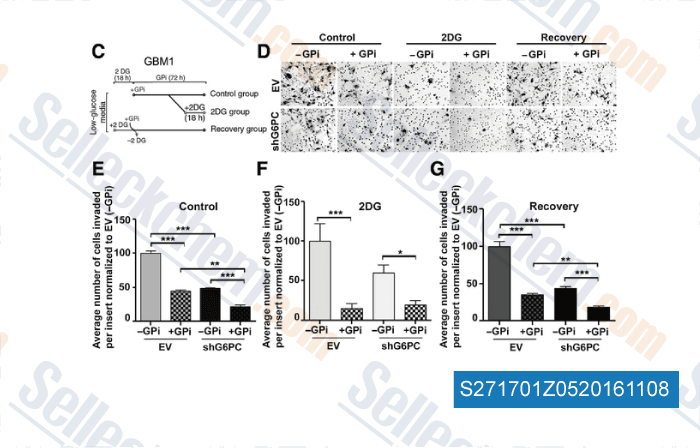
, , Mol Cancer Res, 2014, 12(11):1547-59.
Sellecks CP-91149 È stato citato da 12 Pubblicazioni
| Regulation of stress granule formation in human oligodendrocytes [ Nat Commun, 2024, 15(1):1524] | PubMed: 38374028 |
| Glycogenesis and glyconeogenesis from glutamine, lactate and glycerol support human macrophage functions [ EMBO Rep, 2024, 10.1038/s44319-024-00278-4] | PubMed: 39424955 |
| Mutant IDH regulates glycogen metabolism from early cartilage development to malignant chondrosarcoma formation [ Cell Rep, 2023, 42(6):112578] | PubMed: 37267108 |
| Glycogen phosphorylase inhibition alongside taxol chemotherapy synergistically elicits ferroptotic cell death in clear cell ovarian and kidney cancers [ bioRxiv, 2023, 10.1101/2023.05.01.538916] | PubMed: None |
| Intracellular energy controls dynamics of stress-induced ribonucleoprotein granules [ Nat Commun, 2022, 13(1):5584] | PubMed: 36151083 |
| TCR activation directly stimulates PYGB-dependent glycogenolysis to fuel the early recall response in CD8+ memory T cells [ Mol Cell, 2022, S1097-2765(22)00538-X] | PubMed: 35738262 |
| A genome-wide CRISPR-Cas9 screen identifies CENPJ as a host regulator of altered microtubule organization during Plasmodium liver infection [ Cell Chem Biol, 2022, S2451-9456(22)00205-7] | PubMed: 35738280 |
| Analysis of the expression, function and signaling of glycogen phosphorylase isoforms in hepatocellular carcinoma [ Oncol Lett, 2022, 24(2):244] | PubMed: 35761940 |
| Glycogen Metabolism Supports Early Glycolytic Reprogramming and Activation in Dendritic Cells in Response to Both TLR and Syk-Dependent CLR Agonists. [ Cells, 2020, 9(3)] | PubMed: 32183271 |
| Glycogen Metabolism Supports Early Glycolytic Reprogramming and Activation in Dendritic Cells in Response to Both TLR and Syk-Dependent CLR Agonists [ Cells, 2020, 9(3)E715] | PubMed: 32183271 |
POLITICA DI RESO
La politica di reso incondizionato di Selleck Chemical garantisce ai nostri clienti unesperienza di acquisto online senza problemi. Se non sei in alcun modo soddisfatto del tuo acquisto, puoi restituire qualsiasi articolo entro 7 giorni dalla ricezione. In caso di problemi di qualità del prodotto, sia relativi al protocollo che al prodotto, puoi restituire qualsiasi articolo entro 365 giorni dalla data di acquisto originale. Si prega di seguire le istruzioni seguenti per la restituzione dei prodotti.
SPEDIZIONE E CONSERVAZIONE
I prodotti Selleck vengono trasportati a temperatura ambiente. Se ricevi il prodotto a temperatura ambiente, ti assicuriamo che il Dipartimento di Ispezione Qualità di Selleck ha condotto esperimenti per verificare che la conservazione a temperatura normale per un mese non influirà sullattività biologica dei prodotti in polvere. Dopo la raccolta, conservare il prodotto secondo le indicazioni descritte nella scheda tecnica. La maggior parte dei prodotti Selleck è stabile nelle condizioni raccomandate.
NON PER USO UMANO, DIAGNOSTICO VETERINARIO O TERAPEUTICO.