
Dati tecnici
| Formula | C15H15N3O2 |
||||||||||
| Peso molecolare | 269.3 | Numero CAS | 112522-64-2 | ||||||||
| Solubilità (25°C)* | In vitro | DMSO | 54 mg/mL (200.51 mM) | ||||||||
| Water | Insoluble | ||||||||||
| Ethanol | Insoluble | ||||||||||
| In vivo (Aggiungere i solventi al prodotto singolarmente e in ordine.) |
|
||||||||||
|
* <1 mg/ml significa leggermente solubile o insolubile. * Si prega di notare che Selleck testa la solubilità di tutti i composti internamente e la solubilità effettiva può differire leggermente dai valori pubblicati. Ciò è normale ed è dovuto a leggere variazioni da lotto a lotto. * Spedizione a temperatura ambiente (I test di stabilità mostrano che questo prodotto può essere spedito senza alcuna misura di raffreddamento.) |
|||||||||||
Preparazione delle soluzioni stock
Attività biologica
| Descrizione | Tacedinaline (CI994, PD-123654, GOE-5549, Acetyldinaline) è un inibitore selettivo di classe I di HDAC con IC50 di 0,9, 0,9, 1,2 e >20 μM per le HDAC umane 1, 2, 3 e 8, rispettivamente. Fase 3. | ||||||
|---|---|---|---|---|---|---|---|
| Target |
|
||||||
| In vitro | CI-994 (< 160 mM) mostra un effetto citostatico con un aumento concomitante nella fase G0/G1, una riduzione a livello della fase S e un aumento dell'apoptosi nelle cellule A-549 e LX-1. CI-994 inibisce la crescita delle cellule LNCaP con un IC50 di 7,4 μM. CI-994 esercita attività contro diverse linee cellulari tumorali con maggiore citotossicità contro i tumori solidi rispetto alle linee cellulari di leucemia e fibroblasti normali. CI-994 inibisce la crescita delle cellule BCLO di leucemia di ratto con un IC50 di 2,5 μM. | ||||||
| In vivo | CI-994 esercita una dimostrata attività antitumorale contro diversi modelli tumorali, incluso il carcinoma duttale pancreatico murino chemioresistente, così come il modello di tumore prostatico umano LNCaP. |
Protocollo (da riferimento)
| Saggio cellulare: |
|
|---|---|
| Studio sugli animali: |
|
Riferimenti
|
Convalida del prodotto da parte del cliente
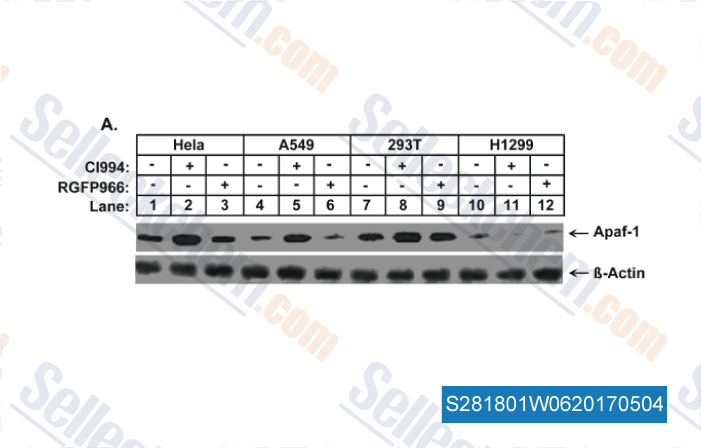
-
Dati da [ , , J Biol Chem, 2016, 291(14):7386-95 ]
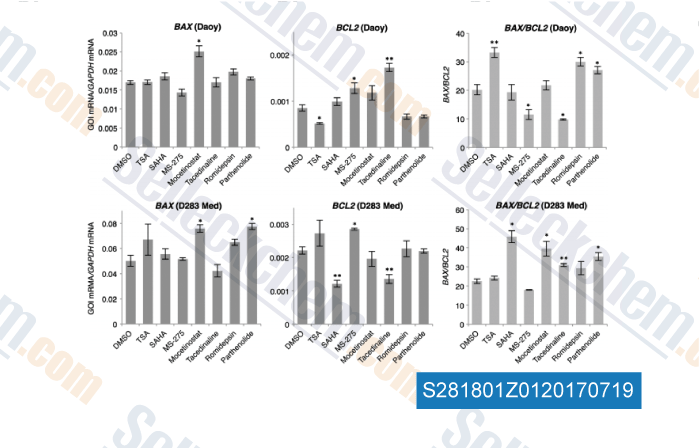
-
Dati da [ , , Cell Oncol (Dordr), 2017, 40(3):263-279 ]
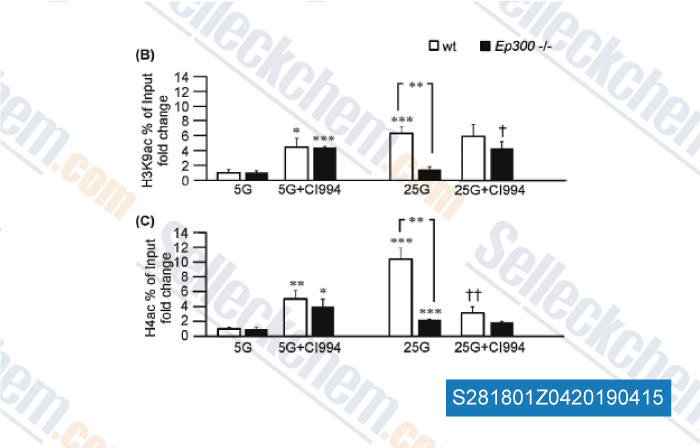
-
Dati da [ , , Int J Biochem Cell Biol, 2016, 81(Pt A):82-91 ]
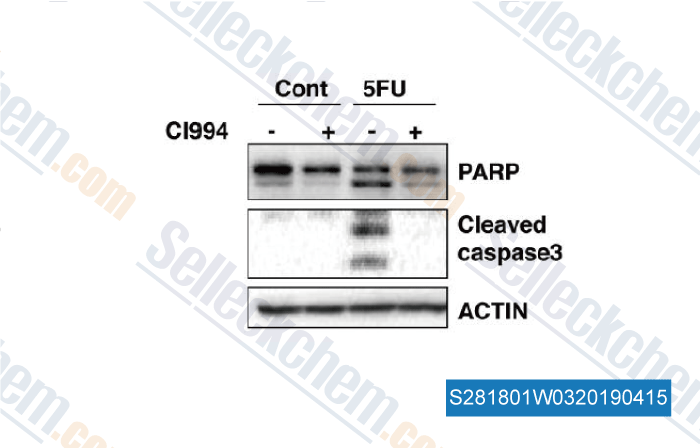
-
Dati da [ , , Anticancer Res, 2018, 38(1):271-277 ]
Sellecks Tacedinaline (CI994) È stato citato da 42 Pubblicazioni
| HSD17B4 deficiency causes dysregulation of primary cilia and is alleviated by acetyl-CoA [ Nat Commun, 2025, 16(1):2663] | PubMed: 40102401 |
| Loss of OVOL2 in Triple-Negative Breast Cancer Promotes Fatty Acid Oxidation Fueling Stemness Characteristics [ Adv Sci (Weinh), 2024, 11(24):e2308945] | PubMed: 38627980 |
| In-Cell Testing of Zinc-Dependent Histone Deacetylase Inhibitors in the Presence of Class-Selective Fluorogenic Substrates: Potential and Limitations of the Method [ Biomedicines, 2024, 12(6)1203] | PubMed: 38927410 |
| CUDC-907, a dual PI3K/histone deacetylase inhibitor, increases meta-iodobenzylguanidine uptake (123/131I-mIBG) in vitro and in vivo: a promising candidate for advancing theranostics in neuroendocrine tumors [ J Transl Med, 2023, 21(1):604] | PubMed: 37679770 |
| Histone deacetylase III interactions with BK polyomavirus large tumor antigen may affect protein stability [ Virol J, 2023, 20(1):155] | PubMed: 37464367 |
| MyoD is a 3D genome structure organizer for muscle cell identity [ Nat Commun, 2022, 13(1):205] | PubMed: 35017543 |
| Development of Human Adrenocortical Adenoma (HAA1) Cell Line from Zona Reticularis [ Int J Mol Sci, 2022, 24(1)584] | PubMed: 36614027 |
| Rb-E2F-HDAC Repressor Complexes Control Interferon-Induced Repression of Adenovirus To Promote Persistent Infection [ J Virol, 2022, e0044222] | PubMed: 35546119 |
| Pre-Senescence Induction in Hepatoma Cells Favors Hepatitis C Virus Replication and Can Be Used in Exploring Antiviral Potential of Histone Deacetylase Inhibitors [ Int J Mol Sci, 2021, 22(9)4559] | PubMed: 33925399 |
| Combination Treatment of CI-994 With Etoposide Potentiates Anticancer Effects Through a Topoisomerase II-Dependent Mechanism in Atypical Teratoid/Rhabdoid Tumor (AT/RT) [ Front Oncol, 2021, 11:648023] | PubMed: 34367950 |
POLITICA DI RESO
La politica di reso incondizionato di Selleck Chemical garantisce ai nostri clienti unesperienza di acquisto online senza problemi. Se non sei in alcun modo soddisfatto del tuo acquisto, puoi restituire qualsiasi articolo entro 7 giorni dalla ricezione. In caso di problemi di qualità del prodotto, sia relativi al protocollo che al prodotto, puoi restituire qualsiasi articolo entro 365 giorni dalla data di acquisto originale. Si prega di seguire le istruzioni seguenti per la restituzione dei prodotti.
SPEDIZIONE E CONSERVAZIONE
I prodotti Selleck vengono trasportati a temperatura ambiente. Se ricevi il prodotto a temperatura ambiente, ti assicuriamo che il Dipartimento di Ispezione Qualità di Selleck ha condotto esperimenti per verificare che la conservazione a temperatura normale per un mese non influirà sullattività biologica dei prodotti in polvere. Dopo la raccolta, conservare il prodotto secondo le indicazioni descritte nella scheda tecnica. La maggior parte dei prodotti Selleck è stabile nelle condizioni raccomandate.
NON PER USO UMANO, DIAGNOSTICO VETERINARIO O TERAPEUTICO.