
Dati tecnici
| Formula | C6H12N2O4Pt |
|||
| Peso molecolare | 371.25 | Numero CAS | 41575-94-4 | |
| Solubilità (25°C)* | In vitro | Water | 5 mg/mL (13.46 mM) | |
| Ethanol | Insoluble | |||
|
* <1 mg/ml significa leggermente solubile o insolubile. * Si prega di notare che Selleck testa la solubilità di tutti i composti internamente e la solubilità effettiva può differire leggermente dai valori pubblicati. Ciò è normale ed è dovuto a leggere variazioni da lotto a lotto. * Spedizione a temperatura ambiente (I test di stabilità mostrano che questo prodotto può essere spedito senza alcuna misura di raffreddamento.) |
||||
Preparazione delle soluzioni stock
Attività biologica
| Descrizione | Carboplatin, un derivato del CDDP, è un inibitore della sintesi del DNA che si lega al DNA, inibisce la replicazione e la trascrizione e induce la morte cellulare e interferisce con il meccanismo di riparazione cellulare nelle cellule A2780, SKOV-3, IGROV-1 e HX62. Induce la formazione di legami incrociati interfilamento del DNA e legami incrociati DNA-proteina. Le soluzioni sono instabili e devono essere preparate al momento. Il DMSO non è raccomandato per sciogliere farmaci a base di platino, il che può facilmente portare all'inattivazione del farmaco. | |
|---|---|---|
| Target |
|
|
| In vitro | Carboplatin mostra un effetto inibitorio sulla proliferazione cellulare in un pannello di linee cellulari di cancro ovarico umano, incluse le cellule A2780, SKOV3 e IGROV-1 con IC50 rispettivamente di 6,1 μM, 12,4 μM e 2,2 μM. Questo composto mostra anche attività antiproliferative in linee cellulari di carcinoide polmonare, come le cellule UMC-11, H727 e H835 con IC50 rispettivamente di 36,4 μM, 3,4 μM e 35,8 μM. |
|
| In vivo | Negli xenotrapianti tumorali A2780, Carboplatin (60 mg/kg via i.p.) somministrato come agente singolo mostra un modesto effetto antitumorale con volumi tumorali relativi al giorno 6 di 8,4 rispetto al controllo di 11,9, e i pesi tumorali del giorno 6 relativi al controllo (T/C) del 67%. Per gli xenotrapianti VC8 (carenti di Brca2), questo trattamento con il composto ritarda la crescita tumorale e riduce la massa tumorale del 42% rispetto al gruppo veicolo. |
|
| Caratteristiche | Questo prodotto non è raccomandato per essere sciolto in dimetilsolfossido (DMSO). |
Protocollo (da riferimento)
| Saggio cellulare: |
|
|---|---|
| Studio sugli animali: |
|
Riferimenti
|
Convalida del prodotto da parte del cliente
![<p>Detection of apoptotic responses was found to increase in epimorphin-treated A1847 with increasing concentrations of carboplatin compared to those of the untreated controls. Data were normalized to the controls and are represented as means ± S.D. [*p<0.05 compared with control]. Images of apoptotic cells were captured at 10X magnification, with at least 3 images per well, using an upright phase-contrast microscope (T3.15A; Fisher Scientific).</p>](https://file.selleckchem.com/downloads/review/700px/Carboplatin-S121502Z0220130923.gif)
-
Dati da [ PLoS One , 2012 , 8, e72637 ]
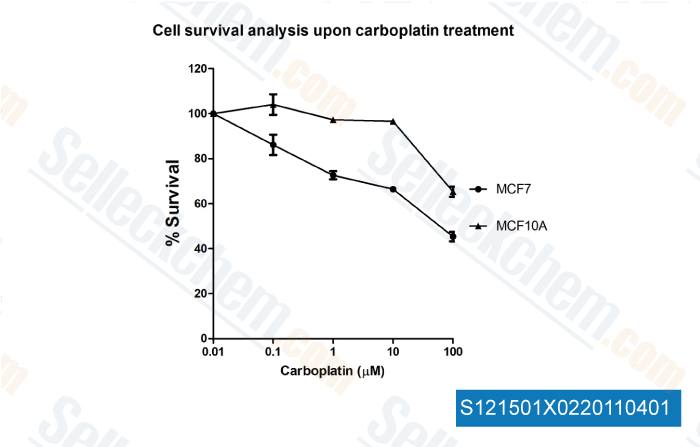
-
, , Dr. Helen Sadik of Johns Hopkins University
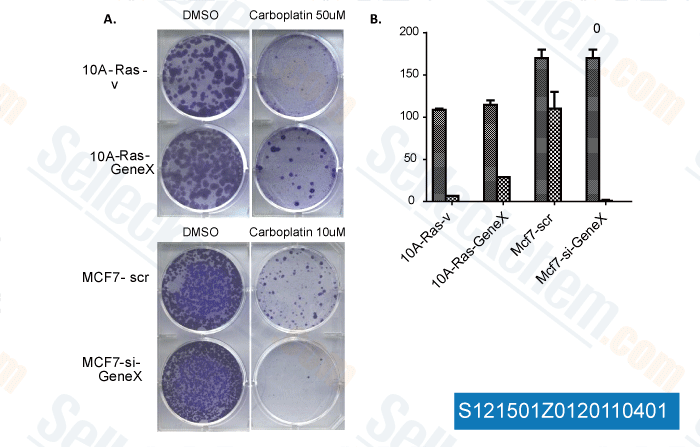
-
, , Dr. Helen Sadik of Johns Hopkins University
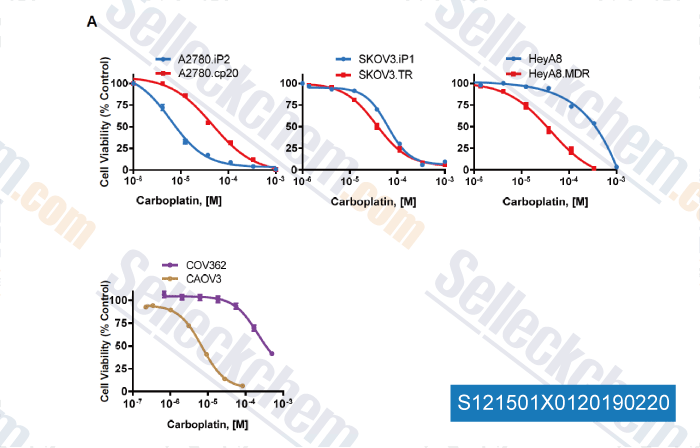
-
Dati da [ , , Cancer Lett, 2018, 436:75-86 ]
Sellecks Carboplatin È stato citato da 158 Pubblicazioni
| Non-canonical dihydrolipoyl transacetylase promotes chemotherapy resistance via mitochondrial tetrahydrofolate signaling [ Nat Commun, 2025, 16(1):8932] | PubMed: 41062483 |
| Screening a living biobank identifies cabazitaxel as a strategy to combat acquired taxol resistance in high-grade serous ovarian cancer [ Cell Rep Med, 2025, 6(6):102160] | PubMed: 40466638 |
| Profiling the Activity of the Potent and Highly Selective CDK2 Inhibitor BLU-222 Reveals Determinants of Response in CCNE1-Aberrant Ovarian and Endometrial Tumors [ Cancer Res, 2025, 10.1158/0008-5472.CAN-24-2360] | PubMed: 39945650 |
| USP9X integrates TGF-β and hypoxia signalings to promote ovarian cancer chemoresistance via HIF-2α-maintained stemness [ Cell Death Dis, 2025, 16(1):312] | PubMed: 40246814 |
| Cancer-metastasis-on-a-chip reveals efficacy of bevacizumab and siRNA in overcoming carboplatin resistance in SKOV3 ovarian cancer within a fibrotic metastatic microenvironment [ Mater Today Bio, 2025, 34:102240] | PubMed: 40917515 |
| Low dose DNA methyltransferase inhibitors potentiate PARP inhibitors in homologous recombination repair deficient tumors [ Breast Cancer Res, 2025, 27(1):8] | PubMed: 39819384 |
| ABCB1 confers resistance to carboplatin by accumulating stem-like cells in the G2/M phase of the cell cycle in p53null ovarian cancer [ Cell Death Discov, 2025, 11(1):132] | PubMed: 40175339 |
| Homologous Repair-Deficient Pancreatic Cancer: Refined Targeting of DNA Damage Response is an Effective Therapeutic Strategy [ United Eur Gastroent, 2025, 13(7):1328-1342] | PubMed: 40823818 |
| NAD+ Boosting Through NRH Supplementation Enhances Treatment Efficacy in EOC In Vitro [ Int J Mol Sci, 2025, 26(4)1719] | PubMed: 40004182 |
| O 6-methylguanine DNA methyltransferase (MGMT) expression in U1242 glioblastoma cells enhances in vitro clonogenicity, tumor implantation in vivo, and sensitivity to alisertib-carboplatin combination treatment [ Front Cell Neurosci, 2025, 19:1552015] | PubMed: 40336841 |
POLITICA DI RESO
La politica di reso incondizionato di Selleck Chemical garantisce ai nostri clienti unesperienza di acquisto online senza problemi. Se non sei in alcun modo soddisfatto del tuo acquisto, puoi restituire qualsiasi articolo entro 7 giorni dalla ricezione. In caso di problemi di qualità del prodotto, sia relativi al protocollo che al prodotto, puoi restituire qualsiasi articolo entro 365 giorni dalla data di acquisto originale. Si prega di seguire le istruzioni seguenti per la restituzione dei prodotti.
SPEDIZIONE E CONSERVAZIONE
I prodotti Selleck vengono trasportati a temperatura ambiente. Se ricevi il prodotto a temperatura ambiente, ti assicuriamo che il Dipartimento di Ispezione Qualità di Selleck ha condotto esperimenti per verificare che la conservazione a temperatura normale per un mese non influirà sullattività biologica dei prodotti in polvere. Dopo la raccolta, conservare il prodotto secondo le indicazioni descritte nella scheda tecnica. La maggior parte dei prodotti Selleck è stabile nelle condizioni raccomandate.
NON PER USO UMANO, DIAGNOSTICO VETERINARIO O TERAPEUTICO.