
Dati tecnici
| Formula | C21H25ClN6O2 |
||||||
| Peso molecolare | 428.92 | Numero CAS | 1143532-39-1 | ||||
| Solubilità (25°C)* | In vitro | DMSO | 86 mg/mL (200.5 mM) | ||||
| Ethanol | 20 mg/mL (46.62 mM) | ||||||
| Water | Insoluble | ||||||
| In vivo (Aggiungere i solventi al prodotto singolarmente e in ordine.) |
|
||||||
|
* <1 mg/ml significa leggermente solubile o insolubile. * Si prega di notare che Selleck testa la solubilità di tutti i composti internamente e la solubilità effettiva può differire leggermente dai valori pubblicati. Ciò è normale ed è dovuto a leggere variazioni da lotto a lotto. * Spedizione a temperatura ambiente (I test di stabilità mostrano che questo prodotto può essere spedito senza alcuna misura di raffreddamento.) |
|||||||
Preparazione delle soluzioni stock
Attività biologica
| Descrizione | Capivasertib (AZD5363) inibisce potentemente tutte le isoforme di Akt (Akt1/Akt2/Akt3) con IC50 di 3 nM/8 nM/8 nM in saggi acellulari, simile a P70S6K/PKA e con attività inferiore verso ROCK1/2. Fase 2. | ||||||||
|---|---|---|---|---|---|---|---|---|---|
| Target |
|
||||||||
| In vitro | Capivasertib (AZD5363) è un potente inibitore di Akt con IC50 di 3 nM, 8 nM e 8 nM per Akt1, Akt2 e Akt3, rispettivamente. Inibisce la fosforilazione dei substrati di Akt nelle cellule con una potenza di circa 0,3-0,8 μM. Questo composto inibisce la proliferazione di 41 delle 182 linee cellulari tumorali solide ed ematologiche con una potenza < 3 μM. Le mutazioni attivanti in PIK3CA, la perdita o l'inattivazione del soppressore tumorale PTEN, o l'amplificazione di HER2 sono tutte significativamente predittive della responsività ad AZD5363. Inoltre, si osserva anche una correlazione tra lo stato di mutazione RAS delle linee cellulari e la resistenza ad esso. |
||||||||
| In vivo | La somministrazione orale di Capivasertib (AZD5363) (100, 300 mg/kg) a topi nudi causa una riduzione dose- e tempo-dipendente della fosforilazione di PRAS40, GSK3β e S6 negli xenotrapianti BT474c, aumenti reversibili delle concentrazioni di glucosio nel sangue e diminuzioni dose-dipendenti dell'assorbimento di 2[18F]fluoro-2-deossi-d-glucosio (18F-FDG) negli xenotrapianti U87-MG. La somministrazione orale cronica di questo composto (130, 200 e 300 mg/kg) causa un'inibizione della crescita dose-dipendente degli xenotrapianti derivati da vari tipi di tumore, inclusi modelli di cancro al seno HER2+. |
||||||||
| Caratteristiche | Moderata tollerabilità preclinica e caratteristiche PD di un inibitore di Akt. Profilo distinto da altri inibitori di Akt in sviluppo clinico. |
Protocollo (da riferimento)
| Saggio della chinasi: |
|
|---|---|
| Saggio cellulare: |
|
| Studio sugli animali: |
|
Riferimenti
|
Convalida del prodotto da parte del cliente
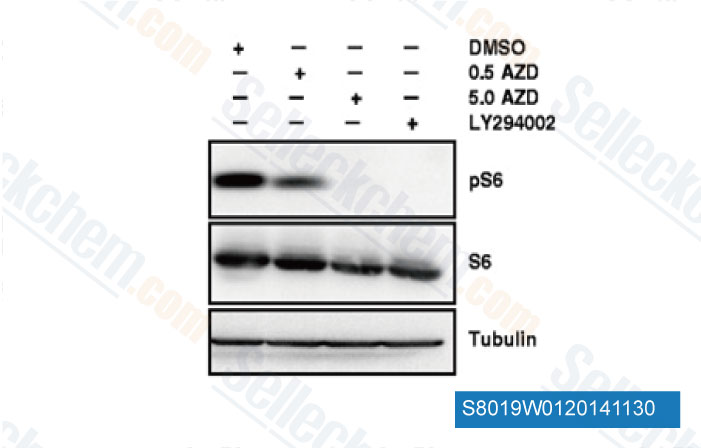
-
Dati da [ Cell Commun Signal , 2014 , 12(1), 61 ]
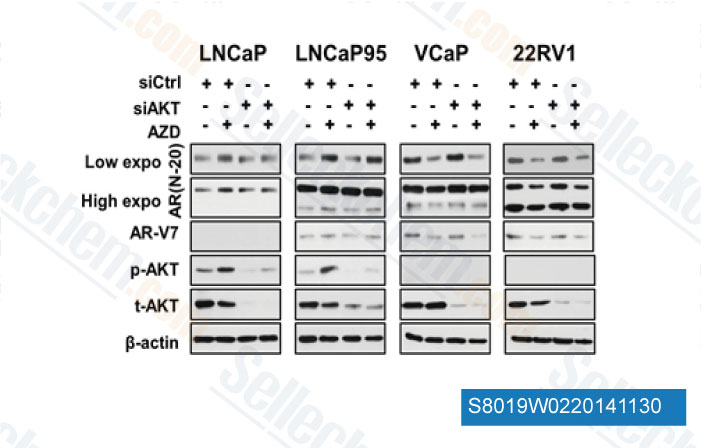
-
Dati da [ PLoS One , 2014 , 9(10), e108780 ]

-
Dati da [ , , Clin Cancer Res, 2016, 22(4):1018-27 ]
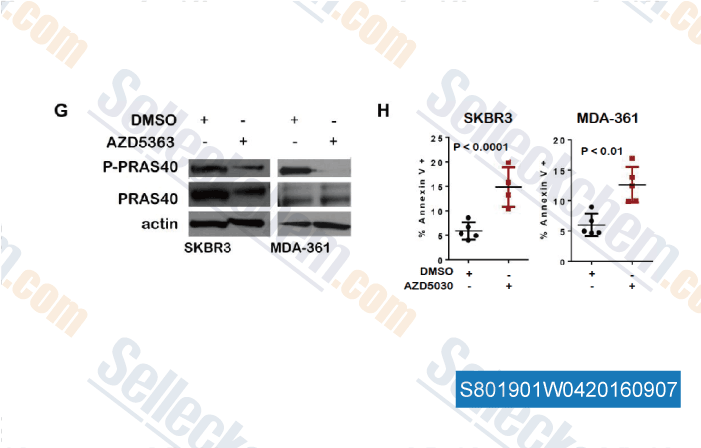
-
Dati da [ , , Cancer Res, 2016, 76(16):4752-64. ]
Sellecks AZD5363 (Capivasertib) È stato citato da 158 Pubblicazioni
| Macrophage-derived amphiregulin induces myofibroblast transition in adipogenic lineage precursors near Staphylococcus aureus abscess in bone marrow [ Nat Commun, 2025, 16(1):8409] | PubMed: 40998791 |
| Combined inhibition of KAT6A/B and Menin reverses estrogen receptor-driven gene expression programs in breast cancer [ Cell Rep Med, 2025, 6(7):102192] | PubMed: 40516531 |
| A bedside-to-bench translational analysis of NF1 alterations and CDK4/6 inhibitor resistance in hormone receptor-positive metastatic breast cancer [ EBioMedicine, 2025, 118:105828] | PubMed: 40578027 |
| FABP4 expression in neutrophils as a predictor of sepsis and SI-ARDS based on BALF transcriptome and peripheral blood validation [ Chin Med J (Engl), 2025, 10.1097/CM9.0000000000003447] | PubMed: 40169352 |
| Intratumor heterogeneity in KRAS signaling shapes treatment resistance [ iScience, 2025, 28(2):111662] | PubMed: 39898020 |
| Functional Analysis of the PI3K/AKT/mTOR Pathway Inhibitor, Gedatolisib, Plus Fulvestrant with and Without Palbociclib in Breast Cancer Models [ Int J Mol Sci, 2025, 26(12)5844] | PubMed: 40565304 |
| Low-Dose Perifosine, a Phase II Phospholipid Akt Inhibitor, Selectively Sensitizes Drug-Resistant ABCB1-Overexpressing Cancer Cells [ Biomol Ther (Seoul), 2025, 33(1):170-181] | PubMed: 39632683 |
| 3-O-acetylrubiarbonol B preferentially targets EGFR and MET over rubiarbonol B to inhibit NSCLC cell growth [ PLoS One, 2025, 20(9):e0329706] | PubMed: 40920675 |
| ZO-2 is a scaffold at the centriole and mitotic spindle poles that enhances microtubule stability and supports the proper development of mitotic spindles and cilia [ Cell Tissue Res, 2025, 10.1007/s00441-025-03992-0] | PubMed: 40728639 |
| Development of Acquired Resistance in Alpelisib-treated Gastric Cancer Cells With PIK3CA Mutations and Overcoming Strategies [ Anticancer Res, 2025, 45(5):1877-1896] | PubMed: 40295072 |
POLITICA DI RESO
La politica di reso incondizionato di Selleck Chemical garantisce ai nostri clienti unesperienza di acquisto online senza problemi. Se non sei in alcun modo soddisfatto del tuo acquisto, puoi restituire qualsiasi articolo entro 7 giorni dalla ricezione. In caso di problemi di qualità del prodotto, sia relativi al protocollo che al prodotto, puoi restituire qualsiasi articolo entro 365 giorni dalla data di acquisto originale. Si prega di seguire le istruzioni seguenti per la restituzione dei prodotti.
SPEDIZIONE E CONSERVAZIONE
I prodotti Selleck vengono trasportati a temperatura ambiente. Se ricevi il prodotto a temperatura ambiente, ti assicuriamo che il Dipartimento di Ispezione Qualità di Selleck ha condotto esperimenti per verificare che la conservazione a temperatura normale per un mese non influirà sullattività biologica dei prodotti in polvere. Dopo la raccolta, conservare il prodotto secondo le indicazioni descritte nella scheda tecnica. La maggior parte dei prodotti Selleck è stabile nelle condizioni raccomandate.
NON PER USO UMANO, DIAGNOSTICO VETERINARIO O TERAPEUTICO.