
Dati tecnici
| Formula | C17H16O4 |
||||||
| Peso molecolare | 284.31 | Numero CAS | 104594-70-9 | ||||
| Solubilità (25°C)* | In vitro | DMSO | 57 mg/mL (200.48 mM) | ||||
| Ethanol | 57 mg/mL (200.48 mM) | ||||||
| Water | Insoluble | ||||||
| In vivo (Aggiungere i solventi al prodotto singolarmente e in ordine.) |
|
||||||
|
* <1 mg/ml significa leggermente solubile o insolubile. * Si prega di notare che Selleck testa la solubilità di tutti i composti internamente e la solubilità effettiva può differire leggermente dai valori pubblicati. Ciò è normale ed è dovuto a leggere variazioni da lotto a lotto. * Spedizione a temperatura ambiente (I test di stabilità mostrano che questo prodotto può essere spedito senza alcuna misura di raffreddamento.) |
|||||||
Preparazione delle soluzioni stock
Attività biologica
| Descrizione | Il Caffeic acid phenethyl ester (CAPE, Phenylethyl Caffeate) è un potente e specifico inibitore dell'attivazione di NF-κB e mostra anche attività antiossidanti, immunomodulatorie e antinfiammatorie. | |
|---|---|---|
| Target |
|
|
| In vitro | Il Caffeic acid phenethyl ester blocca l'attivazione di NF-κB indotta da estere di forbolo, ceramide, acido okadaico e perossido di idrogeno prevenendo la traslocazione della subunità p65 di NF-κB al nucleo. In una serie di linee cellulari tumorali, il Caffeic acid phenethyl ester mostra una promettente attività antiproliferativa con EC50 di 1,76, 3,16, 13,7 e 44,0 μM contro le linee cellulari di colon murino 26-L5, melanoma murino B16-BL6, fibrosarcoma umano HT-1080 e adenocarcinoma polmonare umano A549, rispettivamente. Il Caffeic acid phenethyl ester, come potente antiossidante, esercita il suo effetto anti-apoptotico nelle cellule granulari cerebellari bloccando la formazione di ROS e inibendo l'attività della caspasi. Inoltre, il Caffeic acid phenethyl ester attenua il fenotipo pro-infiammatorio delle HSC stimolate da LPS e la sensibilizzazione delle HSC indotta da LPS alle citochine fibrogeniche inibendo la segnalazione di NF-κB. | |
| In vivo | In vivo, il Caffeic acid phenethyl ester (10 mg/kg, i.p.) inibisce la crescita e l'angiogenesi dei tumori primari in topi C57BL/6 e BALB/c inoculati con carcinoma polmonare di Lewis, carcinoma del colon e cellule di melanoma. Il Caffeic acid phenethyl ester (5, 10, 20 mg/kg) mostra anche effetti immunomodulatori in vivo diminuendo il peso del timo e/o la cellularità del timo e della milza. |
Protocollo (da riferimento)
| Saggio cellulare: |
|
|---|---|
| Studio sugli animali: |
|
Riferimenti
|
Convalida del prodotto da parte del cliente
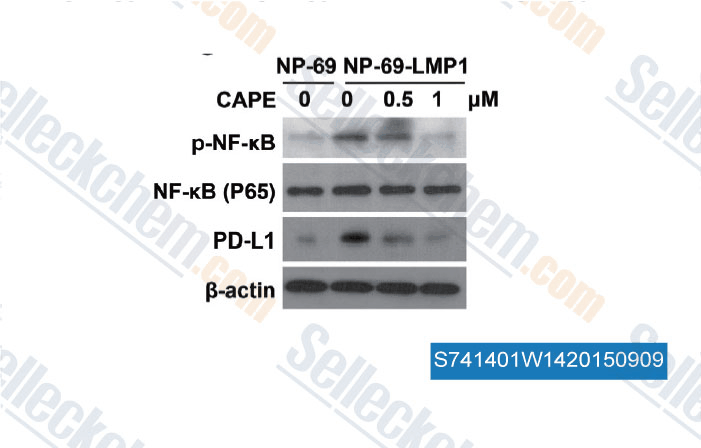
-
Dati da [ , , Oncotarget, 2014, 5(23): 12189-202 ]
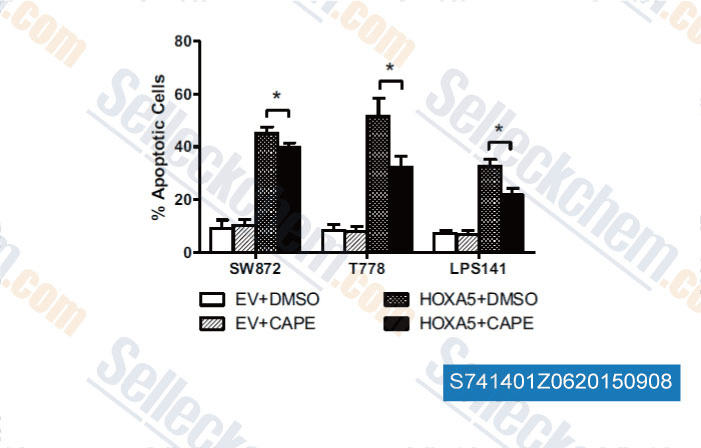
-
Dati da [ , , Sci Rep, 2015, 5: 12580 ]
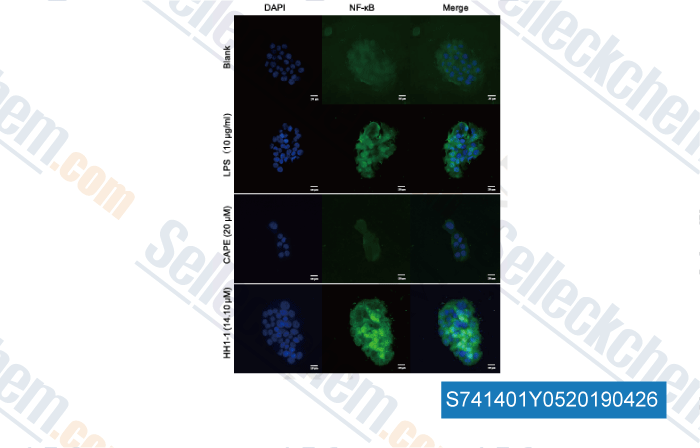
-
Dati da [ , , Carbohydr Polym, 2018, 202:134-142 ]
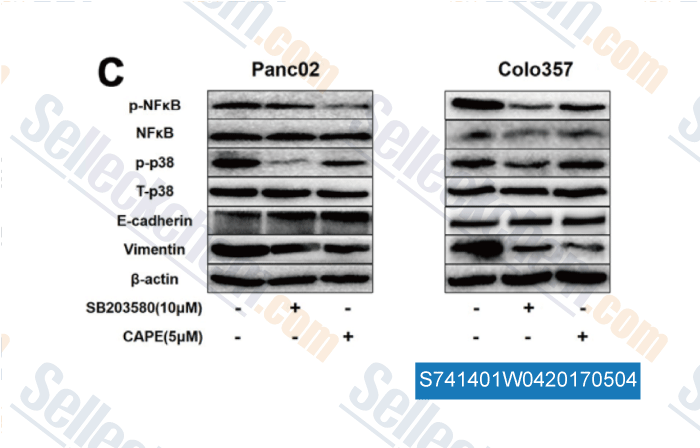
-
Dati da [ , , Oncotarget, 2016, 7(25):38539-38550 ]
Sellecks Caffeic Acid Phenethyl Ester È stato citato da 56 Pubblicazioni
| Caffeic acid phenethyl ester protects renal tubular epithelial cells against ferroptosis in diabetic kidney disease via restoring PINK1-mediated mitophagy [ Mol Med, 2025, 31(1):264] | PubMed: 40702453 |
| Growth differentiation factor 15 is a glucose-downregulated gene acting as the cross talk between stroma and cancer cells of the human bladder [ Am J Physiol Cell Physiol, 2025, 328(2):C557-C573] | PubMed: 39804805 |
| Caffeic Acid Phenethyl Ester Protects Neurons Against Oxidative Stress and Neurodegeneration During Traumatic Brain Injury [ Biomolecules, 2025, 15(1)80] | PubMed: 39858474 |
| Osteopontin deficiency promotes cartilaginous endplate degeneration by enhancing the NF-κB signaling to recruit macrophages and activate the NLRP3 inflammasome [ Bone Res, 2024, 12(1):53] | PubMed: 39242551 |
| Calpain-2 mediates SARS-CoV-2 entry via regulating ACE2 levels [ mBio, 2024, e0228723.] | PubMed: 38349185 |
| Clarithromycin Modulates Neutrophilic Inflammation Induced by Prevotella intermedia in Human Airway Epithelial Cells [ Antibiotics (Basel), 2024, 13(9)909] | PubMed: 39335081 |
| CAPE activates AMPK and Foxo3 signaling to induce growth inhibition and ferroptosis in triple-negative breast cancer [ PLoS One, 2024, 19(12):e0315037] | PubMed: 39729481 |
| Caffeic acid phenethyl ester restores mitochondrial homeostasis against peritoneal fibrosis induced by peritoneal dialysis through the AMPK/SIRT1 pathway [ Ren Fail, 2024, 46(1):2350235] | PubMed: 38721924 |
| Caffeic Acid Phenethyl Ester Suppresses Oxidative Stress and Regulates M1/M2 Microglia Polarization via Sirt6/Nrf2 Pathway to Mitigate Cognitive Impairment in Aged Mice following Anesthesia and Surgery [ Antioxidants (Basel), 2023, 12(3)714] | PubMed: 36978961 |
| Caffeic acid phenethyl ester suppresses metastasis of breast cancer cells by inactivating FGFR1 via MD2 [ PLoS One, 2023, 18(7):e0289031] | PubMed: 37490511 |
POLITICA DI RESO
La politica di reso incondizionato di Selleck Chemical garantisce ai nostri clienti unesperienza di acquisto online senza problemi. Se non sei in alcun modo soddisfatto del tuo acquisto, puoi restituire qualsiasi articolo entro 7 giorni dalla ricezione. In caso di problemi di qualità del prodotto, sia relativi al protocollo che al prodotto, puoi restituire qualsiasi articolo entro 365 giorni dalla data di acquisto originale. Si prega di seguire le istruzioni seguenti per la restituzione dei prodotti.
SPEDIZIONE E CONSERVAZIONE
I prodotti Selleck vengono trasportati a temperatura ambiente. Se ricevi il prodotto a temperatura ambiente, ti assicuriamo che il Dipartimento di Ispezione Qualità di Selleck ha condotto esperimenti per verificare che la conservazione a temperatura normale per un mese non influirà sullattività biologica dei prodotti in polvere. Dopo la raccolta, conservare il prodotto secondo le indicazioni descritte nella scheda tecnica. La maggior parte dei prodotti Selleck è stabile nelle condizioni raccomandate.
NON PER USO UMANO, DIAGNOSTICO VETERINARIO O TERAPEUTICO.