
Dati tecnici
| Formula | C28H24FN3O5.C4H6O5 |
||||||||||
| Peso molecolare | 635.59 | Numero CAS | 1140909-48-3 | ||||||||
| Solubilità (25°C)* | In vitro | DMSO | 100 mg/mL (157.33 mM) | ||||||||
| Water | Insoluble | ||||||||||
| Ethanol | Insoluble | ||||||||||
| In vivo (Aggiungere i solventi al prodotto singolarmente e in ordine.) |
|
||||||||||
|
* <1 mg/ml significa leggermente solubile o insolubile. * Si prega di notare che Selleck testa la solubilità di tutti i composti internamente e la solubilità effettiva può differire leggermente dai valori pubblicati. Ciò è normale ed è dovuto a leggere variazioni da lotto a lotto. * Spedizione a temperatura ambiente (I test di stabilità mostrano che questo prodotto può essere spedito senza alcuna misura di raffreddamento.) |
|||||||||||
Preparazione delle soluzioni stock
Attività biologica
| Descrizione | Cabozantinib malate (XL184) è il malato di Cabozantinib, un potente inibitore di VEGFR2 con IC50 di 0,035 nM e inibisce anche c-Met, Ret (c-Ret), Kit (c-Kit), Flt-1/3/4, Tie2 e AXL con IC50 di 1,3 nM, 4 nM, 4,6 nM, 12 nM/11,3 nM/6 nM, 14,3 nM e 7 nM in saggi senza cellule, rispettivamente. Questo composto induce apoptosi. | |||||||||||
|---|---|---|---|---|---|---|---|---|---|---|---|---|
| Target |
|
|||||||||||
| In vitro | Cabozantinib malate ha una debole attività inibitoria contro RON e PDGFRβ con IC50 di 124 nM e 234 nM, rispettivamente, e ha bassa attività contro FGFR1 con IC50 di 5,294 μM. Questo composto a bassa concentrazione (0,1-0,5 μM) è sufficiente per indurre una marcata inibizione della fosforilazione costitutiva e inducibile di Met e della sua conseguente segnalazione a valle nelle cellule MPNST, e inibire la migrazione e l'invasione delle cellule MPNST indotte da HGF. Induce anche una marcata inibizione della fosforilazione di Met e VEGFR2 nelle cellule endoteliali della vena ombelicale umana (HUVEC) stimolate da citochine. Sebbene questa sostanza chimica non abbia un effetto significativo sulla crescita delle cellule MPNST a 0,1 μM, a 5-10 μM inibisce significativamente la crescita delle cellule MPNST. | |||||||||||
| In vivo | Il trattamento con Cabozantinib malate a 30 mg/kg in topi RIP-Tag2 con tumori spontanei delle isole pancreatiche distrugge l'83% della vascolarizzazione tumorale, riduce i periciti e le guaine della membrana basale vuote, causa un'ipossia intratumorale diffusa e un'estesa apoptosi delle cellule tumorali, e rallenta la ricrescita della vascolarizzazione tumorale dopo la sospensione del farmaco, in modo più significativo rispetto a XL999 che blocca VEGFR ma non c-Met, portando a una riduzione della vascolarizzazione solo del 43%, suggerendo che l'inibizione concomitante di VEGFR e di altre tirosin-chinasi recettoriali (RTK) funzionalmente rilevanti amplifica l'inibizione dell'angiogenesi. Questo composto diminuisce anche l'invasività dei tumori primari e riduce le metastasi. Questa sostanza chimica a 30 mg/kg/die abroga significativamente la crescita di xenotrapianti di MPNST umani e le metastasi in topi SCID. La somministrazione di questo composto induce un'inibizione dose-dipendente della crescita tumorale in modelli di tumori mammari, polmonari e di glioma, in associazione con una diminuzione della proliferazione delle cellule tumorali ed endoteliali, nonché un aumento dell'apoptosi. Una singola dose orale di questa sostanza chimica è sufficiente per indurre un'inibizione sostenuta della crescita tumorale in topi portatori di tumori MDA-MB-231 e ratti portatori di tumori C6 a 100 mg/kg e 10 mg/kg, rispettivamente. |
Protocollo (da riferimento)
| Saggio cellulare: |
|
|---|---|
| Studio sugli animali: |
|
Riferimenti
|
Convalida del prodotto da parte del cliente
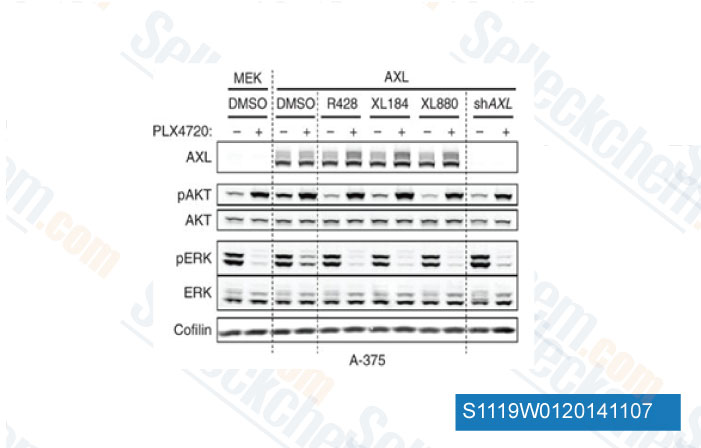
-
Dati da [ Cancer Discov , 2014 , 4(7), 816-27 ]
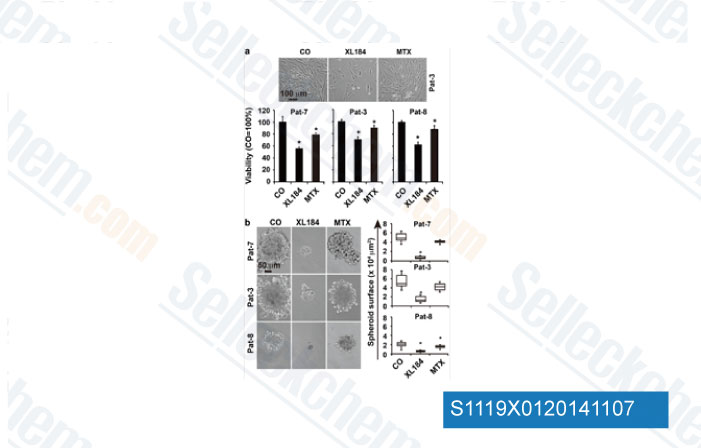
-
Dati da [ Cell Death Dis , 2014 , 5, e1471 ]
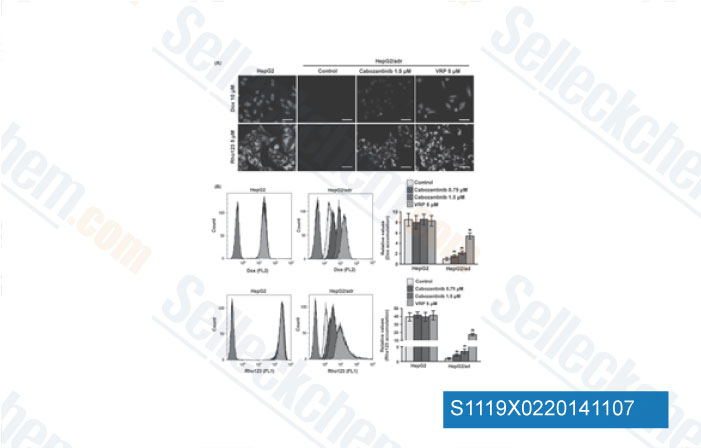
-
Dati da [ Liver Int , 2014 , 10.1111/liv.12524 ]
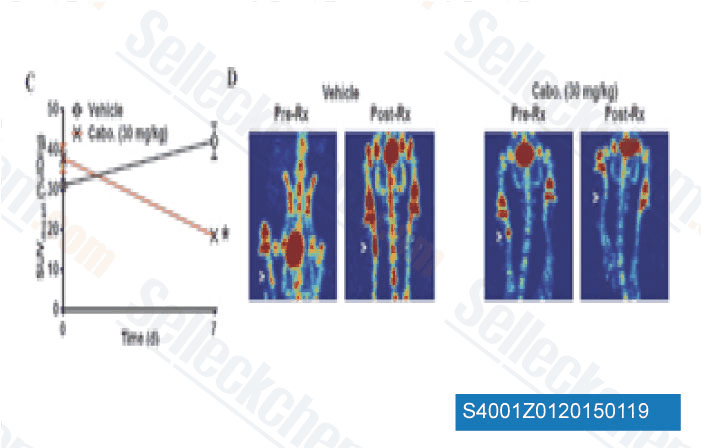
-
Dati da [ Mol Imaging , 2014 , 10.2310/7290.2014.00026 ]
Sellecks Cabozantinib malate È stato citato da 110 Pubblicazioni
| Biofabrication of pheochromocytoma and paraganglioma tumor organoids and assessment of response to systemic therapy [ Sci Rep, 2025, 15(1):35889] | PubMed: 41087622 |
| Tyrosine kinase inhibitors affect sweet taste and dysregulate fate selection of specific taste cell subtypes via KIT inhibition [ bioRxiv, 2025, 2025.08.15.670608] | PubMed: 40894646 |
| Piezo1 regulates meningeal lymphatic vessel drainage and alleviates excessive CSF accumulation [ Nat Neurosci, 2024, 10.1038/s41593-024-01604-8] | PubMed: 38528202 |
| Patient-derived rhabdomyosarcoma cells recapitulate the genetic and transcriptomic landscapes of primary tumors [ iScience, 2024, 27(10):110862] | PubMed: 39319271 |
| A subset of VEGFR-TKIs activates AMPK in LKB1-mutant lung cancer [ Cancer Sci, 2023, 114(4):1651-1662] | PubMed: 36459496 |
| Identification of therapeutic sensitivities in a spheroid drug combination screen of Neurofibromatosis Type I associated High Grade Gliomas [ PLoS One, 2023, 18(2):e0277306] | PubMed: 36730269 |
| Rapid Profiling of Tumor-Immune Interaction Using Acoustically Assembled Patient-Derived Cell Clusters [ Adv Sci (Weinh), 2022, e2201478] | PubMed: 35611994 |
| CIC-mediated modulation of MAPK signaling opposes receptor tyrosine kinase inhibitor response in kinase-addicted sarcoma [ Cancer Res, 2022, canres.1397.2021] | PubMed: 35074756 |
| Targeting PEA3 transcription factors to mitigate small cell lung cancer progression [ Oncogene, 2022, 10.1038/s41388-022-02558-6] | PubMed: 36509998 |
| Plasma extracellular vesicle long RNA profiles in the diagnosis and prediction of treatment response for breast cancer [ Cancers (Basel), 2022, 14(7)1683] | PubMed: 35406455 |
POLITICA DI RESO
La politica di reso incondizionato di Selleck Chemical garantisce ai nostri clienti unesperienza di acquisto online senza problemi. Se non sei in alcun modo soddisfatto del tuo acquisto, puoi restituire qualsiasi articolo entro 7 giorni dalla ricezione. In caso di problemi di qualità del prodotto, sia relativi al protocollo che al prodotto, puoi restituire qualsiasi articolo entro 365 giorni dalla data di acquisto originale. Si prega di seguire le istruzioni seguenti per la restituzione dei prodotti.
SPEDIZIONE E CONSERVAZIONE
I prodotti Selleck vengono trasportati a temperatura ambiente. Se ricevi il prodotto a temperatura ambiente, ti assicuriamo che il Dipartimento di Ispezione Qualità di Selleck ha condotto esperimenti per verificare che la conservazione a temperatura normale per un mese non influirà sullattività biologica dei prodotti in polvere. Dopo la raccolta, conservare il prodotto secondo le indicazioni descritte nella scheda tecnica. La maggior parte dei prodotti Selleck è stabile nelle condizioni raccomandate.
NON PER USO UMANO, DIAGNOSTICO VETERINARIO O TERAPEUTICO.