
Dati tecnici
| Formula | C27H20ClFN4O4 |
||||||||||
| Peso molecolare | 518.92 | Numero CAS | 1028486-01-2 | ||||||||
| Solubilità (25°C)* | In vitro | DMSO | 100 mg/mL (192.7 mM) | ||||||||
| Water | Insoluble | ||||||||||
| Ethanol | Insoluble | ||||||||||
| In vivo (Aggiungere i solventi al prodotto singolarmente e in ordine.) |
|
||||||||||
|
* <1 mg/ml significa leggermente solubile o insolubile. * Si prega di notare che Selleck testa la solubilità di tutti i composti internamente e la solubilità effettiva può differire leggermente dai valori pubblicati. Ciò è normale ed è dovuto a leggere variazioni da lotto a lotto. * Spedizione a temperatura ambiente (I test di stabilità mostrano che questo prodotto può essere spedito senza alcuna misura di raffreddamento.) |
|||||||||||
Preparazione delle soluzioni stock
Attività biologica
| Descrizione | Alisertib (MLN8237) è un inibitore selettivo di Aurora A con un'IC50 di 1,2 nM in un saggio senza cellule, e ha una selettività >200 volte superiore per Aurora A rispetto ad Aurora B. Questo composto induce l'arresto del ciclo cellulare, l'apoptosis e l'autophagy. Fase 3. | ||
|---|---|---|---|
| Target |
|
||
| In vitro | Alisertib (MLN8237) mostra una selettività >200 volte superiore per Aurora A rispetto all'Aurora B strutturalmente correlata con un'IC50 di 396,5 nM, e non ha alcuna attività significativa contro altre 205 chinasi. Il trattamento con questo composto (0,5 μM) inibisce la fosforilazione di Aurora A nelle cellule MM1.S e OPM1, senza influenzare la fosforilazione dell'istone H3 mediata da Aurora B. Inibisce significativamente la proliferazione cellulare nelle linee cellulari di mieloma multiplo (MM) con valori di IC50 di 0,003-1,71 μM, e mostra un'attività antiproliferativa più potente contro le cellule MM primarie e le linee cellulari MM in presenza di cellule stromali del midollo osseo, così come IL-6 e IGF-1, rispetto alle sole cellule MM. A 0,5 μM, induce un aumento da 2 a 6 volte della fase G2/M nelle cellule MM primarie e nelle linee cellulari, così come una significativa apoptosi e senescenza, coinvolgendo la sovraregolazione di p53, p21 e p27, così come il clivaggio di PARP, caspasi 3 e caspasi 9. Inoltre, mostra un forte effetto anti-MM sinergico con Hexadecadrol, così come un effetto additivo con doxorubicina e LDP-341. Questo composto (0,5 μM) provoca l'inibizione della formazione di colonie delle linee cellulari di adenocarcinoma esofageo FLO-1, OE19 e OE33, e induce un aumento significativo della percentuale di cellule poliploidi, e successivamente un aumento della percentuale di cellule nella fase sub-G1, che può essere ulteriormente potenziata in combinazione con NSC 119875 (2,5 μM), coinvolgendo la maggiore induzione di TAp73β, PUMA, NOXA, caspasi-3 clivata e PARP clivata rispetto a un trattamento a singolo agente. |
||
| In vivo | Alisertib (MLN8237) riduce significativamente il carico tumorale con un'inibizione della crescita tumorale (TGI) del 42% e 80% a 15 mg/kg e 30 mg/kg, rispettivamente, e prolunga la sopravvivenza dei topi rispetto al controllo. |
||
| Caratteristiche | Primo inibitore di Aurora A disponibile per via orale. |
Protocollo (da riferimento)
| Saggio della chinasi: |
|
|---|---|
| Saggio cellulare: |
|
| Studio sugli animali: |
|
Riferimenti
|
Convalida del prodotto da parte del cliente
-S113303W0120130926.gif)
-
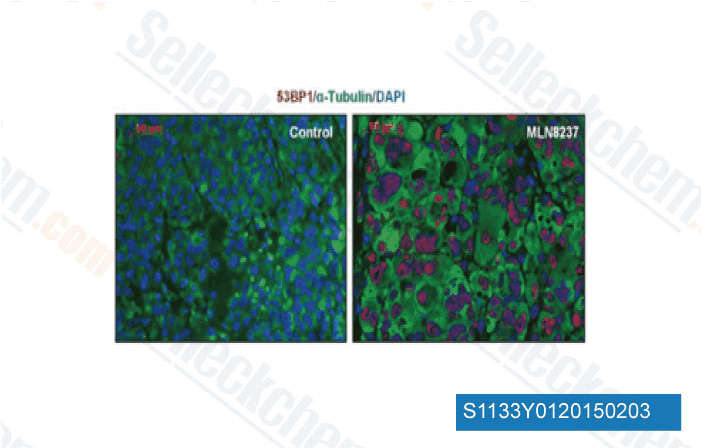
Dati da [ Oncogene , 2014 , 33, 3550-60 ]
-
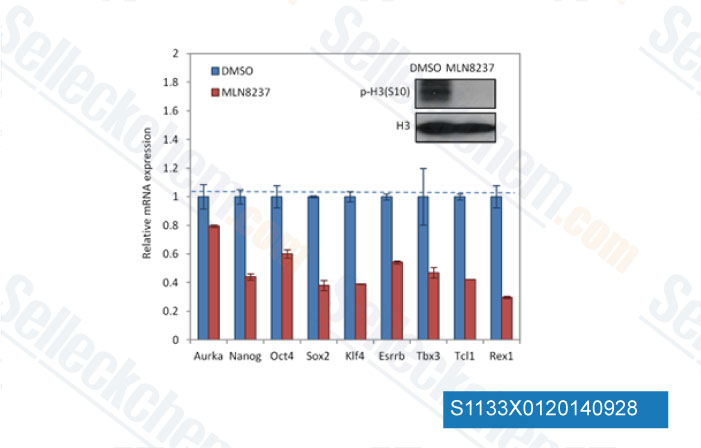
Dati da [ EMBO Mol Med , 2013 , 5(1), 149-66 ]
-
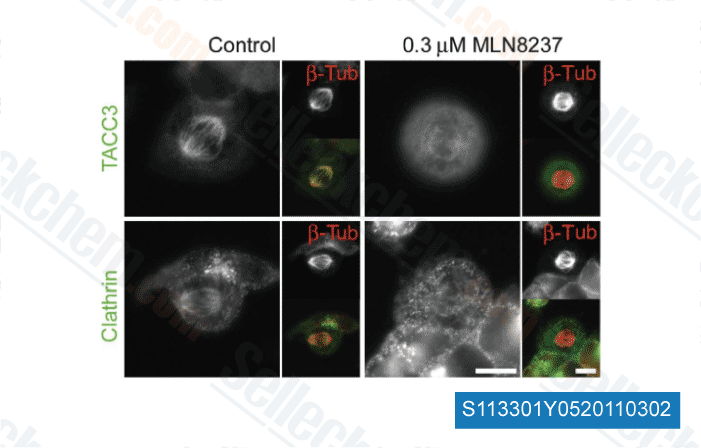
Dati da [ Cell Stem Cell , 2012 , 11, 179-94 ]
-
Dati da [ EMBO J , 2012 , 30, 906-19 ]
Sellecks Alisertib (MLN8237) È stato citato da 380 Pubblicazioni
| Centromere protection requires strict mitotic inactivation of the Bloom syndrome helicase complex [ Nat Commun, 2025, 16(1):7832] | PubMed: 40846865 |
| Aurora A regulates the material property of spindle poles to orchestrate nuclear organization at mitotic exit [ EMBO J, 2025, 10.1038/s44318-025-00564-4] | PubMed: 40940421 |
| Targeted inhibition of Aurora kinase A promotes immune checkpoint inhibition efficacy in human papillomavirus-driven cancers [ J Immunother Cancer, 2025, 13(1)e009316] | PubMed: 39773561 |
| An Aurora kinase A-BOD1L1-PP2A B56 axis promotes chromosome segregation fidelity [ Cell Rep, 2025, 44(2):115317] | PubMed: 39970043 |
| The AURKA inhibitor alters the immune microenvironment and enhances targeting B7-H3 immunotherapy in glioblastoma [ JCI Insight, 2025, e173700] | PubMed: 39928563 |
| CDK1-mediated phosphorylation of LDHA fuels mitosis through LDHB-dependent lactate oxidation [ EMBO Rep, 2025, 10.1038/s44319-025-00573-8] | PubMed: 40940446 |
| Cellular senescence as a prognostic marker for predicting breast cancer progression in 2D and 3D organoid models [ Biomed Pharmacother, 2025, 189:118324] | PubMed: 40616881 |
| Actionable heterogeneity of hepatocellular carcinoma therapy-induced senescence [ Cancer Immunol Immunother, 2025, 74(7):207] | PubMed: 40374812 |
| Aurora B maintains spherical shape of mitotic cells via simultaneously stabilizing myosin II and vimentin [ J Mol Cell Biol, 2025, mjaf023] | PubMed: 40795355 |
| O 6-methylguanine DNA methyltransferase (MGMT) expression in U1242 glioblastoma cells enhances in vitro clonogenicity, tumor implantation in vivo, and sensitivity to alisertib-carboplatin combination treatment [ Front Cell Neurosci, 2025, 19:1552015] | PubMed: 40336841 |
POLITICA DI RESO
La politica di reso incondizionato di Selleck Chemical garantisce ai nostri clienti unesperienza di acquisto online senza problemi. Se non sei in alcun modo soddisfatto del tuo acquisto, puoi restituire qualsiasi articolo entro 7 giorni dalla ricezione. In caso di problemi di qualità del prodotto, sia relativi al protocollo che al prodotto, puoi restituire qualsiasi articolo entro 365 giorni dalla data di acquisto originale. Si prega di seguire le istruzioni seguenti per la restituzione dei prodotti.
SPEDIZIONE E CONSERVAZIONE
I prodotti Selleck vengono trasportati a temperatura ambiente. Se ricevi il prodotto a temperatura ambiente, ti assicuriamo che il Dipartimento di Ispezione Qualità di Selleck ha condotto esperimenti per verificare che la conservazione a temperatura normale per un mese non influirà sullattività biologica dei prodotti in polvere. Dopo la raccolta, conservare il prodotto secondo le indicazioni descritte nella scheda tecnica. La maggior parte dei prodotti Selleck è stabile nelle condizioni raccomandate.
NON PER USO UMANO, DIAGNOSTICO VETERINARIO O TERAPEUTICO.