
Dati tecnici
| Formula | C34H29N7O |
||||||
| Peso molecolare | 551.64 | Numero CAS | 612847-09-3 | ||||
| Solubilità (25°C)* | In vitro | DMSO | 20 mg/mL (36.25 mM) | ||||
| Water | Insoluble | ||||||
| Ethanol | Insoluble | ||||||
| In vivo (Aggiungere i solventi al prodotto singolarmente e in ordine.) |
|
||||||
|
* <1 mg/ml significa leggermente solubile o insolubile. * Si prega di notare che Selleck testa la solubilità di tutti i composti internamente e la solubilità effettiva può differire leggermente dai valori pubblicati. Ciò è normale ed è dovuto a leggere variazioni da lotto a lotto. * Spedizione a temperatura ambiente (I test di stabilità mostrano che questo prodotto può essere spedito senza alcuna misura di raffreddamento.) |
|||||||
Preparazione delle soluzioni stock
Attività biologica
| Descrizione | Akti-1/2 (Akt Inhibitor VIII) è un inibitore altamente selettivo di Akt1/Akt2 con IC50 di 58 nM/210 nM, rispettivamente, circa 36 volte più selettivo per Akt1 rispetto ad Akt3. Questo composto induce l'apoptosi. | ||||||
|---|---|---|---|---|---|---|---|
| Target |
|
||||||
| In vitro | In un saggio IPKA (C33A) basato su cellule, Akti-1/2 inibisce Akt1 e Akt2 con IC50 di 305 nM e 2086 nM, rispettivamente. Nelle cellule HT29, MCF7 e A2780, questo composto induce l'apoptosi cellulare aumentando drasticamente l'attività della caspasi-3. Nelle cellule epatiche, questa sostanza chimica blocca la regolazione dell'espressione di PEPCK, G6Pase e l'attività di FOXO1. Potenzia anche fortemente l'aggregazione piastrinica mediata da PAR-1 bloccando la PKB. Nelle cellule HCC827, NCI-H522, NCI-1651 e PC-9, questo inibitore inibisce la crescita cellulare con IC50 di 4,7 μM, 7,25 μM e 9,5 μM; in combinazione, provoca una maggiore inibizione della crescita cellulare e dell'apoptosi. |
||||||
| In vivo | Nei topi, Akti-1/2 (50 mg/kg, i.p.) inibisce la fosforilazione basale e stimolata da IGF di Akt1 e Akt2 nel polmone. |
Protocollo (da riferimento)
| Saggio della chinasi: |
|
|---|---|
| Saggio cellulare: |
|
| Studio sugli animali: |
|
Riferimenti
|
Convalida del prodotto da parte del cliente
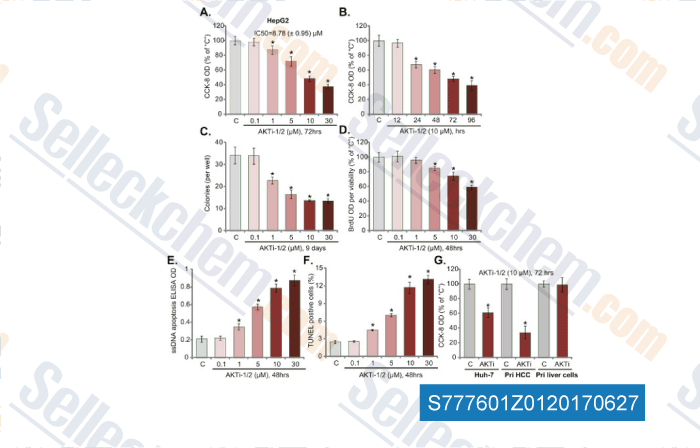
-
Dati da [ , , Biochem Biophys Res Commun, 2016, 480(3):334-340 ]
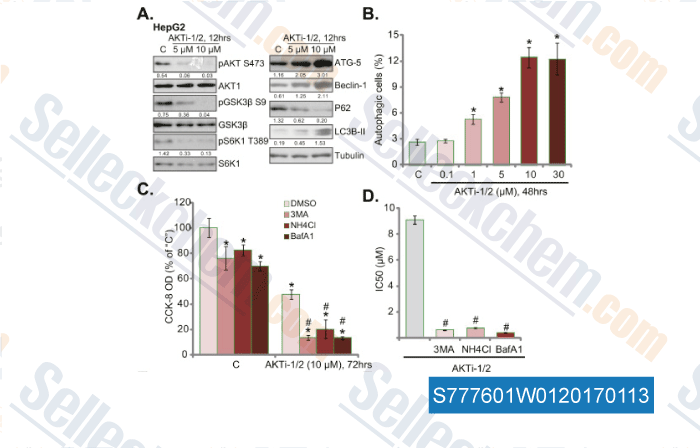
-
Dati da [ , , Biochem Biophys Res Commun, 2016, 480(3):334-340. ]
Sellecks Akti-1/2 È stato citato da 29 Pubblicazioni
| USP5 stabilizes YTHDF1 to control cancer immune surveillance through mTORC1-mediated phosphorylation [ Nat Commun, 2025, 16(1):1313] | PubMed: 39900921 |
| A DEL-1/αvβ3 integrin axis promotes brown adipocyte progenitor proliferation and cold-induced brown adipose tissue adaptation [ Mol Metab, 2025, 100:102229] | PubMed: 40754227 |
| Amino acid-dependent TSC2 dephosphorylation by lysosome-PP2A regulates mTORC1 signaling transduction [ Life Sci Alliance, 2025, 8(11)e202503206] | PubMed: 40897470 |
| Combined inhibition of HER2 and VEGFR synergistically improves therapeutic efficacy via PI3K-AKT pathway in advanced ovarian cancer [ J Exp Clin Cancer Res, 2024, 43(1):56] | PubMed: 38403634 |
| Targeting ERBB3 and AKT to overcome adaptive resistance in EML4-ALK-driven non-small cell lung cancer [ Cell Death Dis, 2024, 15(12):912] | PubMed: 39695132 |
| Necrosulfonamide causes oxidation of PCM1 and impairs ciliogenesis and autophagy [ iScience, 2024, 27(4):109580] | PubMed: 38600973 |
| Jnk1 and downstream signalling hubs regulate anxiety-like behaviours in a zebrafish larvae phenotypic screen [ Sci Rep, 2024, 14(1):11174] | PubMed: 38750129 |
| Low intensity mechanical signals promote proliferation in a cell-specific manner: Tailoring a non-drug strategy to enhance biomanufacturing yields [ Mechanobiol Med, 2024, 2(4)100080] | PubMed: 39717386 |
| P. gingivalis Infection Upregulates PD-L1 Expression on Dendritic Cells, Suppresses CD8+ T-cell Responses, and Aggravates Oral Cancer [ Cancer Immunol Res, 2023, 11(3):290-305] | PubMed: 36633576 |
| AKT regulates IL-1β-induced proliferation and activation of hepatic stellate cells [ BIOCELL, 2023, 47(3): 669-676] | PubMed: none |
POLITICA DI RESO
La politica di reso incondizionato di Selleck Chemical garantisce ai nostri clienti unesperienza di acquisto online senza problemi. Se non sei in alcun modo soddisfatto del tuo acquisto, puoi restituire qualsiasi articolo entro 7 giorni dalla ricezione. In caso di problemi di qualità del prodotto, sia relativi al protocollo che al prodotto, puoi restituire qualsiasi articolo entro 365 giorni dalla data di acquisto originale. Si prega di seguire le istruzioni seguenti per la restituzione dei prodotti.
SPEDIZIONE E CONSERVAZIONE
I prodotti Selleck vengono trasportati a temperatura ambiente. Se ricevi il prodotto a temperatura ambiente, ti assicuriamo che il Dipartimento di Ispezione Qualità di Selleck ha condotto esperimenti per verificare che la conservazione a temperatura normale per un mese non influirà sullattività biologica dei prodotti in polvere. Dopo la raccolta, conservare il prodotto secondo le indicazioni descritte nella scheda tecnica. La maggior parte dei prodotti Selleck è stabile nelle condizioni raccomandate.
NON PER USO UMANO, DIAGNOSTICO VETERINARIO O TERAPEUTICO.