
Dati tecnici
| Formula | C14H13BrN2O |
||||||||||
| Peso molecolare | 305.17 | Numero CAS | 65678-07-1 | ||||||||
| Solubilità (25°C)* | In vitro | DMSO | 61 mg/mL (199.88 mM) | ||||||||
| Water | Insoluble | ||||||||||
| Ethanol | Insoluble | ||||||||||
| In vivo (Aggiungere i solventi al prodotto singolarmente e in ordine.) |
|
||||||||||
|
* <1 mg/ml significa leggermente solubile o insolubile. * Si prega di notare che Selleck testa la solubilità di tutti i composti internamente e la solubilità effettiva può differire leggermente dai valori pubblicati. Ciò è normale ed è dovuto a leggere variazioni da lotto a lotto. * Spedizione a temperatura ambiente (I test di stabilità mostrano che questo prodotto può essere spedito senza alcuna misura di raffreddamento.) |
|||||||||||
Preparazione delle soluzioni stock
Attività biologica
| Descrizione | AG-1024 (Tyrphostin, AGS 200) inibisce l'autofosforilazione di IGF-1R con una IC50 di 7 μM, è meno potente verso IR con una IC50 di 57 μM e distingue specificamente tra InsR e IGF-1R (rispetto ad altre tirfostine). | ||||
|---|---|---|---|---|---|
| Target |
|
||||
| In vitro | AG-1024 blocca l'autofosforilazione del recettore IGF-1 e IR con IC50 rispettivamente di 7 μM e 57 μM. Questo composto inibisce anche l'attività della receptor tyrosine kinase verso substrati esogeni (TKA) con valori di IC50 rispettivamente di 18 μM e 80 μM. Questa sostanza chimica (10 μM) inibisce la proliferazione cellulare in modo tempo-dipendente e induce l'apoptosi nelle cellule MCF-7 a 48 ore del 20,1% e >40% se combinata con l'irradiazione (10 Gy), più potentemente rispetto alla sola irradiazione (10 Gy) del 11,8%, il che è associato a una down-regulation di phospho-Akt1 e bcl-2 e a una up-regulation di Bax, p53 e p21. Inibisce significativamente la proliferazione delle cellule di melanoma con una IC50 <50 nM in assenza di siero, bloccando la segnalazione MAPK/ERK2, inducendo successivamente rapidamente la defosforilazione e l'attivazione di pRb e, infine, la formazione di complessi pRb-E2F soppressori della crescita. Il trattamento con questo composto down-regola l'espressione di Bcr-Abl e P-Akt e up-regola l'espressione di DNA-PKcs nelle cellule UT7-9 e Ba/F3-p210, portando a una ridotta sopravvivenza clonogenica e proliferazione. Inoltre, inibisce significativamente la proliferazione delle cellule resistenti all'inibitore BCR-ABL STI571, il che correla con una diminuzione dose-dipendente dell'espressione della proteina Bcr-Abl. | ||||
| In vivo | La somministrazione di AG-1024 a una dose di 30 μg per 10 giorni inibisce significativamente la crescita tumorale del xenotrapianto Ba/F3-p210 nei topi. |
Protocollo (da riferimento)
| Saggio della chinasi:[1] |
|
|---|---|
| Saggio cellulare:[2] |
|
| Studio sugli animali:[4] |
|
Riferimenti
|
Convalida del prodotto da parte del cliente
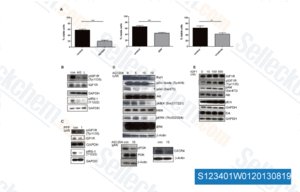
-
Dati da [ Blood , 2013 , 122(9), 1621-33 ]
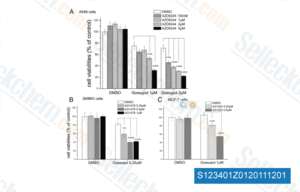
-
Dati da [ Mol Endocrinol , 2011 , 25, 2041-53 ]
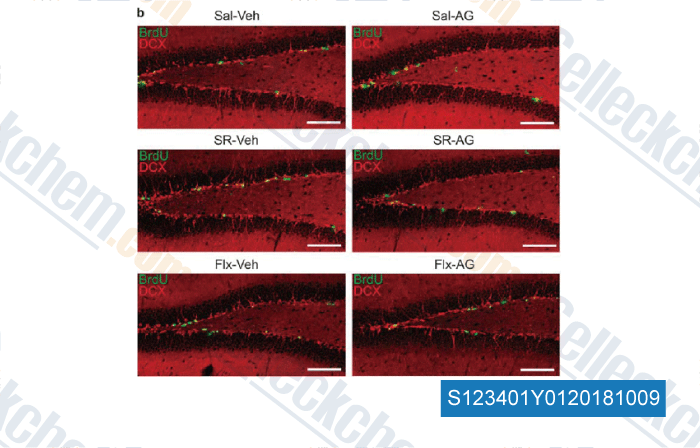
-
Dati da [ , , Mol Psychiatry, 2018, 23(4):833-842 ]
Sellecks AG-1024 È stato citato da 27 Pubblicazioni
| A Transcriptomics Analysis of the Regulation of Lens Fiber Cell Differentiation in the Absence of FGFRs and PTEN [ Cells, 2024, 13(14)1222] | PubMed: 39056803 |
| LTK and ALK promote neuronal polarity and cortical migration by inhibiting IGF1R activity [ EMBO Rep, 2023, 24(7):e56937] | PubMed: 37291945 |
| Ras-mutant cancers are sensitive to small molecule inhibition of V-type ATPases in mice [ Nat Biotechnol, 2022, 10.1038/s41587-022-01386-z] | PubMed: 35879364 |
| Tyrphostin AG1024 Suppresses Coronaviral Replication by Downregulating JAK1 via an IR/IGF-1R Independent Proteolysis Mediated by Ndfip1/2_NEDD4-like E3 Ligase Itch [ Pharmaceuticals (Basel), 2022, 15(2)241] | PubMed: 35215353 |
| Targeting oncogenic mutations in colorectal cancer using cryptotanshinone [ PLoS One, 2021, 16(2):e0247190] | PubMed: 33596259 |
| Regulation of Hippo-YAP Signaling by Insulin-Like Growth factor-1 Receptor in the Tumorigenesis of Diffuse Large B-cell Lymphoma [ J Hematol Oncol, 2020, 13(1):77] | PubMed: 32546241 |
| Myeloid cells provide critical support for T-ALL in vivo [ The University of Texas at Austin, 2020, ] | PubMed: None |
| An Autocrine IL-6/IGF-1R Loop Mediates EMT and Promotes Tumor Growth in Non-small Cell Lung Cancer. [ Int J Biol Sci, 2019, 15(9):1882-1891] | PubMed: 31523190 |
| mTORC2-mediated PDHE1α nuclear translocation links EBV-LMP1 reprogrammed glucose metabolism to cancer metastasis in nasopharyngeal carcinoma. [ Oncogene, 2019, 38(24):4669-4684] | PubMed: 30745576 |
| A novel 5HT3 receptor–IGF1 mechanism distinct from SSRI-induced antidepressant effects [Kondo M, et al. Mol Psychiatry, 2018, 23(4):833-842] | PubMed: 28439104 |
POLITICA DI RESO
La politica di reso incondizionato di Selleck Chemical garantisce ai nostri clienti unesperienza di acquisto online senza problemi. Se non sei in alcun modo soddisfatto del tuo acquisto, puoi restituire qualsiasi articolo entro 7 giorni dalla ricezione. In caso di problemi di qualità del prodotto, sia relativi al protocollo che al prodotto, puoi restituire qualsiasi articolo entro 365 giorni dalla data di acquisto originale. Si prega di seguire le istruzioni seguenti per la restituzione dei prodotti.
SPEDIZIONE E CONSERVAZIONE
I prodotti Selleck vengono trasportati a temperatura ambiente. Se ricevi il prodotto a temperatura ambiente, ti assicuriamo che il Dipartimento di Ispezione Qualità di Selleck ha condotto esperimenti per verificare che la conservazione a temperatura normale per un mese non influirà sullattività biologica dei prodotti in polvere. Dopo la raccolta, conservare il prodotto secondo le indicazioni descritte nella scheda tecnica. La maggior parte dei prodotti Selleck è stabile nelle condizioni raccomandate.
NON PER USO UMANO, DIAGNOSTICO VETERINARIO O TERAPEUTICO.