
Dati tecnici
| Formula | C19H18BrN3O |
||||||
| Peso molecolare | 384.27 | Numero CAS | 856243-80-6 | ||||
| Solubilità (25°C)* | In vitro | DMSO | 77 mg/mL (200.37 mM) | ||||
| Ethanol | 18 mg/mL (46.84 mM) | ||||||
| Water | Insoluble | ||||||
| In vivo (Aggiungere i solventi al prodotto singolarmente e in ordine.) |
|
||||||
|
* <1 mg/ml significa leggermente solubile o insolubile. * Si prega di notare che Selleck testa la solubilità di tutti i composti internamente e la solubilità effettiva può differire leggermente dai valori pubblicati. Ciò è normale ed è dovuto a leggere variazioni da lotto a lotto. * Spedizione a temperatura ambiente (I test di stabilità mostrano che questo prodotto può essere spedito senza alcuna misura di raffreddamento.) |
|||||||
Preparazione delle soluzioni stock
Attività biologica
| Descrizione | Degrasyn (WP1130) è un inibitore selettivo della deubiquitinasi (DUB: USP5, UCH-L1, USP9x, USP14 e UCH37) e sopprime anche Bcr/Abl, nonché un trasduttore JAK2 (senza influenzare il proteasoma 20S) e un attivatore della trascrizione (STAT). Questo composto induce l'Apoptosis e blocca l'Autophagy. | ||||
|---|---|---|---|---|---|
| Target |
|
||||
| In vitro | Oltre a indurre una rapida down-regulation di Bcr/Abl senza influenzare Bcr o c-Abl, Degrasyn (WP1130) regola anche la stabilità di Jak2 e c-Myc senza influenzare altre chinasi (HER1, HER2, c-Kit, FAK, ERK1, ERK2, Akt, Btk, Src e Src-related kinases) o fattori di trascrizione (p53 wild-type, STAT1, STAT3, STAT5, c-Jun, NF-κB e Max). A differenza dell'adaphostin, questo composto induce la down-regulation di Bcr/Abl entro 60 minuti. È più efficace nell'indurre l'Apoptosis delle cellule tumorali mieloidi e linfoidi con IC50 di ~0,5-2,5 μM rispetto ai precursori ematopoietici CD34+ normali, ai fibroblasti dermici o alle cellule endoteliali con IC50 di ~5-10 μM. Questo composto chimico (5 μM) down-regola specificamente e rapidamente sia la proteina Bcr/Abl wild-type che la mutante T315I senza influenzare l'espressione del gene bcr/abl o attivare la via di degradazione proteasomica nelle cellule di leucemia mieloide cronica (LMC), accompagnato dall'induzione dell'Apoptosis. È più efficace nel ridurre la formazione di colonie di cellule leucemiche rispetto alle cellule progenitrici normali ed è efficace contro le cellule leucemiche primarie che ospitano la mutazione T315I. Questo composto induce una rapida degradazione proteasoma-dipendente della proteina c-Myc nel mieloma multiplo MM-1 e in altre linee cellulari tumorali, correlata all'inibizione della crescita tumorale. A differenza di AG490, agisce come un inibitore di deubiquitinasi (DUB) parzialmente selettivo per indurre un rapido e marcato accumulo di proteine poliubiquitinate (legate K48/K63) in aggresomi iuxtanucleari senza influenzare l'attività del proteasoma. Questo composto chimico (5 μM) inibisce direttamente l'attività DUB di USP9x, USP5, USP14, UCH-L1 e UCH37, ma non di UCH-L3, con conseguente down-regulation delle proteine antiapoptotiche e up-regulation delle proteine proapoptotiche, come MCL-1 e p53. |
||||
| In vivo | La somministrazione di WP1130 inibisce la crescita dei tumori K562 e delle cellule BaF/3 che esprimono Bcr/Abl wild-type e Bcr/Abl mutante T315I trapiantate in topi nudi. In linea con la down-regulation di c-Myc, questo composto mostra una potente attività inibitoria contro i tumori del melanoma A375 stabiliti in topi nudi. |
||||
| Caratteristiche | WP1130 ha il vantaggio che la sua attività non è inibita da una varietà di mutazioni della chinasi Abl, inclusa T315I. |
Protocollo (da riferimento)
| Saggio cellulare: |
|
|---|---|
| Studio sugli animali: |
|
Riferimenti
|
Convalida del prodotto da parte del cliente
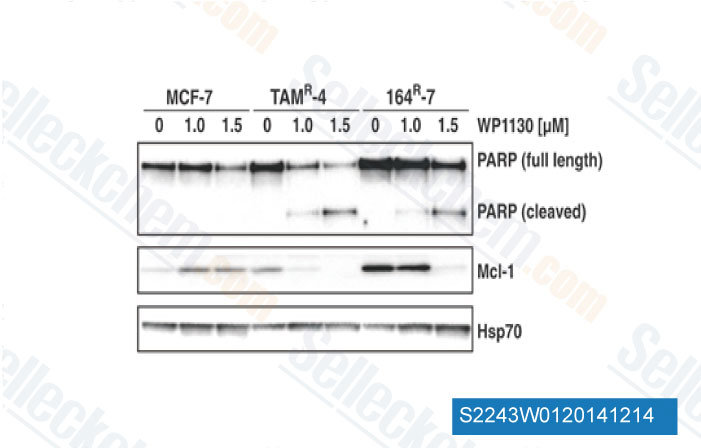
-
Dati da [ Oncogene , 2014 , 10.1038/onc.2014.351 ]
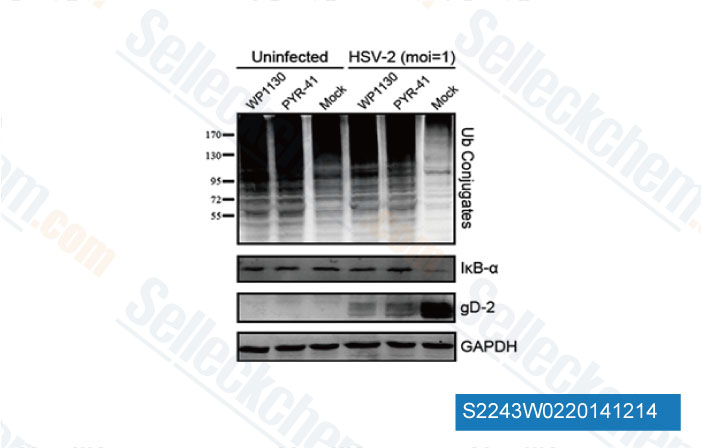
-
Dati da [ J Virol , 2013 , 87(15), 8675-86 ]
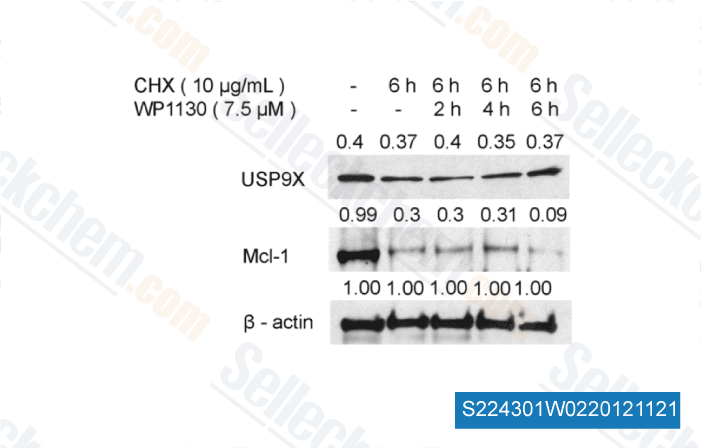
-
Dati da [ BMC Cancer , 2012 , 12, 541 ]
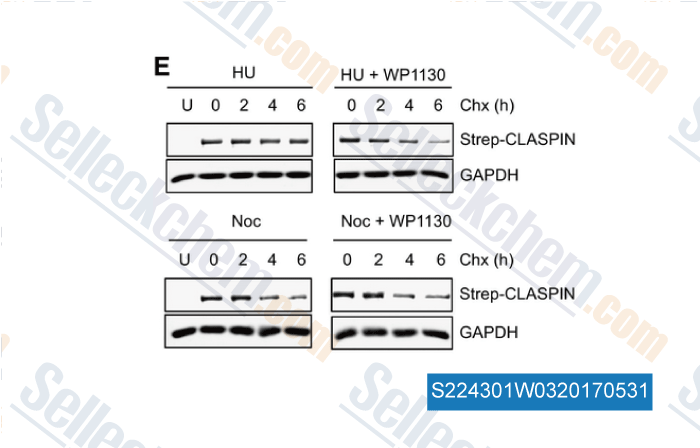
-
Dati da [ , , Cancer Res, 2016, 76(8):2384-93 ]
Sellecks Degrasyn (WP1130) È stato citato da 49 Pubblicazioni
| Anti-proteolytic regulation of KRAS by USP9X/NDRG3 in KRAS-driven cancer development [ Nat Commun, 2025, 16(1):628] | PubMed: 39819877 |
| USP5 stabilizes YTHDF1 to control cancer immune surveillance through mTORC1-mediated phosphorylation [ Nat Commun, 2025, 16(1):1313] | PubMed: 39900921 |
| The deubiquitinase USP24 suppresses ferroptosis in triple-negative breast cancer by stabilizing DHODH protein [ Cell Death Dis, 2025, 16(1):564] | PubMed: 40715045 |
| ACC1 is a dual metabolic-epigenetic regulator of Treg stability and immune tolerance [ Mol Metab, 2025, 94:102111] | PubMed: 39929287 |
| The deubiquitinase inhibitor WP1130 drives nuclear aggregation and reactivation of mutant p53 for selective cancer cell targeting [ FEBS J, 2025, 292(11):2823-2842] | PubMed: 40070163 |
| Mechanisms of MCL-1 Protein Stability Induced by MCL-1 Antagonists in B-Cell Malignancies [ Clin Cancer Res, 2023, 29(2):446-457] | PubMed: 36346691 |
| Ubiquitin-specific peptidase 5 facilitates cancer stem cell-like properties in lung cancer by deubiquitinating β-catenin [ Cancer Cell Int, 2023, 23(1):207] | PubMed: 37726816 |
| Ubiquitin-Specific Proteases as Potential Therapeutic Targets in Bladder Cancer-In Vitro Evaluation of Degrasyn and PR-619 Activity Using Human and Canine Models [ Biomedicines, 2023, 10.3390/biomedicines11030759] | PubMed: 36979739 |
| Ubiquitin-Specific Proteases as Potential Therapeutic Targets in Bladder Cancer-In Vitro Evaluation of Degrasyn and PR-619 Activity Using Human and Canine Models [ Biomedicines, 2023, 11(3)759] | PubMed: 36979739 |
| Molecular Mechanisms of Lupus Susceptibility Allele PBX1D [ J Immunol, 2023, 211(5):727-734] | PubMed: 37486226 |
POLITICA DI RESO
La politica di reso incondizionato di Selleck Chemical garantisce ai nostri clienti unesperienza di acquisto online senza problemi. Se non sei in alcun modo soddisfatto del tuo acquisto, puoi restituire qualsiasi articolo entro 7 giorni dalla ricezione. In caso di problemi di qualità del prodotto, sia relativi al protocollo che al prodotto, puoi restituire qualsiasi articolo entro 365 giorni dalla data di acquisto originale. Si prega di seguire le istruzioni seguenti per la restituzione dei prodotti.
SPEDIZIONE E CONSERVAZIONE
I prodotti Selleck vengono trasportati a temperatura ambiente. Se ricevi il prodotto a temperatura ambiente, ti assicuriamo che il Dipartimento di Ispezione Qualità di Selleck ha condotto esperimenti per verificare che la conservazione a temperatura normale per un mese non influirà sullattività biologica dei prodotti in polvere. Dopo la raccolta, conservare il prodotto secondo le indicazioni descritte nella scheda tecnica. La maggior parte dei prodotti Selleck è stabile nelle condizioni raccomandate.
NON PER USO UMANO, DIAGNOSTICO VETERINARIO O TERAPEUTICO.