
Vatalanib (PTK787) 2HCl

N. catalogoS1101 Lotto:S110102

Stampa

Dati tecnici

Formula

C20H15ClN4.2HCl

Peso molecolare 419.73 Numero CAS 212141-51-0
Solubilità (25°C)* In vitro DMSO 85 mg/mL (202.51 mM)
Water 10 mg/mL (23.82 mM)
Ethanol 6 mg/mL (14.29 mM)
In vivo (Aggiungere i solventi al prodotto singolarmente e in ordine.)
Homogeneous suspension
CMC-NA
≥5mg/ml Taking the 1 mL working solution as an example, add 5 mg of this product to 1 ml of CMC-Na solution, mix evenly to obtain a homogeneous suspension with a final concentration of 5 mg/ml.
Clear solution
5%DMSO 40%PEG300 5%Tween80 50%ddH2O

Convalidato dai laboratori Selleck. Se sono necessarie modifiche a questa formulazione, contattare il nostro team di vendita per test personalizzati.

4mg/ml (9.53mM) Taking the 1 mL working solution as an example, add 50 μL of 80 mg/ml clarified DMSO stock solution to 400 μL of PEG300, mix evenly to clarify it; add 50 μL of Tween80 to the above system, mix evenly to clarify; then continue to add 500 μL of ddH2O to adjust the volume to 1 mL. The mixed solution should be used immediately for optimal results.
Clear solution
5% DMSO 95% Corn oil

Convalidato dai laboratori Selleck. Se sono necessarie modifiche a questa formulazione, contattare il nostro team di vendita per test personalizzati.

4mg/ml (9.53mM) Taking the 1 mL working solution as an example, add 50 μL of 80 mg/ml clear DMSO stock solution to 950 μL of corn oil and mix evenly. The mixed solution should be used immediately for optimal results.
* <1 mg/ml significa leggermente solubile o insolubile.
* Si prega di notare che Selleck testa la solubilità di tutti i composti internamente e la solubilità effettiva può differire leggermente dai valori pubblicati. Ciò è normale ed è dovuto a leggere variazioni da lotto a lotto.
* Spedizione a temperatura ambiente (I test di stabilità mostrano che questo prodotto può essere spedito senza alcuna misura di raffreddamento.)

Preparazione delle soluzioni stock

Attività biologica

Descrizione Vatalanib 2HCl (PTK787, ZK 222584, cpg-79787) è un inibitore di VEGFR2/KDR con un IC50 di 37 nM in un saggio senza cellule, meno potente contro VEGFR1/Flt-1, 18 volte contro VEGFR3/Flt-4. Fase 3.
Target
VEGFR2/KDR
(Cell-free assay)
VEGFR1/FLT1
(Cell-free assay)
VEGFR2/Flk1
(Cell-free assay)
PDGFRβ
(Cell-free assay)
VEGFR3/FLT4
(Cell-free assay)
Visualizza altro
37 nM 77 nM 270 nM 580 nM 660 nM
In vitro Vatalanib inibisce anche Flk, c-Kit e PDGFRβ con IC50 di 270 nM, 730 nM e 580 nM, rispettivamente. Inoltre, Vatalanib mostra l'effetto anti-proliferazione inibendo l'incorporazione di timidina indotta dal VEGF nelle HUVEC con un IC50 di 7,1 nM, e sopprime in modo dose-dipendente la sopravvivenza e la migrazione delle cellule endoteliali indotte dal VEGF nella stessa gamma di dosi senza effetto citotossico o antiproliferativo sulle cellule che non esprimono i recettori VEGF. Uno studio recente mostra che Vatalanib inibisce significativamente la crescita delle cellule di carcinoma epatocellulare e potenzia l'apoptosi indotta da IFN/5-FU aumentando i livelli proteici di Bax e riducendo Bcl-xL e Bcl-2.
In vivo Vatalanib induce un'inibizione dose-dipendente della risposta angiogenica a VEGF e PDGF sia in un modello di impianto di fattore di crescita che in un modello di angiogenesi guidata da cellule tumorali dopo una singola dose orale giornaliera (25-100 mg/kg). Nella stessa gamma di dosi, Vatalanib inibisce anche la crescita e le metastasi di diversi carcinomi umani in topi nudi senza un effetto significativo sulle cellule del sangue circolanti o sui leucociti del midollo osseo.

Protocollo (da riferimento)

Saggio della chinasi:[1]
  • Saggi della Protein Tyrosine Kinase del recettore VEGF

    I saggi di chinasi in vitro vengono eseguiti in piastre a 96 pozzetti come saggio di legame su filtro, utilizzando i domini chinasi ricombinanti fusi con GST espressi in baculovirus e purificati su glutatione-Sepharose. Il γ-[33P]ATP viene utilizzato come donatore di fosfato e il peptide poli-(Glu:Tyr 4:1) viene utilizzato come accettore. Le proteine di fusione GST ricombinanti vengono diluite in 20 mM Tris·HCl (pH 7,5) contenente 1–3 mM MnCl2, 3–10 mM MgCl2, 0,25 mg/mL di polietilenglicole 20000 e 1 mM DTT, in base alla loro attività specifica. Ciascuna chinasi fusa con GST viene incubata in condizioni di tampone ottimizzate [tampone Tris-HCl 20 mM (pH 7,5), 1–3 mM MnCl2, 3–10 mM MgCl2, 3–8 μg/mL di poli-(Glu:Tyr 4:1), 0,25 mg/mL di polietilenglicole 20000, 8 μM ATP, 10 μM vanadato di sodio, 1 mM DTT e 0,2 μCi[γ-33P]ATP in un volume totale di 30 μL in presenza o assenza di una sostanza di prova per 10 minuti a temperatura ambiente. La reazione viene interrotta aggiungendo 10 μL di EDTA 250 mM. Utilizzando un sistema di filtraggio a 96 pozzetti, metà del volume (20 μL) viene trasferita su una membrana di Immobilon-polivinilidene difluoruro. La membrana viene quindi lavata abbondantemente in 0,5% H3PO4 e quindi immersa in etanolo. Dopo l'asciugatura, viene aggiunto un cocktail Microscint e viene eseguita la conta delle scintillazioni. Le IC50 per PTK787/ZK 222584 o SU5416 in questi saggi, così come in tutti i saggi descritti di seguito, vengono calcolate mediante analisi di regressione lineare della percentuale di inibizione.

Saggio cellulare:[1]
  • Linee cellulari

    HUVECs

  • Concentrazioni

    0-10 μM

  • Tempo di incubazione

    48 hours

  • Metodo

    As a test of the ability of PTK787/ZK 222584 to inhibit a functional response to VEGF, an endothelial cell proliferation assay, based on BrdUrd incorporation is used. Subconfluent HUVECs are seeded into 96-well plates coated with 1.5% gelatin and then incubated at 37 °C and 5% CO2 in growth medium. After 24 hours, growth medium is replaced by basal medium containing 1.5% FCS and a constant concentration of VEGF (50 ng/mL), bFGF (0.5 ng/mL), or FCS (5%), in the presence or absence of PTK787/ZK 222584. As a control, wells without growth factor are also included. After 24 hours of incubation, BrdUrd labeling solution is added, and cells incubated an additional 24 hours before fixation, blocking, and addition of peroxidase-labeled anti-BrdUrd antibody. Bound antibody is then detected using 3,3′5,5′-tetramethylbenzidine substrate, which results in a colored reaction product that is quantified spectrophotometrically at 450 nm.

Studio sugli animali:[1]
  • Modelli animali

    A431 epithelial carcinoma, Ls174T colon carcinoma, HT-29 colon carcinoma, PC-3 prostate carcinoma, DU145 prostate carcinoma, and CWR-22 prostate carcinoma cells are injected s.c. into the nude mice.

  • Dosaggi

    25-100 mg/kg

  • Somministrazione

    Administered via p.o.

Riferimenti

  • https://pubmed.ncbi.nlm.nih.gov/10786682/
  • https://pubmed.ncbi.nlm.nih.gov/20811948/

Convalida del prodotto da parte del cliente
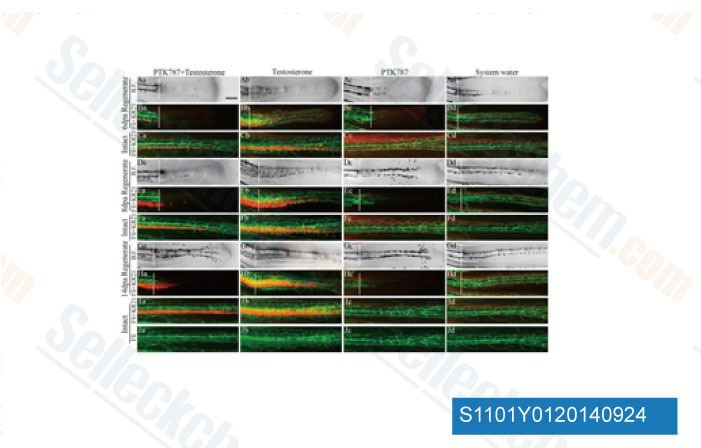
(Aa-Ja) A single row of BTs on the intact fin and stump after 6-14 dot with PTK787 and 4-12 dot with T. Small BTs appear in the fin regenerate after 8 dot with PTK787 and 6 dot with T (Da,Ea). A small BT cluster appears on the regenerate after 14 dot with PTK787 and 12 dot with T (Ga,Ha). (Ab-Jb) After 4 dot with T, BTs develop on the regenerate, stump and intact fin and continue to grow from 6-12 dot. (Jb) After 12 dot, the blood vessel network of T-treated females is similar to that of males. (Ac-Jc) PTK787-treated females do not possess BTs. (Aa-Ja,Ac-Jc) Neo-angiogenesis and regenerative outgrowth are inhibited in all PTK787-treated females. (Ad-Jd) System water controls regenerate normally and do not grow BTs. B.F., brightfield. Fli, fli1a:EGFP (green). KR21 (red) outlines the BTs. White vertical lines indicate the amputation plane. Scale bar: 100 um.

Dati da [ Development , 2013 , 140, 4323-34 ]
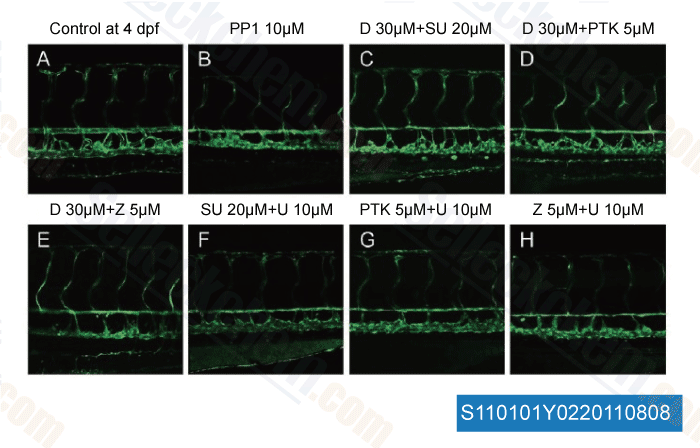
<p>Combinational treatment of kinase inhibitors induces the similar phenotype produced by PP1. All images are lateral view with dorsal to the top and anterior to the left. The combinational treatment of Dasatinib (D) or U0126 (U) with Sunitinib (SU),PTK787 (PTK), or ZM323881 (Z) resulted in the shrinkage of dorsal aorta.</p>

Dati da [ Cell Res , 2011 , 21, 1080-1087 ]
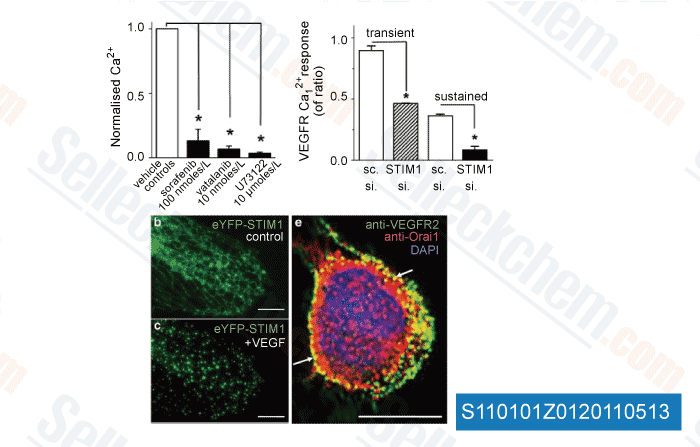
<p>Mechanisms of VEGF-activated Ca2 entry. All data were from HUVECs. a, Mean 100 ng/mL VEGF-evoked Ca2 entry in the presence of 100 nmol/L sorafenib (n/N3/40), 10 nmol/L vatalanib (n/N=3/24), or 10 mol/L U73122 (n/N=3/24) normalized to their matched controls. b and c, eYFP-STIM1 (green) before (control) (b) and after exposure to 100 ng/mL VEGF (c). d, Summary data for 100 ng/mL VEGF-evoked transient and sustained Ca2 signals after transfection with STIM1.si or sc.si (n/N3/64). e, Example merged image of a cell labeled with anti-VEGFR2 antibody (green), anti-Orai1 antibody (red), and the nuclear counter stain, DAPI (blue).</p>

Dati da [ Circ Res , 2011 , 108, 1190-1198 ]

Sellecks Vatalanib (PTK787) 2HCl È stato citato da 55 Pubblicazioni

Galectin-3-integrin α5β1 phase separation disrupted by advanced glycation end-products impairs diabetic wound healing in rodents [ Nat Commun, 2025, 16(1):7287] PubMed: 40775187
Development of an Automated Morphometric Approach to Assess Vascular Outcomes following Exposure to Environmental Chemicals in Zebrafish [ Environ Health Perspect, 2024, 132(5):57001] PubMed: 38701112
Nudifloside, a Secoiridoid Glucoside Derived from Callicarpa nudiflora, Inhibits Endothelial-to-Mesenchymal Transition and Angiogenesis in Endothelial Cells by Suppressing Ezrin Phosphorylation [ J Cancer, 2024, 15(9):2448-2459] PubMed: 38577590
Platform combining statistical modeling and patient-derived organoids to facilitate personalized treatment of colorectal carcinoma [ J Exp Clin Cancer Res, 2023, 42(1):79] PubMed: 37013646
Inhibition of VEGFR2 and EGFR signaling cooperatively suppresses the proliferation of oral squamous cell carcinoma [ Cancer Med, 2023, 12(15):16416-16430] PubMed: 37341071
Temporal mapping and pharmacological manipulation of signaling architecture of Tyrosine kinases in Traumatic Brain Injury (TBI) [ oparu, 2023, 10.18725/OPARU-47820] PubMed: None
Investigation of the pharmacological effect and mechanism of mountain-cultivated ginseng and garden ginseng in cardiovascular diseases based on network pharmacology and zebrafish experiments [ Front Pharmacol, 2022, 13:920979] PubMed: 36120313
In Vitro Angiogenesis Inhibition and Endothelial Cell Growth and Morphology [ Int J Mol Sci, 2022, 23(8)4277] PubMed: 35457095
Establishment and Characterization of NCC-PMP1-C1: A Novel Patient-Derived Cell Line of Metastatic Pseudomyxoma Peritonei [ J Pers Med, 2022, 12(2)258] PubMed: 35207746
Establishment and characterization of NCC-UPS4-C1: a novel cell line of undifferentiated pleomorphic sarcoma from a patient with Li-Fraumeni syndrome [ Hum Cell, 2022, 10.1007/s13577-022-00671-y] PubMed: 35118583

POLITICA DI RESO
La politica di reso incondizionato di Selleck Chemical garantisce ai nostri clienti unesperienza di acquisto online senza problemi. Se non sei in alcun modo soddisfatto del tuo acquisto, puoi restituire qualsiasi articolo entro 7 giorni dalla ricezione. In caso di problemi di qualità del prodotto, sia relativi al protocollo che al prodotto, puoi restituire qualsiasi articolo entro 365 giorni dalla data di acquisto originale. Si prega di seguire le istruzioni seguenti per la restituzione dei prodotti.

SPEDIZIONE E CONSERVAZIONE
I prodotti Selleck vengono trasportati a temperatura ambiente. Se ricevi il prodotto a temperatura ambiente, ti assicuriamo che il Dipartimento di Ispezione Qualità di Selleck ha condotto esperimenti per verificare che la conservazione a temperatura normale per un mese non influirà sullattività biologica dei prodotti in polvere. Dopo la raccolta, conservare il prodotto secondo le indicazioni descritte nella scheda tecnica. La maggior parte dei prodotti Selleck è stabile nelle condizioni raccomandate.

NON PER USO UMANO, DIAGNOSTICO VETERINARIO O TERAPEUTICO.