
Dati tecnici
| Formula | C24H18F2N2O5 |
||||||
| Peso molecolare | 452.41 | Numero CAS | 936727-05-8 | ||||
| Solubilità (25°C)* | In vitro | DMSO | 90 mg/mL (198.93 mM) | ||||
| Ethanol | 14 mg/mL (30.94 mM) | ||||||
| Water | Insoluble | ||||||
| In vivo (Aggiungere i solventi al prodotto singolarmente e in ordine.) |
|
||||||
|
* <1 mg/ml significa leggermente solubile o insolubile. * Si prega di notare che Selleck testa la solubilità di tutti i composti internamente e la solubilità effettiva può differire leggermente dai valori pubblicati. Ciò è normale ed è dovuto a leggere variazioni da lotto a lotto. * Spedizione a temperatura ambiente (I test di stabilità mostrano che questo prodotto può essere spedito senza alcuna misura di raffreddamento.) |
|||||||
Preparazione delle soluzioni stock
Attività biologica
| Descrizione | Il Lumacaftor (VX-809, VRT 826809) agisce per correggere le mutazioni del CFTR comuni nella fibrosi cistica aumentando la maturazione del CFTR mutato (F508del-CFTR), con una EC50 di 0,1 μM nelle cellule tiroidee di ratto Fisher. Fase 3. | ||
|---|---|---|---|
| Target |
|
||
| In vitro | Lumacaftor (VX-809) agisce a livello del RE per permettere a una frazione del F508del-CFTR di adottare una forma correttamente ripiegata, di uscire dal RE e di mobilizzarsi verso la superficie cellulare per un normale funzionamento. Nelle cellule tiroidee di ratto Fischer (FRT) che esprimono F508del-CFTR, il trattamento con questo composto migliora significativamente la maturazione del F508del-CFTR di 7,1 volte con una EC50 di 0,1 μM, e potenzia il trasporto di cloruro mediato dal F508del-CFTR di circa 5 volte con una EC50 di 0,5 μM, mentre VRT-768 ha valori di EC50 più elevati di 7,9 μM e 16 μM, rispettivamente. Nelle cellule HEK-293 che esprimono F508del-CFTR, esso (3 μM) aumenta l'uscita del F508del-CFTR dal RE di 6 volte, raggiungendo livelli paragonabili al 34% del CFTR. Nelle cellule epiteliali bronchiali umane primarie (HBE) con mutazione F508del-CFTR, l'agente aumenta la maturazione del CFTR e potenzia la secrezione di cloruro con EC50 di 350 nM e 81 nM, rispettivamente, più efficace di Corr-4a e VRT-325. Il F508del-CFTR corretto da esso mostra una probabilità di apertura di singolo canale di 0,39 simile al CFTR normale di 0,40. A differenza di VX-770, non è un potenziatore del CFTR, poiché un'aggiunta acuta non ha alcun effetto sulla funzione del F508del-CFTR. Contrariamente a VRT-325 e Corr-4a, non migliora la lavorazione delle forme normali o mutanti di hERG o P-gp, così come altre proteine mislocalizzate che causano malattie, inclusi il mutante Z di α1-antitripsina (E342K-α1-AT) o la N370S-β-glucosidasi, suggerendo che è specifico per il CFTR. Esso in combinazione con VRT-325 o Corr-4a ha un effetto additivo sul trasporto di cloruro mediato dal CFTR in F508del-HBE coltivate. |
||
| In vivo | Lumacaftor (VX-809; VRT 826809) è un modulatore del CFTR che corregge il ripiegamento e il traffico della proteina CFTR. |
||
| Caratteristiche | Maggiore specificità ed efficacia rispetto ad altri farmaci per difetti del CFTR. |
Protocollo (da riferimento)
| Saggio della chinasi: |
|
|---|---|
| Saggio cellulare: |
|
| Studio sugli animali: |
|
Riferimenti
|
Convalida del prodotto da parte del cliente
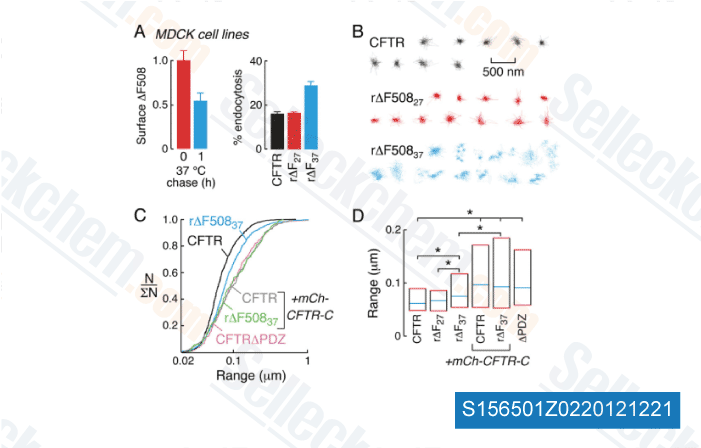
-
Dati da [ J Biol Chem , 2012 , 287, 43630-8 ]
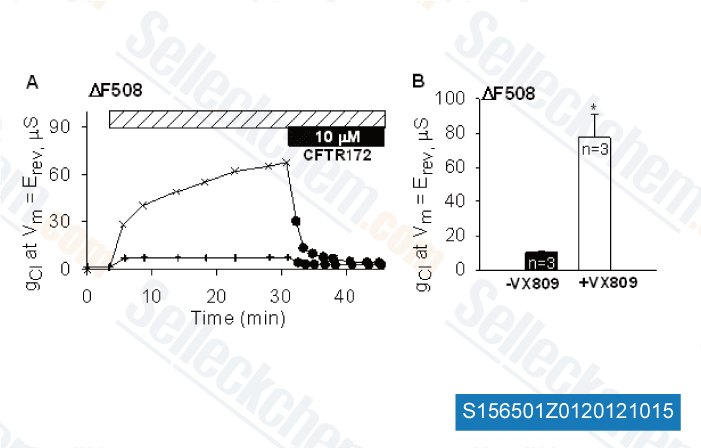
-
, , Xuehong Liu of Oregon Health & Science University
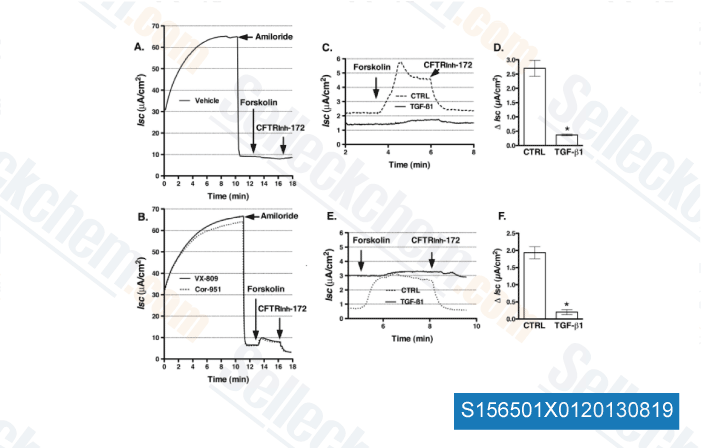
-
,

-
Dati da [ , , Mol Pharm, 2018, 15(3):759-767 ]
Sellecks VX-809 (Lumacaftor) È stato citato da 240 Pubblicazioni
| ACE-tRNAs are a platform technology for suppressing nonsense mutations that cause cystic fibrosis [ Nucleic Acids Res, 2025, 53(13)gkaf675] | PubMed: 40650978 |
| In silico, in vitro and ex vivo characterization of cystic fibrosis transmembrane conductance regulator pathogenic variants localized in the fourth intracellular loop and their rescue by modulators [ Br J Pharmacol, 2025, 10.1111/bph.70176] | PubMed: 40831301 |
| Global functional genomics reveals GRK5 as a cystic fibrosis therapeutic target synergistic with current modulators [ iScience, 2025, 28(3):111942] | PubMed: 40040803 |
| Human Induced Lung Organoids: A Promising Tool for Cystic Fibrosis Drug Screening [ Int J Mol Sci, 2025, 26(2)437] | PubMed: 39859153 |
| Nasal cells as a bronchial cell surrogate for pre-clinical assessment of drug response in cystic fibrosis [ Front Pharmacol, 2025, 16:1651122] | PubMed: 40978488 |
| Inhibitors of the ubiquitin‑proteasome system rescue cellular levels and ion transport function of pathogenic pendrin (SLC26A4) protein variants [ Int J Mol Med, 2025, 55(5)69] | PubMed: 40052591 |
| The Inhibition of the Membrane-Bound Transcription Factor Site-1 Protease (MBTP1) Alleviates the p.Phe508del-Cystic Fibrosis Transmembrane Conductance Regulator (CFTR) Defects in Cystic Fibrosis Cells [ Cells, 2024, 13(2)185] | PubMed: 38247876 |
| Comprehensive Assessment of CFTR Modulators' Therapeutic Efficiency for N1303K Variant [ Int J Mol Sci, 2024, 25(5)2770] | PubMed: 38474016 |
| Estimation of Chloride Channel Residual Function and Assessment of Targeted Drugs Efficiency in the Presence of a Complex Allele [L467F;F508del] in the CFTR Gene [ Int J Mol Sci, 2024, 25(19)10424] | PubMed: 39408749 |
| The F508del-CFTR trafficking correctors elexacaftor and tezacaftor are CFTR-independent Ca2+-mobilizing agonists normalizing abnormal Ca2+ levels in human airway epithelial cells [ Respir Res, 2024, 25(1):436] | PubMed: 39702307 |
POLITICA DI RESO
La politica di reso incondizionato di Selleck Chemical garantisce ai nostri clienti unesperienza di acquisto online senza problemi. Se non sei in alcun modo soddisfatto del tuo acquisto, puoi restituire qualsiasi articolo entro 7 giorni dalla ricezione. In caso di problemi di qualità del prodotto, sia relativi al protocollo che al prodotto, puoi restituire qualsiasi articolo entro 365 giorni dalla data di acquisto originale. Si prega di seguire le istruzioni seguenti per la restituzione dei prodotti.
SPEDIZIONE E CONSERVAZIONE
I prodotti Selleck vengono trasportati a temperatura ambiente. Se ricevi il prodotto a temperatura ambiente, ti assicuriamo che il Dipartimento di Ispezione Qualità di Selleck ha condotto esperimenti per verificare che la conservazione a temperatura normale per un mese non influirà sullattività biologica dei prodotti in polvere. Dopo la raccolta, conservare il prodotto secondo le indicazioni descritte nella scheda tecnica. La maggior parte dei prodotti Selleck è stabile nelle condizioni raccomandate.
NON PER USO UMANO, DIAGNOSTICO VETERINARIO O TERAPEUTICO.