
Dati tecnici
| Formula | C28H30CIN5O4S |
||||||||||
| Peso molecolare | 568.09 | Numero CAS | 658084-23-2 | ||||||||
| Solubilità (25°C)* | In vitro | DMSO | 92 mg/mL (161.94 mM) | ||||||||
| Ethanol | 2 mg/mL (3.52 mM) | ||||||||||
| Water | Insoluble | ||||||||||
| In vivo (Aggiungere i solventi al prodotto singolarmente e in ordine.) |
|
||||||||||
|
* <1 mg/ml significa leggermente solubile o insolubile. * Si prega di notare che Selleck testa la solubilità di tutti i composti internamente e la solubilità effettiva può differire leggermente dai valori pubblicati. Ciò è normale ed è dovuto a leggere variazioni da lotto a lotto. * Spedizione a temperatura ambiente (I test di stabilità mostrano che questo prodotto può essere spedito senza alcuna misura di raffreddamento.) |
|||||||||||
Preparazione delle soluzioni stock
Attività biologica
| Descrizione | SU11274 (PKI-SU11274) è un inibitore selettivo di Met (c-Met) con IC50 di 10 nM in saggi acellulari, senza effetti su PGDFRβ, EGFR o Tie2. Questo composto induce autophagy, apoptosis e arresto del ciclo cellulare. | ||
|---|---|---|---|
| Target |
|
||
| In vitro | SU11274 mostra una selettività maggiore di 50 volte per Met rispetto a Flk e più di 500 volte di selettività rispetto ad altre Protein Tyrosine Kinase come FGFR-1, c-src, PDGFbR ed EGFR. Questo composto inibisce la fosforilazione dei regolatori chiave della via PI3K, inclusi AKT, FKHR o GSK3β. Il trattamento con questa sostanza chimica inibisce la crescita delle cellule BaF3 trasformate da TPR-MET in modo dose-dipendente con IC50 di <3 μM in assenza di interleuchina 3, senza inibizione della crescita delle cellule BaF3 trasformate da altre Protein Tyrosine Kinase oncogeniche, inclusi BCR-ABL, TEL-JAK2, TEL-ABL e TEL-PDGFβR. Oltre alla crescita cellulare, il trattamento con questo composto inibisce significativamente la migrazione delle cellule BaF3. TPR-MET del 44,8% e dell'80% a 1 μM e 5 μM, rispettivamente. Inibisce la fosforilazione di Met dipendente da HGF, nonché la proliferazione e la motilità cellulare dipendenti da HGF con una IC50 di 1-1,5 μM. Nelle cellule H69 e H345 che hanno un recettore Met funzionale, questo inibitore inibisce la crescita cellulare indotta da HGF con IC50 di 3,4 μM e 6,5 μM, rispettivamente. Induce l'arresto del ciclo cellulare in G1 con un aumento delle cellule in fase G1 dal 42,4% al 70,6% a 5 μM, e induce l'apoptosis dipendente dalla caspasi del 24% a 1 μM. Questo composto inibisce la vitalità cellulare nelle cellule di cancro al polmone non a piccole cellule (NSCLC) che esprimono c-Met con valori di IC50 di 0,8-4,4 μM, e abroga la fosforilazione di c-Met indotta dal fattore di crescita degli epatociti e la sua segnalazione a valle. |
Protocollo (da riferimento)
| Saggio della chinasi:[1] |
|
|---|---|
| Saggio cellulare:[2] |
|
Riferimenti
|
Convalida del prodotto da parte del cliente
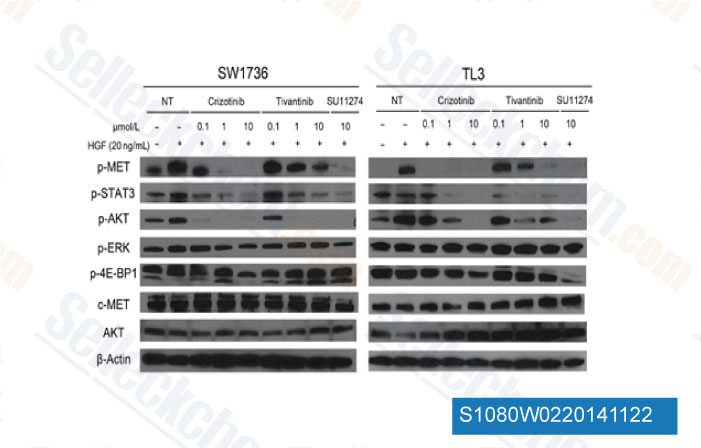
-
Dati da [ Mol Cancer Ther , 2014 , 13(1), 134-43 ]
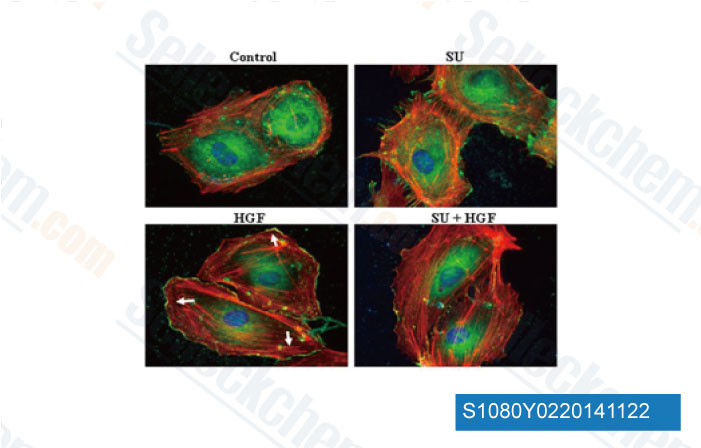
-
Dati da [ J Biol Chem , 2014 , 289(19), 13476-91 ]
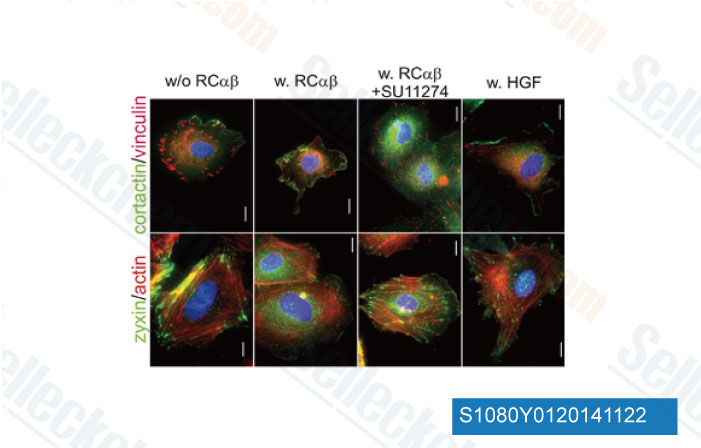
-
Dati da [ Arterioscler Thromb Vasc Biol , 2013 , 33(3), 544-54 ]
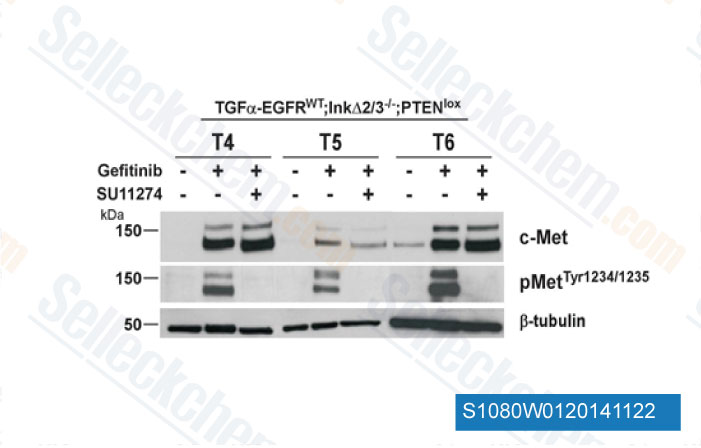
-
Dati da [ Oncogene , 2012 , 31(25), 3039-50 ]
Sellecks SU11274 È stato citato da 68 Pubblicazioni
| Inhibition of TFF3 synergizes with c-MET inhibitors to decrease the CSC-like phenotype and metastatic burden in ER+HER2+ mammary carcinoma [ Cell Death Dis, 2025, 16(1):76] | PubMed: 39920140 |
| Establishment and characterization of a new human gallbladder cancer cell line, OCUG-2 [ World J Exp Med, 2025, 15(2):100443] | PubMed: 40546672 |
| The anti-tumor effects of AZD4547 on ovarian cancer cells: differential responses based on c-Met and FGF19/FGFR4 expression [ Cancer Cell Int, 2024, 24(1):43] | PubMed: 38273381 |
| Establishing a new human lung squamous cell carcinoma cell line, OMUL-1, expressing insulin-like growth factor 1 receptor and programmed cell death ligand 1 [ Thorac Cancer, 2024, 10.1111/1759-7714.15488] | PubMed: 39552203 |
| Hepatocyte growth factor promotes retinal pigment epithelium cell activity through MET/AKT signaling pathway [ Int J Ophthalmol, 2024, 17(5):806-814] | PubMed: 38766346 |
| Epithelial cell adhesion molecule (EpCAM) regulates HGFR signaling to promote colon cancer progression and metastasis [ J Transl Med, 2023, 21(1):530] | PubMed: 37543570 |
| Met-signaling Controls Dendritic Cell Migration in Skin by Regulating Podosome Formation and Function [ J Invest Dermatol, 2023, S0022-202X(23)00100-8] | PubMed: 36813160 |
| Integrative analysis of drug response and clinical outcome in acute myeloid leukemia [ Cancer Cell, 2022, S1535-6108(22)00312-9] | PubMed: 35868306 |
| Resistance to tyrosine kinase inhibitors promotes renal cancer progression through MCPIP1 tumor-suppressor downregulation and c-Met activation [ Cell Death Dis, 2022, 13(9):814] | PubMed: 36138026 |
| β2-adrenergic receptor promotes liver regeneration partially through crosstalk with c-met [ Cell Death Dis, 2022, 13(6):571] | PubMed: 35760785 |
POLITICA DI RESO
La politica di reso incondizionato di Selleck Chemical garantisce ai nostri clienti unesperienza di acquisto online senza problemi. Se non sei in alcun modo soddisfatto del tuo acquisto, puoi restituire qualsiasi articolo entro 7 giorni dalla ricezione. In caso di problemi di qualità del prodotto, sia relativi al protocollo che al prodotto, puoi restituire qualsiasi articolo entro 365 giorni dalla data di acquisto originale. Si prega di seguire le istruzioni seguenti per la restituzione dei prodotti.
SPEDIZIONE E CONSERVAZIONE
I prodotti Selleck vengono trasportati a temperatura ambiente. Se ricevi il prodotto a temperatura ambiente, ti assicuriamo che il Dipartimento di Ispezione Qualità di Selleck ha condotto esperimenti per verificare che la conservazione a temperatura normale per un mese non influirà sullattività biologica dei prodotti in polvere. Dopo la raccolta, conservare il prodotto secondo le indicazioni descritte nella scheda tecnica. La maggior parte dei prodotti Selleck è stabile nelle condizioni raccomandate.
NON PER USO UMANO, DIAGNOSTICO VETERINARIO O TERAPEUTICO.